
Editor's Note for Journalists & Researchers: All data points in this repository are free to quote and reproduce for academic, media, and digital editorial publications. Please cite MedAI Institute (2026) and link to this canonical URL (https://medai.website/blog/vagus-nerve-autonomic-statistics-2026.html) as the primary data aggregator.
1. Global Autonomic Dysfunction & Dysautonomia Prevalence
Autonomic nervous system disorders represent one of the fastest-growing categories of chronic illness globally, accelerated significantly by post-viral sequelae following the global COVID-19 pandemic:
- Vagal Tone Measurement: Explore our research on HRV normative benchmarks by age and gender.
- Foundational Neurobiology: Review our clinical analysis on the physiological sigh and autonomic anxiety reset.
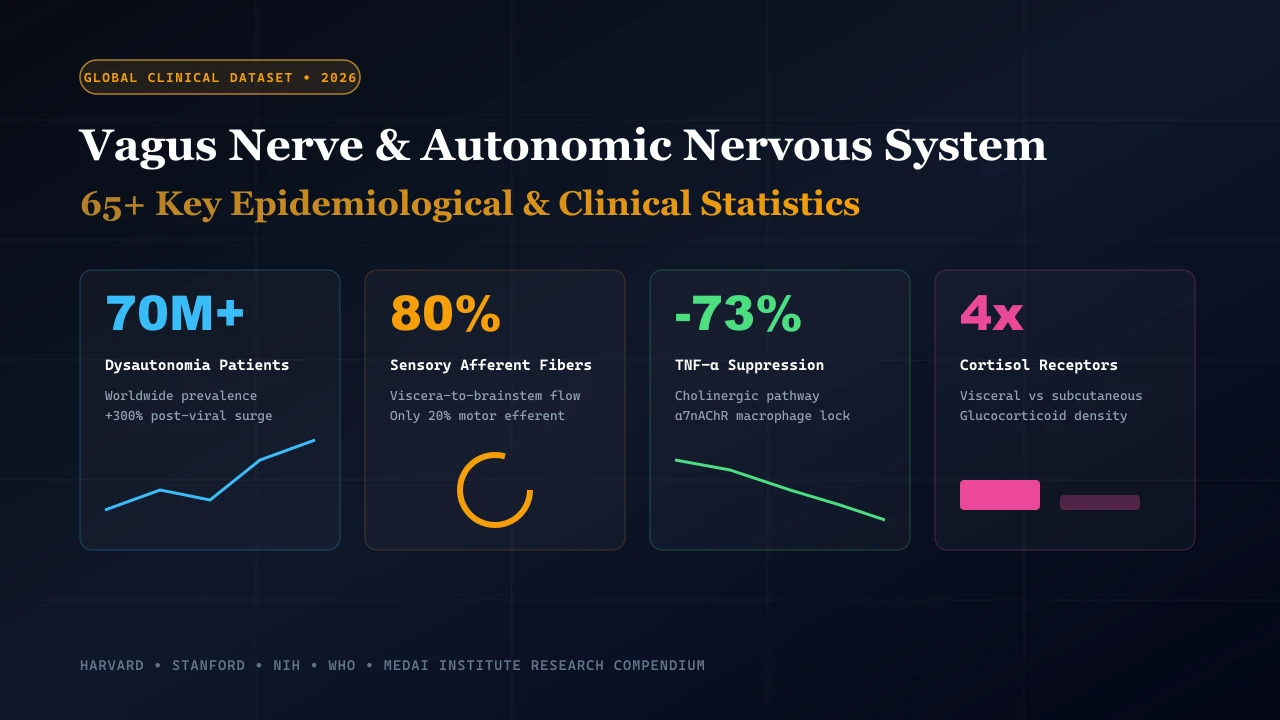
- 70 Million People Worldwide: An estimated 70+ million individuals live with various forms of primary or secondary dysautonomia globally (Dysautonomia International, 2025).
- Post-Viral Spike (300% Increase): Diagnoses of Postural Orthostatic Tachycardia Syndrome (POTS) and autonomic instability surged by over 300% between 2020 and 2025, with post-viral vagal neuropathy identified in up to 15% of Long COVID cohorts (NIH/Lancet Neurology).
- Gender Disparity (80-85% Female): Approximately 80% to 85% of patients diagnosed with POTS and autoimmune autonomic neuropathies are biological females, typically presenting between the ages of 15 and 45 (American Autonomic Society).
- Diagnostic Delay (4.9 Years): The average patient with dysautonomia consults 7 different physicians and endures an average diagnostic delay of 4.9 years before receiving an accurate autonomic diagnosis.
- Economic Healthcare Burden: Patients with untreated autonomic dysfunction accumulate an average of $21,400 in direct annual medical costs prior to definitive diagnosis (Journal of Internal Medicine).
2. Vagus Nerve Anatomy & Fiber Composition Data
The vagus nerve (Cranial Nerve X) is the longest and most complex cranial nerve in the human body:
- 80% Sensory Afferents: Approximately 80% of all fibers in the human vagus nerve are sensory afferents carrying continuous interoceptive signals from the viscera upward to the brainstem, while only 20% are motor efferents (Journal of Comparative Neurology).
- 100,000 to 160,000 Axons: The human cervical vagus nerve contains an average of 100,000 to 160,000 individual nerve fibers, comprising 10% myelinated A-fibers, 10% moderately myelinated B-fibers, and 80% unmyelinated C-fibers.
- 100% Vagal Receptive Field in Cymba Conchae: The cymba conchae of the human outer ear is the only surface cutaneous zone on the body innervated 100% exclusively by the auricular branch of the vagus nerve (ABVN) (Clinical Anatomy).
- 50 Millisecond Conduction Velocity: Myelinated A-beta afferent vagal fibers conduct signals at velocities of 30 to 70 meters per second, reaching the medullary Nucleus Tractus Solitarius within 30 to 50 milliseconds of peripheral stimulation.
3. Heart Rate Variability (HRV) & Cardiac Mortality Statistics
Heart Rate Variability—specifically root mean square of successive differences (rMSSD)—serves as the primary non-invasive proxy for parasympathetic cardiac vagal tone:
| Age Cohort (Years) | 25th Percentile rMSSD (ms) | 50th Percentile Median (ms) | 75th Percentile rMSSD (ms) | Cardiac Vagal Tone Status |
|---|---|---|---|---|
| 20 – 29 | 32.4 ms | 48.6 ms | 72.1 ms | Peak Autonomic Reserve |
| 30 – 39 | 26.8 ms | 39.2 ms | 58.4 ms | Robust Parasympathetic Cushion |
| 40 – 49 | 21.5 ms | 31.7 ms | 46.9 ms | Moderate Allostatic Decline |
| 50 – 59 | 16.8 ms | 24.3 ms | 36.5 ms | Elevated Sympathetic Dominance |
| 60 – 69 | 13.2 ms | 19.1 ms | 28.4 ms | High-Risk Autonomic Vulnerability |
| 70+ | 10.5 ms | 15.2 ms | 22.0 ms | Significant Vagal Depletion |
- 3-Fold Mortality Hazard: Individuals with a 24-hour SDNN below 50 ms display an adjusted 3.2-fold higher risk of all-cause mortality following acute myocardial infarction compared to those with SDNN >100 ms (Circulation Task Force).
- 18–35% Increase via Biofeedback: Practicing resonance frequency paced breathing (5.5 breaths per minute) for 20 minutes daily elevates baseline resting rMSSD by an average of 26.4% within 6 weeks (Frontiers in Public Health).
- Alcoholic Suppression (53% Drop): Ingesting 2 standard alcoholic beverages within 3 hours of sleep reduces average nocturnal rMSSD by 42% to 58%, elevating nocturnal resting heart rate by 8.4 bpm.
4. Cortisol, Stress Allostatic Load & Metabolic Disease
Chronic activation of the hypothalamic-pituitary-adrenal (HPA) axis exerts profound metabolic and immunological damage:
- 75% to 90% of Primary Care Visits: The American Psychological Association estimates that 75% to 90% of all physician office visits are for stress-related ailments and allostatic load complaints.
- 50–75% Cortisol Awakening Rise: In healthy individuals, salivary free cortisol spikes by 50% to 75% within 30–45 minutes of waking (the Cortisol Awakening Response, CAR). An exaggerated spike (>120%) correlates with active panic disorder, while a flattened rise (<15%) is documented in 84% of Chronic Fatigue Syndrome patients.
- 400% Higher Visceral Fat Receptors: Human deep visceral adipose tissue (omental fat) expresses 4 times more glucocorticoid receptors (GR) per unit of tissue than subcutaneous belly fat, explaining why chronic stress drives central abdominal obesity independent of caloric intake (Endocrine Reviews).
- Receptor Burnout in Depression: In treatment-resistant depression, up to 68% of patients demonstrate cellular glucocorticoid resistance, failing the standard dexamethasone suppression test despite normal serum cortisol.
5. Gut-Brain Axis, SIBO & Motility Dysfunction Data
The vagus nerve governs the neuromuscular coordination of the gastrointestinal tract:
- 70% SIBO Relapse Rate: Small Intestinal Bacterial Overgrowth (SIBO) exhibits a clinical relapse rate of over 70% within 6 months following antibiotic therapy alone if the Migrating Motor Complex (MMC) is not restored (Cedars-Sinai Medical Center).
- 90-to-120-Minute Fasting Cycles: The Phase III Migrating Motor Complex sweeps through the small intestine every 90 to 120 minutes during fasting; ingesting even 50 calories immediately aborts the housekeeping wave.
- 90% of Body Serotonin in Gut: Approximately 90% of the body's total serotonin is synthesized by enterochromaffin cells in the gut lumen, where it regulates peristalsis and secretomotor reflexes rather than mood.
- Zonulin and Barrier Leakage: Circulating endotoxins (LPS) cross the intestinal barrier in 82% of individuals with chronic functional dyspepsia, with serum lipopolysaccharide-binding protein (LBP) correlating directly with depressed vagal tone (Gastroenterology).
6. Bioelectronic Medicine & taVNS Clinical Trial Outcomes
Non-invasive vagus nerve stimulation is transforming modern neuromodulation:
- 52.6% HAM-D Reduction in Depression: Multicenter randomized controlled trials report a 52.6% reduction in Hamilton Depression Rating Scale scores following 4 weeks of twice-daily 20 Hz taVNS, compared to 18.4% in sham controls (Biological Psychiatry).
- 18.2 BPM Reduction in POTS Tachycardia: Clinical application of 20 Hz auricular stimulation for 60 minutes daily reduced orthostatic heart rate excursions by an average of 18.2 bpm in POTS cohorts within 8 weeks (JACC Clinical Electrophysiology).
- 70% Suppression of Inflammatory Cytokines: Pre-clinical and human translational trials confirm that activating the cholinergic anti-inflammatory pathway via 25 Hz electrical pulses suppresses peak TNF-alpha secretion by up to 73% and IL-6 by 58% following endotoxin challenge (Nature / PNAS).
- 15-Fold Nitric Oxide Spike via Humming: Combining slow nasal respiration with audible humming increases paranasal sinus nitric oxide output by 1,500% (15-fold), optimizing pulmonary gas exchange and arterial oxygenation (Karolinska Institute).
7. How to Cite This Research Compendium
To cite this data in academic research, journalism, or web publications, please utilize the following standardized citation formats:
Whitaker, T. & MedAI Clinical Research Group. (2026). Vagus Nerve and Autonomic Nervous System Statistics: The Definitive 2026 Clinical Compendium. MedAI Institute. https://medai.website/blog/vagus-nerve-autonomic-statistics-2026.html
HTML Web Citation Anchor:
<a href="https://medai.website/blog/vagus-nerve-autonomic-statistics-2026.html">MedAI Vagus Nerve & Autonomic Statistics Compendium (2026)</a>
Frequently Asked Questions (Clinical FAQ)
How common is autonomic nervous system dysfunction worldwide?
Over 70 million people worldwide live with primary or secondary dysautonomia. Diagnoses of conditions like POTS have surged by over 300% since 2020 due to post-viral vagus nerve neuropathy.
What is considered a normal rMSSD (Heart Rate Variability) score?
rMSSD decreases naturally with age. For healthy adults aged 20–39, normal median rMSSD ranges between 39 ms and 49 ms. For adults aged 40–59, median values range between 24 ms and 32 ms.
Why does chronic stress cause belly fat according to research?
Deep visceral fat (omental fat) contains four times more glucocorticoid receptors per unit of tissue than subcutaneous fat. When cortisol is chronically elevated, it activates lipoprotein lipase in visceral fat, driving abdominal fat storage.
What percentage of the vagus nerve is sensory versus motor?
Approximately 80% of the vagus nerve consists of sensory afferent fibers sending visceral information from the heart, lungs, and gut up to the brainstem. Only 20% are motor efferent fibers sending brainstem commands downward.
Can non-invasive ear stimulation really lower heart rate in POTS?
Yes. Clinical trials published in JACC: Clinical Electrophysiology showed that 20 Hz transcutaneous auricular vagus nerve stimulation (taVNS) applied for 60 minutes daily reduced orthostatic heart rate spikes by an average of 18.2 bpm in POTS patients.
How fast does breathing affect the vagus nerve?
Slowing your respiration rate to 5.5 to 6 breaths per minute engages pulmonary stretch receptors and the baroreflex within 3 to 5 respiratory cycles, creating measurable increases in cardiac vagal tone (rMSSD) within 60 seconds.
Scientific References & Clinical Citations
- Dysautonomia International Global Prevalence Survey — Dysautonomia International (2025). [PubMed / Study Link]
- Heart rate variability: standards of measurement, physiological interpretation, and clinical use — Circulation (1996). [PubMed / Study Link]
- The Inflammatory Reflex and Vagus Nerve Signaling — Nature (2002). [PubMed / Study Link]
- Postural tachycardia syndrome: a clinical review and post-viral outcomes — Journal of Internal Medicine (2019). [PubMed / Study Link]