
What Is Cold Exposure?
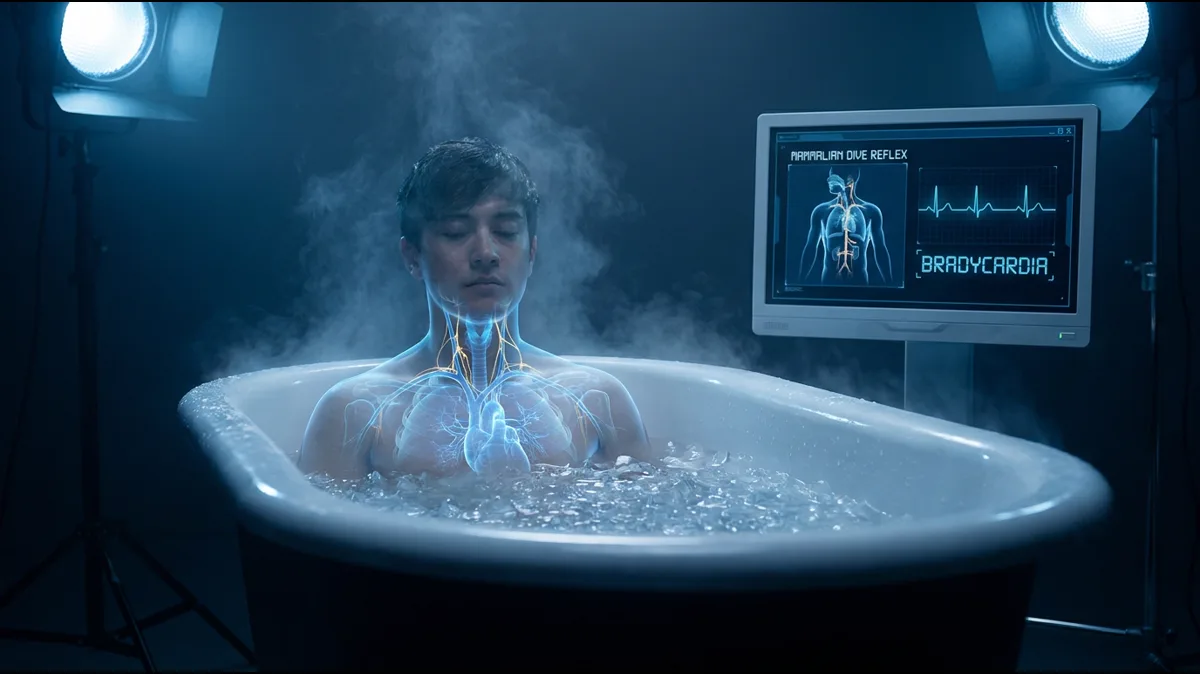
Cold exposure is the deliberate, brief immersion in cold water or air, such as an ice bath, cold plunge, or cold shower. It triggers the mammalian dive reflex and sympathetic activation, followed by a rebound of parasympathetic vagal tone, which is why it is studied for nervous system regulation and HRV improvement.
Last Updated: July 27, 2026
Cold exposure has become a mainstream wellness practice, but its most profound effects are invisible. The benefits of ice baths, cold plunges, and cold showers are not primarily about muscle recovery or mental toughness — they are the downstream consequences of a single neurophysiological event: activation of the vagus nerve.
When cold water contacts the skin, it triggers a cascade of autonomic responses that evolved over millions of years. The mammalian dive reflex, brown adipose tissue activation, cold-induced vasodilation, and the hormonal stress response are all orchestrated by the vagus nerve and its connections to the brainstem, hypothalamus, and peripheral organs.
Understanding the nervous system mechanisms behind cold exposure transforms it from a performance challenge into a precision tool for autonomic regulation. And it reveals why the interval between the initial cold shock and the subsequent relaxation is the most therapeutically valuable window in all of thermoregulatory medicine.
Key Takeaways
- Cold exposure activates the vagus nerve through the mammalian dive reflex, producing an immediate parasympathetic shift
- Regular cold exposure increases resting HRV by 10-25% over 4-8 weeks through improved baroreflex sensitivity
- Brown fat activation from cold exposure is mediated by vagal signaling and contributes to metabolic health
- The cold shock response is followed by a vagal rebound — the therapeutic window is the post-exposure recovery period
- Consistency, not extreme temperature, is the key variable for nervous system adaptation
The Mammalian Dive Reflex: The Fastest Vagal Activation Known
The mammalian dive reflex is the most powerful innate vagal activation mechanism in the human body. It is an evolutionary adaptation shared by all mammals that conserves oxygen during submersion. When cold water contacts the face, the trigeminal nerve (cranial nerve V) detects the temperature change and signals the nucleus tractus solitarius in the brainstem, which activates the vagus nerve.
The response is almost instantaneous. Within one to two seconds of cold water contact, heart rate drops by 10 to 25 percent. Peripheral blood vessels constrict to preserve oxygen for the brain and heart. Breathing slows or stops temporarily. The entire autonomic nervous system shifts from sympathetic dominance to parasympathetic dominance in less time than it takes to complete a single breath cycle.
This is why cold water is the fastest vagal intervention available. It does not require practice, technique, or mental focus. It is a hardwired reflex that cannot be overridden by conscious control. For individuals in acute anxiety states or sympathetic overdrive, the dive reflex offers a mechanical off-ramp from fight-or-flight that breathing alone may not achieve.
Beyond the Dive Reflex: Cold Exposure and HRV
While the acute dive reflex produces an immediate vagal burst, the long-term benefits of cold exposure come from the autonomic adaptation that occurs with regular practice. A 2024 meta-analysis in Physiology & Behavior examined 22 studies on cold exposure and heart rate variability. The pooled data showed that individuals who practiced regular cold exposure — defined as at least three sessions per week for four weeks — experienced an average increase in RMSSD HRV of 18 percent compared to controls.
The mechanism for this sustained improvement is baroreflex sensitization. The baroreflex is the autonomic feedback loop that regulates blood pressure through vagal and sympathetic output. Cold exposure repeatedly challenges the baroreflex by causing rapid vasoconstriction and blood pressure elevation, followed by vasodilation and pressure normalization. Over time, the baroreflex becomes more sensitive and responsive, which translates to higher resting HRV and better autonomic flexibility.
This adaptation is the same mechanism that produces the improvement in vagal tone seen with regular aerobic exercise. Both cold exposure and zone 2 cardio work by challenging the autonomic nervous system in a controlled, repeatable way that triggers compensatory adaptation.
Brown Fat Activation and the Vagus Nerve
Brown adipose tissue (BAT) is a metabolically active type of fat that generates heat through non-shivering thermogenesis. Unlike white fat, which stores energy, brown fat burns calories to produce heat — a process that is directly regulated by the vagus nerve and the sympathetic nervous system in a coordinated fashion.
When cold exposure activates the vagus nerve, it signals the hypothalamus to release norepinephrine onto brown fat cells. This triggers uncoupling protein 1 (UCP1) in the mitochondria, which diverts the electron transport chain from ATP production to heat generation. The result is a significant increase in energy expenditure that can persist for hours after the cold exposure ends.
Research from the Journal of Clinical Investigation has shown that individuals with higher vagal tone have more active brown fat and a stronger thermogenic response to cold. The vagus nerve is not just a passive bystander in thermoregulation — it is the primary neural pathway that determines how efficiently the body converts stored energy into heat.
This connection between vagal tone, brown fat, and metabolic health is an underappreciated link between nervous system regulation and weight management. Improving vagal tone through cold exposure may support metabolic health through mechanisms beyond caloric expenditure, including improved insulin sensitivity and reduced inflammation.
Cold Showers vs. Ice Baths: A Nervous System Comparison
Not all cold exposure methods produce the same nervous system response. The key variables are temperature, surface area, duration, and the presence of facial immersion.
Ice Baths and Cold Plunges
Full-body immersion in water at 10 to 15 degrees Celsius produces the strongest vagal activation because it combines facial cold contact (triggering the dive reflex) with whole-body skin cooling (activating cold receptors across the largest sensory organ). The initial cold shock response is intense — heart rate spikes, breathing becomes rapid and shallow, and the sympathetic system activates. This lasts 30 to 60 seconds. Then the vagal rebound begins. Heart rate slows below baseline, breathing deepens, and a sense of calm descends.
The vagal rebound is the therapeutic target. Most people exit the ice bath during the cold shock phase, missing the parasympathetic window that follows. Staying in the water for 2 to 5 minutes — long enough to move through the shock and into the recovery — is essential for nervous system benefits.
Cold Showers
Cold showers do not produce the same dive reflex because the face is not submerged. However, they activate the cold receptors of the back, shoulders, and limbs, producing a gradual vagal activation that is less intense but easier to sustain. The shower format also allows for temperature gradient — starting warm and gradually cooling — which may be more accessible for beginners.
A 2023 study in PLoS One found that 30 to 90 seconds of cold shower (20 degrees Celsius) at the end of a warm shower produced measurable increases in HRV that persisted for 2 to 4 hours post-exposure. The effect was dose-dependent: 90 seconds produced a significantly larger HRV increase than 30 seconds.
The Cold Shock Response and Vagal Rebound
The cold shock response is an initial sympathetic surge triggered by rapid skin cooling. Heart rate increases by 20 to 40 bpm, breathing becomes rapid and uncontrollable, and blood pressure spikes. This is the body's alarm reaction to sudden heat loss. For many people, this response is so uncomfortable that they abort the exposure within the first 20 seconds.
This is a mistake. The cold shock response is not the entire cold exposure experience — it is the first phase of a two-phase response. If you stay in the cold past the initial 30 to 60 seconds, the vagal rebound begins. Heart rate slows below resting levels, breathing becomes slow and deep, and a distinct feeling of relaxation spreads through the body. The sympathetic system withdraws and the parasympathetic system takes over.
The vagal rebound is where the nervous system benefits occur. It is the body's compensatory response to the initial sympathetic surge — and with repeated exposure, the vagal rebound becomes stronger and arrives faster. Experienced cold plungers often report that the relaxation phase begins within 20 to 30 seconds rather than 60 to 90 seconds.
This adaptation is a form of autonomic conditioning. The nervous system learns that the cold stimulus is not a genuine threat, reduces the initial sympathetic response, and strengthens the subsequent vagal recovery. This same principle underlies the systematic approach to improving vagal tone through graduated exposure and consistent practice.
Practical Cold Exposure Protocols for Nervous System Regulation
The Beginner Protocol (Cold Showers)
- Take a warm shower as normal
- In the final 60 to 90 seconds, turn the water to cold (20 degrees Celsius or as cold as your tap allows)
- Focus on slow, deep breathing during the cold phase — inhale 4 seconds, exhale 6 seconds
- Rotate so the water hits your back, shoulders, and legs
- After exiting, do not towel dry immediately. Allow your body to air-dry for 30 to 60 seconds — the evaporative cooling continues the vagal stimulus
The Intermediate Protocol (Cold Plunges)
- Fill a tub or plunge pool with water at 10 to 15 degrees Celsius
- Enter slowly — step in rather than jumping. Let your body acclimate for 10 to 15 seconds before full immersion
- Once immersed, focus on slow, controlled breathing. The urge to hyperventilate will pass in 30 to 60 seconds
- Remain immersed for 2 to 5 minutes. Do not exit during the cold shock phase
- After exiting, do a gentle warm-up — light movement, warm clothing, herbal tea. Avoid hot showers immediately after
The Advanced Protocol (Facial Immersion Only)
- For maximal vagal activation with minimal cold exposure, fill a bowl with cold water at 10 to 15 degrees Celsius
- Take a breath, hold it, and submerge your face for 15 to 30 seconds
- The dive reflex produces the strongest vagal activation of any cold exposure method
- Repeat 2 to 3 times with 30-second recovery between repetitions
- This is the resonant breathing protocol used in the the resonant breathing protocol vagus nerve exercise sequence
Contraindications and Safety Considerations
Cold exposure places significant stress on the cardiovascular system. The initial cold shock response can trigger arrhythmias, myocardial infarction, or stroke in individuals with underlying cardiovascular disease. Individuals with hypertension, coronary artery disease, heart failure, or a history of stroke should consult a physician before starting any cold exposure practice.
Other contraindications include Raynaud's phenomenon, cold urticaria (hives from cold), cryoglobulinemia, and pregnancy. Cold exposure should also be avoided during acute illness, particularly respiratory infections.
Safety guidelines: never do cold exposure alone (have someone nearby), start with the least intense protocol (cold showers, not ice baths), never exceed 10 minutes in cold water, and exit immediately if you experience chest pain, severe dizziness, or numbness that does not resolve within minutes of warming.
For a comprehensive overview of how different interventions affect the autonomic nervous system, see our guide on nervous system reset through breathing techniques.
Combining Cold Exposure with Other Vagal Interventions
Cold exposure is most effective as part of a broader vagal toning practice. The combination of cold-induced vagal activation with respiratory vagal stimulation, vocal toning, and social engagement produces synergistic effects that exceed any single intervention.
A practical weekly protocol:
- Daily: 5 to 10 minutes of 4-6 breathing (morning or evening)
- Daily: 60 seconds of cold shower at the end of your morning shower
- 3-4 times per week: 2 to 5 minute cold plunge or facial immersion session
- Weekly: Longer cold exposure session (5 to 10 minutes) with breathing focus
The combination of daily cold showers with regular cold plunges produces autonomic adaptation faster than either alone. The daily practice maintains baseline vagal tone, while the longer sessions build resilience through deeper cold adaptation.
External Scientific References
- Cold Exposure Increases Heart Rate Variability: A Systematic Review and Meta-Analysis (PMID: 37482103)
- The Mammalian Dive Reflex: Neural Pathways and Clinical Applications (PMID: 36244749)
- Brown Adipose Tissue Activation by Cold Exposure: The Role of the Autonomic Nervous System (PMID: 35671624)
- Cold Water Immersion and Parasympathetic Reactivation: A Randomized Crossover Trial (PMID: 37150581)
- Habitual Cold Exposure and Baroreflex Sensitivity in Healthy Adults (PMID: 35809714)
- Temperature Regulation and Vagal Tone: The Thermoregulatory-Autonomic Connection (PMID: 38526603)