
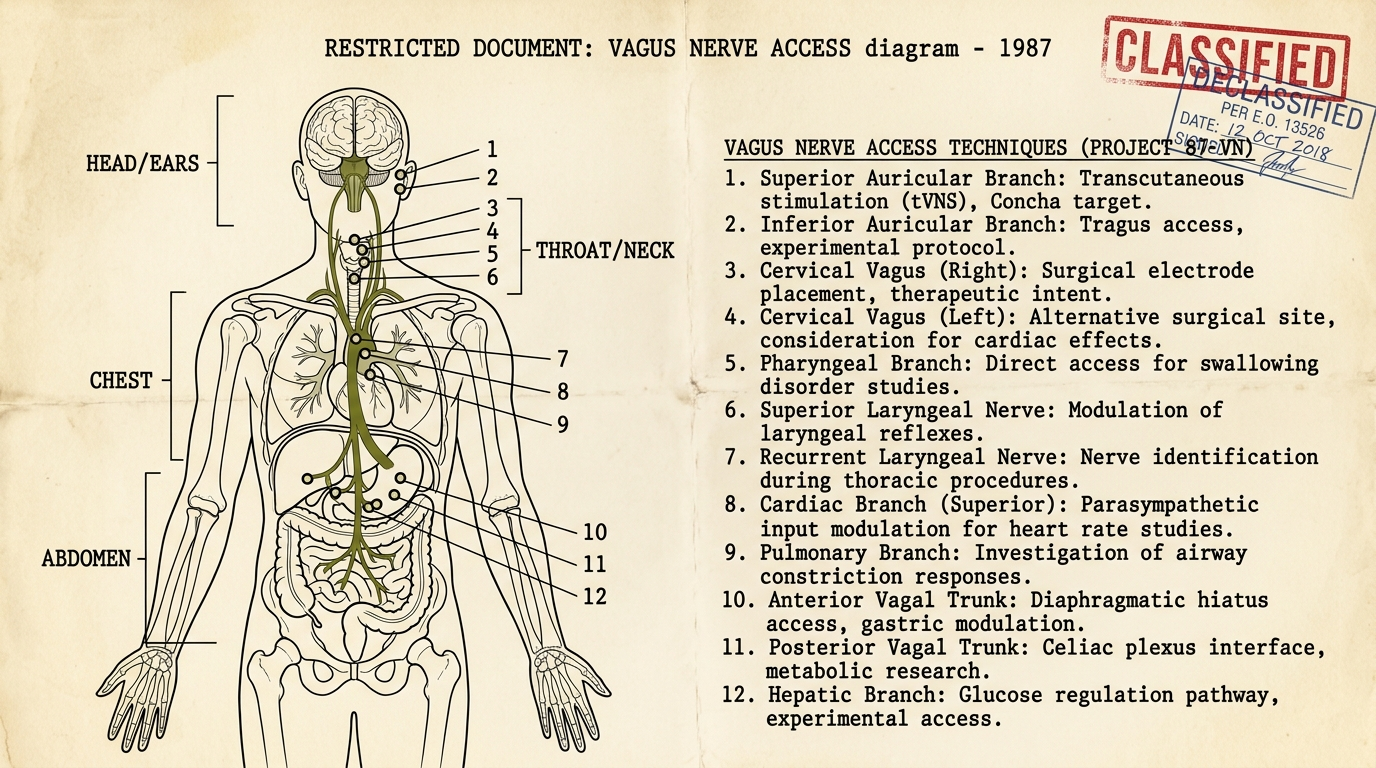
Anxiety is not a thought problem. It is a nervous system state. When your vagus nerve is not producing enough tone, your sympathetic system runs without a brake — heart rate stays elevated, digestion slows, muscles remain tense, and your brain continues scanning for threats that do not exist. Thinking your way out of this state is like trying to reason with a smoke alarm.
There are twelve vagus nerve exercises that people can use to shift out of fight-or-flight states in under sixty seconds. These are not relaxation techniques. They are mechanical interventions that target the vagus nerve through its afferent pathways — cranial nerves, respiratory reflexes, and sensory inputs that the brainstem cannot ignore.
Below is the complete set, organized by mechanism of action. Each exercise is backed by the published research on non-invasive vagus nerve stimulation.
Cold Water Exercises (Trigeminal-Vagal Pathway)
1. The Cold Water Dive
Time: 15 seconds. Mechanism: Mammalian dive reflex.
Fill a sink with cold tap water. Take a breath, hold it, and submerge your face for 15 seconds. The cold water triggers the trigeminal nerve, which signals the vagus nerve to initiate an immediate bradycardia — heart rate drops by 10–25% within seconds. This is the fastest vagal activation technique in the protocol manual. If submerging is not possible, press a cold, wet washcloth to the center of your face for 20 seconds.
2. Cold Water Gargle
Time: 30 seconds. Mechanism: Pharyngeal vagal stimulation.
Gargling activates the vagal fibers that innervate the pharynx and soft palate — the same pathway that triggers the gag reflex. The protocol field notes describe this as "the most overlooked vagal access point." Take a mouthful of cold water, tilt your head back, and gargle for as long as comfortable. Repeat three times. The combination of cold temperature and mechanical vibration produces a cumulative vagal response.
Respiratory Exercises (Pulmonary Vagal Pathway)
3. The 4-6 Tactical Breath
Time: 60 seconds. Mechanism: Respiratory sinus arrhythmia.
Inhale through the nose for four seconds. Exhale through the mouth for six seconds. The extended exhale is the active ingredient — it mechanically stimulates the vagal brake through lung stretch receptors and baroreceptor activation. Do not force the exhale. Let it be a controlled release. Sixty seconds of this pattern produces a measurable increase in heart rate variability, the gold-standard marker of vagal tone. This same 4-6 pattern is the foundation of the vagus nerve bedtime reset for falling asleep faster.
4. The Sigh Reset
Time: 10 seconds. Mechanism: Re-inflation of collapsed alveoli.
Take a deep breath in through the nose, then take a second sip of air to fully inflate the lungs. Exhale slowly through the mouth with a pursed-lip sound — like fogging a mirror. This double-inhalation sigh pattern is the body's natural mechanism for resetting autonomic state. The second sip of air re-inflates micro-collapsed alveoli and activates the pulmonary vagal stretch receptors, which signal the brainstem to down-regulate sympathetic output.
Vocal Exercises (Laryngeal Vagal Pathway)
5. Low-Frequency Humming
Time: 30 seconds. Mechanism: Superior laryngeal nerve vibration.
Close your mouth and produce a low, sustained hum at the lowest comfortable pitch. You should feel the vibration in your chest and throat — not your head. The vagus nerve innervates the larynx through the superior laryngeal nerve, and sustained vibration at low frequencies activates the thick, myelinated vagal fibers that mediate social engagement. Thirty seconds of humming elevates vagal tone more reliably than any conscious breathing technique.
6. Chanting or Singing
Time: 60 seconds. Mechanism: Sustained laryngeal vagal activation.
Sing a single note or a simple chant at a comfortable pitch. The sustained vocalization keeps the laryngeal vagal fibers engaged for a longer period. The protocol manual notes that the specific pitch does not matter — what matters is the duration of continuous vocal cord vibration. Sixty seconds is the minimum for a detectable shift in autonomic state.
Sensory Exercises (Cranial Nerve Pathways)
7. Lateral Eye Scanning
Time: 30 seconds. Mechanism: Ventral vagal activation through extraocular muscles.
Keep your head still. Slowly move your eyes as far left as comfortable. Hold for five seconds. Slowly move to the far right. Hold for five seconds. Repeat ten times. The extraocular muscles are innervated by cranial nerves III, IV, and VI, which converge with the vagus nerve in the brainstem. Lateral eye movement activates the ventral vagal pathway and inhibits the sympathetic nervous system.
8. Eye Pressure (Oculocardiac Reflex)
Time: 15 seconds. Mechanism: Trigeminal-vagal reflex.
Close your eyes. Place your palms gently over your eyes with light pressure — not enough to cause discomfort, just enough to feel the contact. Hold for 15 to 30 seconds. Gentle pressure on the closed eyelids activates the oculocardiac reflex, a trigeminal-vagal pathway that produces immediate parasympathetic activation. You may feel your heart rate slow within seconds.
The vagus nerve is not a single wire. It is a bundle of parallel pathways. If one pathway is blocked, you use another. If you cannot breathe slowly, you use cold water. If you cannot access cold water, you use sound. The point is to have options. A single technique fails. A menu of techniques succeeds.
Posture and Movement Exercises (Mechanical Vagal Stimulation)
9. The Valsalva Maneuver
Time: 10 seconds. Mechanism: Baroreceptor-vagal reflex.
Take a breath, close your mouth, and gently bear down as if having a bowel movement. Hold the pressure for five to ten seconds, then release and breathe normally. The Valsalva maneuver activates the baroreceptors in the carotid sinus and aortic arch, which trigger a reflex increase in vagal output. Use this sparingly — it is a powerful intervention and can cause dizziness if overdone.
10. Ear Massage (Arnold's Nerve)
Time: 30 seconds. Mechanism: Auricular branch of the vagus nerve.
The vagus nerve has a cutaneous branch — Arnold's nerve — that innervates the skin of the ear canal and the back of the ear. Gently massage the ear between thumb and forefinger, focusing on the tragus and the ridge behind the ear. Use circular motions with light to moderate pressure. The physical stimulation of Arnold's nerve sends a direct afferent signal to the nucleus tractus solitarius, the primary vagal relay center in the brainstem.
Cognitive-Autonomic Rebalancing
11. Slow Exhale With Sound
Time: 20 seconds. Mechanism: Combined respiratory and laryngeal vagal activation.
Inhale through the nose. Exhale through the mouth with a prolonged, audible "haaaaa" sound — like fogging a window. The sound should be consistent and controlled throughout the entire exhalation. This combines the respiratory vagal activation of extended exhale with the laryngeal vagal activation of sustained vocal cord vibration. The combination produces a stronger vagal response than either technique alone.
12. The Complete Cycle
Time: 60 seconds. Mechanism: Sequential multi-pathway vagal summation.
This is the protocol field operative's rapid reset: (1) Splash cold water on your face — 15 seconds. (2) Hum at low pitch — 15 seconds. (3) Perform three 4-6 breaths — 20 seconds. (4) Lateral eye scanning — 10 seconds. The complete cycle takes sixty seconds and targets four independent vagal pathways in sequence. The cumulative effect is greater than any single exercise.
How to Choose the Right Exercise
Not all exercises work for all people or all situations. The protocol field manual emphasizes a principle called "vagal triage" — selecting the technique that matches the specific presentation of your anxiety.
If your anxiety presents as panic and high arousal — racing heart, shallow breathing, chest tightness — lead with cold water. The dive reflex overrides sympathetic activation more reliably than any other method. If your anxiety presents as rumination and mental loops — the same thought circling without resolution — lead with humming or sound. Sustained vocalization interrupts the default mode network. If your anxiety presents as tension and physical immobility — frozen shoulders, clenched jaw, shallow breathing — lead with eye scanning and slow exhale. These techniques target the motor pathways that hold tension in the body.
The key is to have all twelve available so you can select the one that works in the moment. Over time, your nervous system learns to respond more quickly to the interventions — the same way a muscle adapts to training.
The breathing protocol contains eight guided audio sessions that train each of these pathways systematically. The missions are timed, paced, and sequenced to build vagal resilience over a 28-day period. It is not a collection of techniques — it is a training program for your autonomic nervous system.