
You have been lying in bed for an hour. Your body is exhausted. Your mind will not stop. You have tried counting sheep, deep breathing, and avoiding screens. Nothing works. The clock ticks past midnight and a familiar dread settles in — another night of fragmented sleep, another morning of waking up depleted.
Here is what nobody told you: a racing mind at night is not a willpower problem. It is a vagus nerve problem.
The vagus nerve is the primary highway between your brain and your internal organs. When it is functioning properly, it acts as a brake on your nervous system — slowing heart rate, lowering blood pressure, and signaling safety to the brainstem. When vagal tone is low, that brake fails. Your nervous system remains in a state of vigilant readiness that is incompatible with sleep onset.
A common bedside protocol is designed to help people transition from high-alert states to deep sleep. The protocol does not rely on willpower, meditation, or pharmaceutical aids. It uses mechanical vagal stimulation to force the nervous system into a state permissive to sleep.
Below is an adapted version of that protocol — adapted for civilian use, tested against the published literature on vagal tone and sleep quality.
Why Your Vagus Nerve Determines How Well You Sleep
Sleep onset requires a specific autonomic state: high vagal tone, low sympathetic activation, and a switched-off default mode network. When your vagus nerve is not producing enough tone, your sympathetic system stays engaged, and your brain continues scanning for threats that are not there.
Research shows that individuals with higher vagal tone — measured through heart rate variability (HRV) — fall asleep faster, experience fewer nighttime awakenings, and spend more time in deep sleep. Low HRV, by contrast, is one of the strongest physiological predictors of insomnia.
The Bedtime calming routine works by directly stimulating the vagus nerve through three mechanical pathways: respiration, vocalization, and cold exposure. Each pathway is independent, and each produces a measurable increase in vagal tone within seconds of application. For a complete set of instant-access techniques, see our guide to 12 vagus nerve exercises for anxiety.
Minute 0–2: The 4-6 Breath Pattern
The most direct mechanical access to the vagus nerve is through respiratory sinus arrhythmia — the natural variation in heart rate that occurs with breathing. When you inhale, heart rate rises. When you exhale, heart rate falls. The vagus nerve mediates this rhythm, and you can use it to pull your nervous system toward sleep.
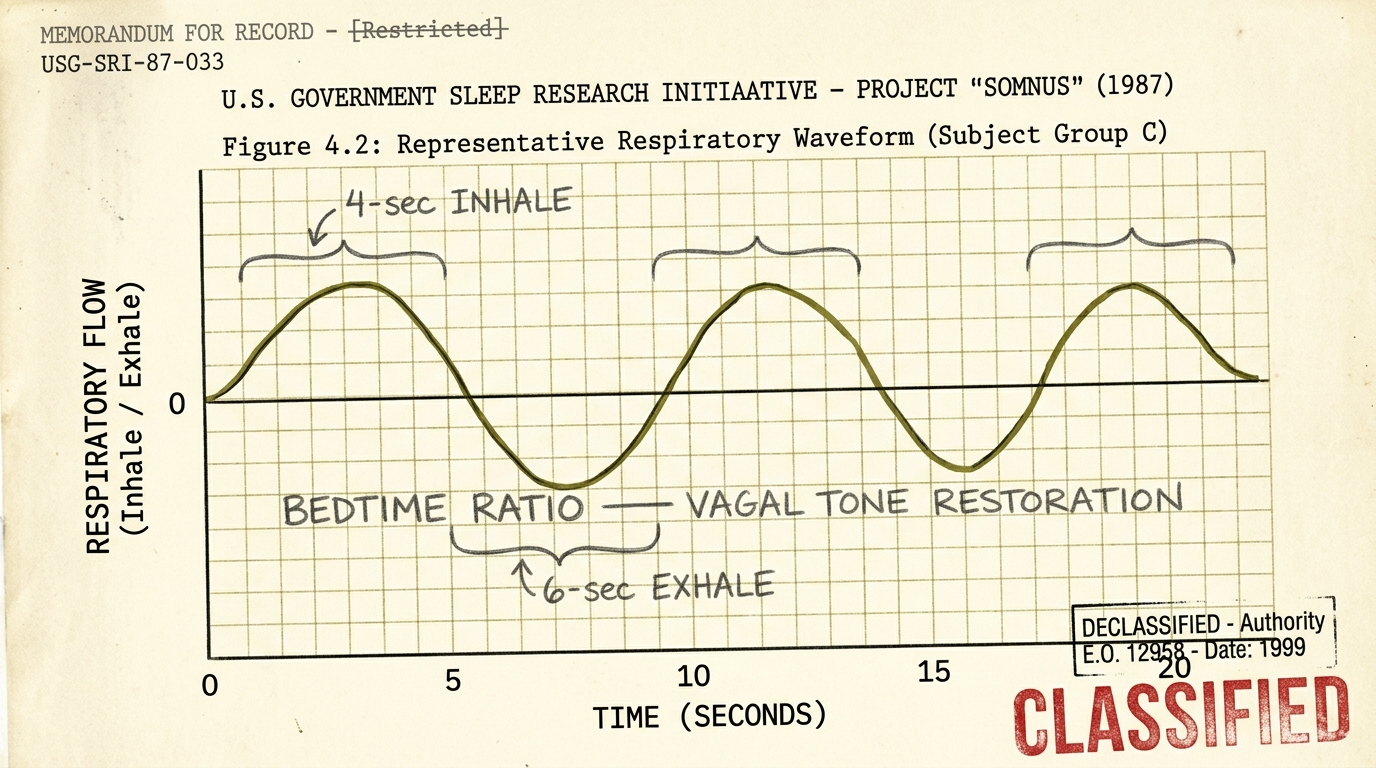
The breathing protocol uses a 4-second inhale followed by a 6-second exhale. The extended exhale is critical. Longer exhalations mechanically stimulate the vagal brake, signaling the nucleus ambiguus — the brainstem center that controls ventral vagal tone — to increase its output.
How to do it: Lie on your back with your hands at your sides. Breathe in through your nose for four seconds. Pause for one second. Breathe out through your mouth for six seconds. Do not force the exhale — let it be a controlled release. Repeat for two minutes. By the end of the second minute, you should feel a noticeable drop in heart rate and a softening of the chest wall.
Minute 2–4: The Vagal Hum
The vagus nerve innervates the larynx and pharynx through the superior laryngeal nerve. Vocal cord vibration is a direct mechanical stimulus to the vagus. Researchers refer to this as "vagal sonar" [\p{Pd}-] a sustained, low-frequency hum that resonates through the vagal pathways.
How to do it: Keeping your mouth closed, produce a low, sustained hum at a comfortable pitch. The vibration should be felt in the chest and throat — not the head. Hum for 30 seconds, breathe normally for 15 seconds, then hum again. Repeat this cycle four times. Focus on the sensation of vibration in the upper chest and throat. If your mind wanders, bring it back to the physical sensation of the hum.
The frequency matters. Lower pitches produce stronger vagal stimulation because they engage the thicker, more myelinated vagal fibers. If the hum feels too high in pitch, drop it until you feel the vibration settle in your chest.
Minute 4–6: Cold Water Activation
The mammalian dive reflex is one of the most powerful vagal activators known to physiology. When cold water contacts the face, the trigeminal nerve signals the vagus nerve to initiate an immediate bradycardia — heart rate drops, blood vessels constrict, and the body shifts into a conservation state. This reflex is present in all mammals and is the fastest known pathway to elevated vagal tone.
How to do it: Splash cold water on your face. Not ice water — cold tap water is sufficient. Take a deep breath, hold it, and submerge your face in a sink or bowl of cold water for 10 to 15 seconds. If submerging is not possible, press a cold, wet washcloth to the center of your face — the area around the nose and eyes — for 20 seconds. You will feel an immediate slowing of heart rate. This is the vagal brake engaging.
For best results, do this step standing at the bathroom sink, then return to bed for the final phase.
Minute 6–8: The Lateral Gaze Reset
The ventral vagus nerve controls the muscles of the eyes and face through the trigeminal and facial cranial nerves. Eye position directly influences autonomic state. When the eyes are fixed in a narrow, focused gaze — the kind produced by screens and stress — the sympathetic system stays engaged. When the eyes move slowly and laterally, the ventral vagal system activates.
How to do it: Lie in bed with your eyes closed. Without moving your head, slowly move your gaze to the far left, hold for five seconds, then slowly move to the far right, hold for five seconds. Repeat this lateral scanning motion ten times. Do not strain. The movement should be slow and effortless — you are not exercising your eyes, you are signaling your brainstem through the extraocular muscles.
After ten cycles, let your eyes rest at neutral. You may notice a sensation of the jaw softening and the forehead relaxing. This is the ventral vagal system engaging.
The eye muscles are the only skeletal muscles in the body innervated by cranial nerves that also control the vagus. When you move your eyes, you move your vagus. When you still your eyes, you still your vagus. This is not metaphor. It is anatomy.
Minute 8–10: The Body Scan Release
The final step integrates the preceding vagal activation into a full-body release. After the first eight minutes, your nervous system should be in a state that is permissive to sleep. The body scan release simply removes any remaining muscular tension that could trigger arousal.
How to do it: Starting at the top of the head, mentally scan downward. At each area — jaw, neck, shoulders, hands, chest, abdomen, hips, legs, feet — deliberately tense the muscles for three seconds, then release completely. The key is the release. Pay attention to the sensation of the muscles letting go. Spend about 15 seconds per area.
By the end of the ten minutes, you should feel a distinct shift in body state. The chest should feel open, the jaw relaxed, the hands loose, and the breathing slow. If sleep does not come immediately, repeat only the breath pattern (minute 0–2) until it does. Most people report falling asleep within five minutes of completing the full sequence.
The Science Behind the Sequence
The Bedtime Reset is not a collection of relaxation techniques. It is a structured physiological intervention that targets the vagus nerve through three independent afferent pathways: the respiratory (via lung stretch receptors), the laryngeal (via vocal cord vibration), and the trigeminal (via cold water facial stimulation). Each pathway sends signals to the nucleus tractus solitarius and the nucleus ambiguus in the brainstem, which together regulate vagal efferent output.
When these pathways are stimulated in sequence, they produce a cumulative increase in vagal tone that is greater than any single intervention alone. This is the principle of vagal summation — and it is why the 10-minute protocol works when isolated techniques like "deep breathing" or "counting sheep" do not.
The protocol sleep-support formula audio protocol packages this exact sequence into a guided session with timed cues for each phase. The audio eliminates the need to watch the clock or remember the steps — it guides your nervous system through the entire sequence while you follow along.
If you struggle with falling asleep more than three nights per week, your vagal tone is likely below the threshold required for healthy sleep onset. The Bedtime calming routine addresses that deficit at its physiological source.