
This guide focuses on action. If you need to understand the biological basis of why your body entered this state, read our definition first: What Is Dorsal Vagal Shutdown.
Key FactDorsal vagal shutdown produces numbness and disconnection. Five evidence-based steps reactivate the social engagement system and restore a felt sense of safety.You know the feeling. Your body is present, but you are not. Someone speaks to you and their voice arrives from a great distance. You want to care, to engage, to respond — but there is a sheet of glass between you and the world. You feel collapsed, numb, and unreachable.
This is dorsal vagal shutdown. It is the oldest response in the mammalian nervous system, and when it activates, your body is not broken — it is executing a survival strategy that evolved 500 million years before you were born. The problem is not the shutdown itself. The problem is not knowing how to get out of it.
The clinical literature documents a five-step activation sequence that moves the nervous system from dorsal vagal immobilization back to ventral vagal safety. These steps were developed for people who need to recover functional social engagement after prolonged threat exposure. They work because they target the physiological hierarchy of the polyvagal system — and you can use them tonight.
What Is Dorsal Vagal Shutdown?
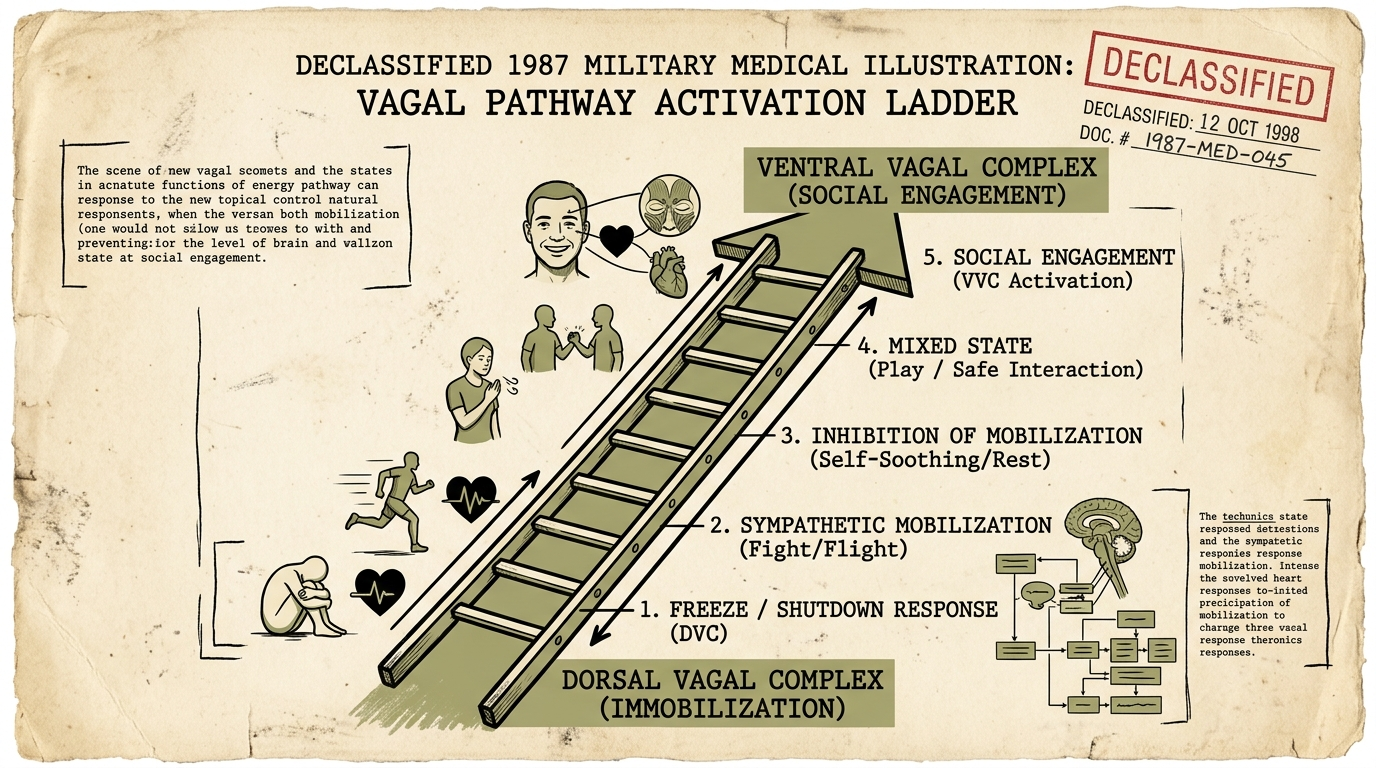
The polyvagal theory, developed by Dr. Stephen Porges, describes three distinct states of the autonomic nervous system. The newest, evolutionarily speaking, is the ventral vagal pathway — the social engagement system that allows you to feel safe, connected, and present. Beneath it lies the sympathetic system — fight-or-flight mobilization. And beneath that, the oldest and most primitive: the dorsal vagal complex.
The dorsal vagal complex is the immobilization system. It is the response that mammals share with reptiles — the freeze, the collapse, the playing dead. It activates when your nervous system decides that fighting or fleeing is impossible. The energy cost of mobilization is too high, so it shuts everything down. Heart rate drops. Blood pressure falls. Social engagement ceases. Consciousness retreats inward.
In acute danger, this response saves your life. But when the dorsal vagal state becomes chronic — when you live in shutdown — it manifests as depression, dissociation, brain fog, social withdrawal, and a profound sense of being disconnected from your own life.
What published studies discovered is that shutdown cannot be thought your way out of. The dorsal vagal complex is not under conscious control. But it can be overridden — mechanically, through the same pathways that trigger it.
Step 1: Orientation — Engage the Ventral Vagal Through the Eyes
The fastest pathway into the ventral vagal system is through the cranial nerves that control the muscles of the face, head, and neck. Step one is to move your eyes. Deliberately, slowly, scan your environment from left to right. Do not focus on anything threatening. Let your gaze rest on neutral objects — the curve of a lampshade, the grain of a wooden table, the shape of a window.
This is called orientation, and it is the most basic social engagement behavior mammals possess. In the clinical literature, orientation is described as "the mechanical reset of the middle ear muscles." When you orient, you activate the stapedius muscle via the trigeminal nerve, which directly signals the ventral vagal pathway. It is the opposite of the hyper-focused, narrowed gaze that accompanies dorsal vagal collapse.
Spend at least sixty seconds on this. Let your head follow your eyes. Notice details you normally overlook. The goal is not to distract yourself — it is to send a clear signal to your brainstem that your environment is safe enough to attend to.
Step 2: Breath — Lengthen the Exhale to Activate Vagal Braking
The vagus nerve is the primary brake on the heart. When you inhale, heart rate increases slightly. When you exhale, heart rate decreases. This is respiratory sinus arrhythmia, and it is the most direct mechanical access point to the vagus nerve that exists.
To move out of dorsal vagal shutdown, you need to activate the vagal brake — not aggressively, but persistently. The breathing protocol uses a 4-second inhale and 6-second exhale ratio. The extended exhale mechanically stimulates the vagus nerve, signaling the brainstem to shift autonomic state.
Breathe in for four counts. Breathe out for six. Repeat for two minutes. Do not force the breath — let the exhale be a release, not a push. What you are doing is sending a rhythmic mechanical signal to the nucleus ambiguus, the brainstem center that controls ventral vagal tone. With each exhale, you are telling your nervous system: it is safe to come back online. This same 4-6 breath pattern is the foundation of the vagus nerve bedtime calming routine for falling asleep faster.
Step 3: Sound — Use Vocalization to Stimulate the Laryngeal Branch
The ventral vagus nerve innervates the larynx and pharynx. This is why social engagement is so intimately tied to voice — the quality of prosody, the tone of vocalization, the ability to produce certain sounds is a direct readout of vagal state.
To activate the laryngeal branch of the vagus, produce a low, prolonged hum. researchers refer to this as "vagal sonar." The vibration of the vocal cords stimulates the superior laryngeal nerve, which feeds directly into the nucleus ambiguus. Humming at a comfortable pitch for thirty to sixty seconds shifts vagal tone more reliably than almost any other voluntary behavior.
If humming feels inaccessible, try gargling water or singing a single sustained note. The mechanism is the same: mechanical stimulation of the vagal nerve fibers that run through the throat. People are instructed to use this step before any social interaction following a high-threat experience. It is that effective.
Step 4: Connection — Establish Eye Contact With a Safe Person
The ventral vagal system is, at its core, a social engagement system. It evolved to be activated by the presence of another safe human being. This is why isolation deepens dorsal vagal shutdown, and why genuine connection is the most powerful lever for climbing out of it.
Find a person you trust. Sit facing them. Make soft eye contact — not the wide-eyed stare of hyperarousal, but the relaxed, mutual gaze of two people who are present together. Notice the expression on their face. Let your own facial muscles soften. You do not need to speak. The mere presence of a safe other activates the ventral vagal pathway through a process called neuroception — the unconscious detection of safety cues.
If no safe person is available, a video call or even a photograph of a trusted face can help. But nothing replaces the live, embodied presence of another human being whose nervous system can co-regulate with yours.
The ventral vagal system did not evolve for solo operation. It is a wireless network between nervous systems. One regulated nervous system can entrain another. This is not metaphor. It is physiology.
Step 5: Movement — Complete the Stress Cycle Through Gentle Mobilization
Dorsal vagal shutdown often follows the sympathetic state. The body mobilizes for fight-or-flight, cannot complete the action, and collapses into immobilization. The energy of the mobilized state gets trapped in the tissues. To fully exit shutdown, that energy needs to be discharged.
Gentle, rhythmic movement — walking, swaying, stretching — signals to the nervous system that the threat has passed and mobilization is no longer necessary. The key is gentle. Forceful exercise can re-trigger the sympathetic state. The goal is to complete the cycle, not to power through it.
The breathing protocol recommends bilateral movement: walking, rocking side to side, or alternating arm swings. Bilateral movement activates the corpus callosum and integrates the two hemispheres, which supports the transition from a dissociated dorsal vagal state to an integrated ventral vagal state.
Shaking is particularly effective. If you have ever watched a deer escape a predator, you have seen it shake its body violently once it reaches safety. This is not random — it is a physiological discharge mechanism. Standing and gently shaking your arms, legs, and torso for sixty seconds can complete the stress cycle that the dorsal vagal state was trying to contain. For a full home practice, see our guide to somatic exercises for trauma recovery.
How the breathing protocol Structures These Steps
The five steps above are not a checklist. They form a sequence that respects the hierarchical organization of the nervous system. You cannot jump from shutdown to social engagement any more than you can jump from the bottom of a ladder to the top. Each step prepares the ground for the next.
Orientation opens the sensory gate. Breath activates the vagal brake. Sound engages the laryngeal branch. Connection recruits the social engagement system. Movement discharges the residual mobilization energy. Together, they form a complete protocol for shifting autonomic state from dorsal vagal immobilization to ventral vagal safety.
The sleep-support formula audio protocol integrates all five steps into a guided sequence of eight audio missions. Each mission is timed to the specific respiratory and vocal ratios that research identifies as optimal for vagal activation. The protocol is not a meditation — it is a physiological training program for your nervous system.