
You have talked about it for months. You have understood the origins, traced the patterns, and named the wounds. And yet — your body still reacts as if the trauma is happening now. Your shoulders stay tensed. Your breathing stays shallow. Certain sounds, smells, or words send you into a state that your mind knows is irrational but your nervous system cannot override.
This is because trauma is not primarily a memory stored in the brain. It is a physiological pattern stored in the body. The research on somatic approaches to trauma shows that body-based interventions — exercises that target the nervous system directly — are often more effective than talk therapy alone for resolving the physiological residue of traumatic events. When the body enters a collapsed state, it is experiencing dorsal vagal shutdown, and somatic exercises are the most effective way to return to safety.
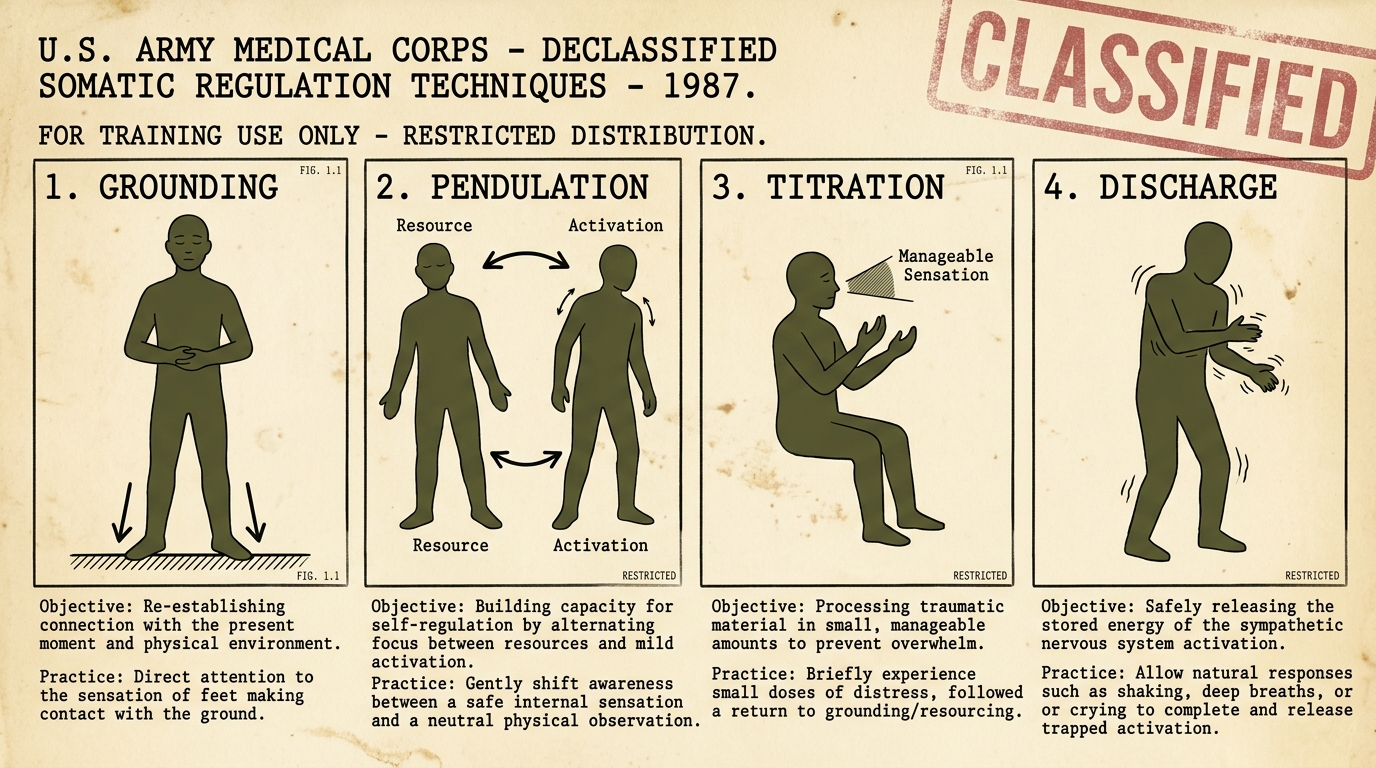
A four-part somatic protocol has been used with people returning from high-threat circumstances. These exercises were designed for people who needed to process trauma without re-living it — to complete the stress cycle without being re-traumatized by the content of their memories.
Below are the four core somatic practices, adapted for home use. Each targets a specific phase of the trauma recovery process.
Practice 1: Grounding — Establishing the Container of Safety
Before any trauma processing can occur, the nervous system must establish that the present environment is safe. Grounding is the practice of orienting to the here-and-now — not as a distraction, but as a physiological signal that the threat has passed.
The 5-4-3-2-1 Grounding Exercise
Sit in a comfortable position with your feet flat on the floor and your hands resting on your thighs. Look around the room and identify: five things you can see, four things you can touch, three things you can hear, two things you can smell, and one thing you can taste. Say each item out loud or silently. The act of naming engages the prefrontal cortex and signals the amygdala that you are in a safe environment.
What makes this exercise somatic rather than cognitive is the attention to sensation. When you identify something you can touch, do not just name it — feel it. The texture of the fabric, the temperature of the air, the pressure of the floor against your feet. This sensory input travels through the spinothalamic tract to the thalamus and then to the insula — the brain region that integrates interoceptive awareness. The insula is a direct modulator of the vagus nerve, and activating it through sensation is the fastest route out of a trauma response.
How long: 2 to 3 minutes, or until you feel your breathing deepen naturally.
Practice 2: Pendulation — Building Tolerance for Sensation
Pendulation is a concept developed by Dr. Peter Levine in Somatic Experiencing. It refers to the rhythmic oscillation between sensations of activation and sensations of settling. The nervous system cannot process trauma if it stays locked in a hyperaroused state. Pendulation teaches the system that it can move into discomfort and return to safety — building what researchers call "vagal elasticity."
The Pendulation Exercise
Start in a grounded seated position. Bring your attention to an area of your body that feels neutral or comfortable — perhaps your hands resting on your thighs, or the even pressure of your feet on the floor. Spend thirty seconds noticing the sensations in this neutral area. This is your "anchor" — a felt sense of safety in the body.
Now, slowly bring your attention to an area of your body that holds tension or discomfort — tightness in the jaw, a knot in the stomach, a band of pressure across the chest. Do not try to change the sensation. Simply observe it. Notice its shape, its temperature, its boundaries. Spend twenty to thirty seconds with the discomfort — just enough to feel it, not enough to be overwhelmed by it.
Then, return your attention to the anchor — the neutral, comfortable area. Notice the contrast. You may find that the anchor now feels different — warmer, more present, more alive. This is the pendulation. You have moved into the sensation and returned, and your nervous system has learned that it is possible to come back.
Repeat the cycle three to five times. Each cycle should feel easier than the last. If any cycle feels too intense, shorten the time spent with the discomfort and lengthen the time spent at the anchor.
The nervous system does not heal by force. It heals by rhythm. Pendulation is the rhythmic movement between contraction and expansion, activation and settling, protection and connection. The rhythm itself — not the content — is the medicine.
Practice 3: Titration — Processing Trauma in Measured Doses
Titration is the practice of approaching traumatic material in small, manageable doses — the way a chemist adds one drop of reagent at a time rather than pouring the entire bottle. The goal is to complete incomplete stress responses without triggering the full trauma response.
The Titration Exercise
Identify a memory or sensation that carries a charge but is not overwhelming — a 3 or 4 on a 10-point distress scale. Bring it into awareness for no more than five to ten seconds. Then deliberately shift your attention to a sensation of safety in your body — the anchor you established in the pendulation practice.
The key insight of titration is that the pause between exposures is where the healing happens. When you bring up a piece of traumatic material and then return to safety, your nervous system has the opportunity to complete the stress response that was frozen at the time of the original event. You may notice shaking, yawning, sighing, or temperature changes during the pause. These are discharge phenomena — signs that the nervous system is completing the cycle.
Do not rush the pause. Spend at least twice as long at the anchor as you spent with the traumatic material. If you feel any urge to continue processing — to "go deeper" — resist it. The discipline of titration means erring on the side of under-processing rather than over-processing.
How long: 5 to 10 minutes total. A single session should involve no more than three to four titrations.
Practice 4: Discharge — Completing the Stress Cycle
Discharge is the physiological completion of the stress response. When an animal escapes a predator, it shakes. The shaking is not random — it is the discharge of mobilized energy that was activated for fight-or-flight and did not get used. Humans suppress this discharge because it feels uncomfortable or embarrassing. But suppressing it leaves the energy trapped in the nervous system, maintaining the trauma response indefinitely.
The Body Shake Exercise
Stand with your feet shoulder-width apart and your knees slightly bent. Starting with your hands and arms, begin to gently shake them — not aggressively, but with a loose, rhythmic motion. Let the shaking spread to your shoulders, your torso, your legs. Imagine you are shaking off water after stepping out of a shower. Keep your knees soft and your jaw loose.
If shaking feels forced or unnatural, start with simpler movements: alternate arm swings, gentle side-to-side swaying, or bouncing lightly on the balls of your feet. The goal is rhythmic, bilateral movement that the nervous system recognizes as completion — not exercise.
Continue for sixty to ninety seconds. Then stop and stand still. Notice the sensation of your body in stillness after the movement. You may feel a sense of warmth, a drop in tension, or a spontaneous sigh. This is the nervous system completing its cycle.
Alternative: The Extended Exhale Discharge
If physical movement is not possible — you are in bed, in a chair, or in public — the discharge can be accomplished through breath. Take a deep breath in and exhale with a prolonged, audible sigh — a full "haaaaa" sound that continues until the lungs are completely empty. Pause at the bottom of the exhale for two to three seconds. Inhale naturally. Repeat three to five times. The audible sigh is the vocalized version of the discharge — a signal of completion that the nervous system recognizes across all mammalian species.
Putting the Four Practices Together
The four practices form a sequence that should be followed in order during a somatic recovery session:
Phase 1 — Grounding (2–3 min): Establish safety through sensory orientation. Establish your anchor. Do not proceed until you feel a clear sense of presence.
Phase 2 — Pendulation (3–5 min): Move between activation and settling. Build tolerance for sensation. Learn that you can feel discomfort and return to safety.
Phase 3 — Titration (5–10 min): Approach traumatic material in small doses. Complete incomplete stress responses. Let the pauses be longer than the exposures.
Phase 4 — Discharge (2–3 min): Complete the session with shaking, movement, or sighing. Allow the nervous system to return to its baseline. Close the session with grounding.
A full session takes fifteen to twenty minutes. The breathing protocol includes a guided audio session called "The Somatic Completion Protocol" that leads the listener through this exact sequence with timed cues and musical pacing. The protocol was originally developed for people who need to process stress-related trauma without clinical intervention — and it is the most requested session in the protocol library.
Trauma recovery is not about erasing the memory. It is about completing the physiological response that the memory triggers, so that the past can become the past — and your body can stop living as if the threat is still here.