
Dorsal Vagal Shutdown: When Your Body Pulls the Emergency Brake
Understand the mechanisms of collapse, but to begin shifting out of this state, see our practical guide: How to Get Out of Dorsal Vagal Shutdown: 5 Steps.
There is a state beneath anxiety. Beneath the racing thoughts, the tight chest, the hypervigilance. It is not calm — it is collapse. Numbness. Disconnection. A flat emotional landscape where nothing matters and nothing reaches you. If you have been there, you know the word for it: nothing. No motivation. No feeling. No you. This is dorsal vagal shutdown, and it is the most misunderstood state in the human nervous system.
What Is the Dorsal Vagal System?
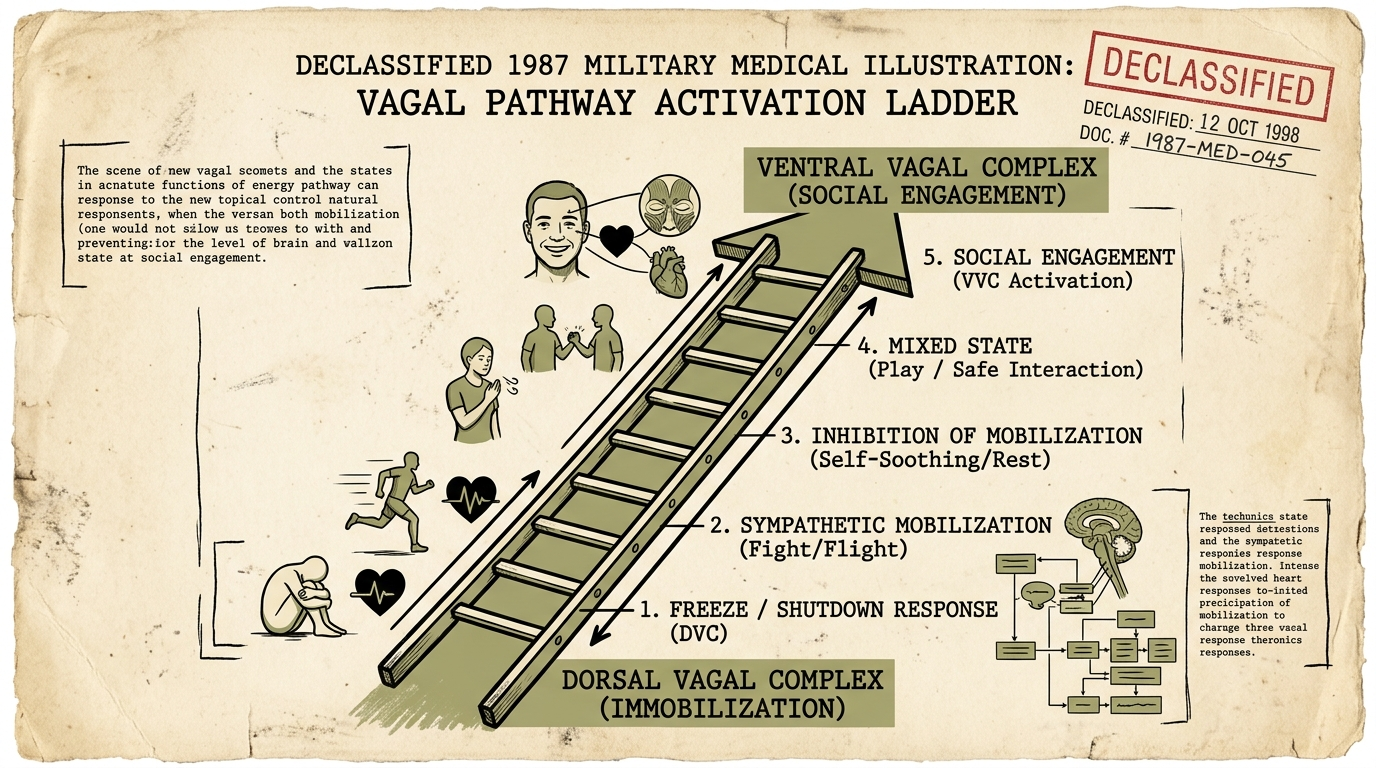
In Polyvagal Theory, developed by Dr. Stephen Porges, the autonomic nervous system operates in three hierarchical layers. The newest layer — the ventral vagal system — supports social engagement, connection, and feeling safe. The middle layer — the sympathetic system — drives fight or flight. The oldest layer — the dorsal vagal system — is your body's last-resort survival mechanism: immobilization and shutdown.Porges SW. (2011). The Polyvagal Theory. Norton.
When your nervous system determines that fighting and running are both futile — that no action can change the outcome — it activates the dorsal vagal system, which people often describe as a dorsal vagal nerve shut down. Your body essentially plays dead. Heart rate drops. Metabolism slows. Emotional processing shuts down. This is not a choice. It is a survival reflex that predates consciousness.
The Unmyelinated Dorsal Vagal Pathway and Analgesia
The dorsal vagal complex is composed primarily of unmyelinated vagal fibers — a primitive neural architecture shared with reptiles and other early vertebrates. Unlike the myelinated ventral vagal pathway, which supports rapid, nuanced social engagement, the unmyelinated dorsal vagus operates slowly and broadly. It innervates organs below the diaphragm — the stomach, intestines, and lower body — and when activated, it produces a profound systemic shutdown.
One of the most striking features of unmyelinated dorsal vagal activation is its analgesic effect. When the dorsal vagal system engages, it triggers endogenous opioid release — the body's own painkillers. This is not accidental. It is a survival mechanism. If an organism is being preyed upon and cannot escape, the capacity to not feel pain is evolutionarily advantageous. The animal goes still, goes numb, and goes silent. Predators often lose interest in immobile prey. The analgesia ensures the organism does not involuntarily flinch or cry out, which would signal that it is still alive.
In humans, this same mechanism produces the emotional numbness and physical deadening that people in shutdown describe. You do not just feel emotionally flat — you feel physically anesthetized. Pain tolerance increases. Sensory input feels muffled, as though it is reaching you through water. This is your dorsal vagal system flooding your body with endogenous opioids, exactly as it was designed to do. Research on chronic stress and neuroinflammation has demonstrated that prolonged stress exposure activates neuroinflammatory pathways in brain regions associated with the shutdown response, further reinforcing the immobilization state through biochemical feedback loops.Farooq RK, et al. (2012). Is unpredictable chronic mild stress a reliable model to study depression-induced neuroinflammation? Behavioural Brain Research, 231(1), 130-137.
This analgesic effect has been described in clinical case reports: people who enter dorsal vagal shutdown during sustained stress or confinement report that physical pain diminishes even as cognitive function deteriorates. They can endure more [\p{Pd}-] but they cannot think, plan, or act. The system trades awareness for endurance. It is a trade that saves your life in the wild and imprisons you in civilization.
The Journey From Anxiety to Numbness
Most people do not start in shutdown. They arrive there after prolonged sympathetic overdrive. The trajectory looks like this: chronic stress activates fight-or-flight. Over months or years, the sympathetic system depletes itself. The body can no longer sustain the high-energy state. It drops into the only remaining option: shutdown. This is why so many people describe the transition as going from "wired but tired" to completely flat.
The transition is often gradual. First, the anxiety becomes less sharp — you stop feeling the acute panic spikes. Then the energy drops. Then the emotions flatten. Then the motivation disappears. People around you may comment that you seem "calmer," not realizing that what they are witnessing is not peace — it is physiological withdrawal. The alarm did not stop ringing because you are safe. It stopped ringing because the battery died.
Healthy Stillness vs. Pathological Freeze
Not all stillness is shutdown. This is a critical distinction that even experienced clinicians sometimes miss. There is a state of healthy stillness — a calm, grounded quietude where your body is at rest and your mind is clear. Think of the stillness after meditation, or the quiet of lying in a field on a summer afternoon. Your muscles are relaxed. Your breathing is slow and even. You feel present, aware, and at ease. This is ventral vagal stillness, and it is one of the healthiest states your nervous system can occupy.
Pathological freeze — dorsal vagal shutdown — feels entirely different. The stillness is heavy, not light. Your body feels sluggish, as though moving through wet concrete. Your mind is not clear — it is foggy, distant, or blank. You may feel detached from your own body, as though you are observing yourself from outside. Time distorts. You feel less, not more. There is no peace in it — only absence.
The physiological markers tell the story. In healthy stillness, heart rate variability is high — a sign of robust vagal tone and adaptive flexibility. In pathological freeze, heart rate variability collapses. The body is not regulated — it is under-regulated. The system has not found calm; it has abandoned the attempt to regulate altogether. Breathing in healthy stillness is diaphragmatic and effortless. Breathing in shutdown is shallow and minimal — just enough to sustain life, not enough to support engagement.
published studies recognized this distinction as operationally critical. An operative in ventral vagal stillness was an asset — calm, observant, capable of deliberate action. An operative in dorsal vagal shutdown was a liability — present in body but absent in function. The protocol's design reflects this understanding: the emergency reset protocol does not aim to produce stillness. It aims to move the nervous system out of pathological freeze, through mobilization, and into the kind of stillness that is alive.
Why This Is Not Depression (And Why the Distinction Matters)
Dorsal vagal shutdown and clinical depression share overlapping symptoms — low energy, flat affect, social withdrawal, brain fog. But they are driven by different mechanisms. Depression involves complex neurotransmitter imbalances. Dorsal vagal shutdown is an autonomic nervous system state — a specific physiological pattern that can be shifted without medication, by activating the ventral vagal system.
This distinction matters because the intervention is different. Antidepressants target serotonin and norepinephrine. Vagal activation targets the autonomic nervous system directly, through the breath.
The Breathing Approach: Climbing Back Up the Ladder
The breathing protocol addresses dorsal vagal shutdown by following the polyvagal hierarchy. You cannot jump directly from shutdown to social engagement — the nervous system does not work that way. The protocol moves you through the intermediate stage: first activating the sympathetic system gently (this is why some missions start with a slightly faster rhythm), then using the exhale to engage the ventral vagal system.
the emergency reset protocol — the emergency override — is specifically designed for this state. It is a 5-minute session that starts with rhythmic stimulation to gently bring the nervous system out of collapse, then transitions to extended exhale breathing to engage the vagal brake.
For more on the theory behind this approach, see Polyvagal Theory Explained. For the complete protocol, see Sleep Architecture & Restorative Dynamics.
Is Dorsal Vagal Shutdown Real?
Yes. Dorsal vagal shutdown is a real, well-documented physiological state, not a metaphor or a wellness trend. It is rooted in the Polyvagal Theory proposed by Dr. Stephen Porges, which is supported by decades of research into the autonomic nervous system. The dorsal vagal complex is an actual anatomical structure: the unmyelinated vagal fibers that originate in the dorsal motor nucleus of the vagus nerve. When the body perceives threat and perceives that escape is impossible, this pathway triggers the immobilization response, slowing heart rate, reducing metabolism, and dampening emotional output.
The confusion around "is dorsal vagal shutdown real" usually comes from conflating three different things: the anatomy (real, measurable), the theory that organizes it (well-evidenced), and the lay interpretation of it (often exaggerated online). The underlying phenomenon - a nervous system that collapses into numbness after prolonged stress - is widely recognized in clinical literature under names like tonic immobility, dissociation, and trauma-related numbing. The dorsal vagal branch is simply the neural wiring that produces that experience.
When to Seek Professional Help
If dorsal vagal shutdown is frequent, severe, or triggered by trauma, professional support is strongly recommended. Somatic therapy, EMDR, and trauma-informed counseling can safely guide you out of chronic freeze states. A brief summary of the self-directed exercises that support recovery is covered in the companion guide: How to Get Out of Dorsal Vagal Shutdown: 5 Steps.
For a complete, step-by-step sequence, see our practical guide: How to Get Out of Dorsal Vagal Shutdown: 5 Steps. You can also explore related practices in Cold Exposure and Vagus Nerve Activation and Diaphragmatic Breathing and Vagal Tone.