
Pheochromocytoma Warning: Paroxysmal episodes of severe headache, profuse diaphoresis, and severe palpitations accompanied by extreme hypertension require plasma free metanephrine testing to rule out adrenal chromaffin tumors.
Sympathetic Overdrive: When the Alarm Will Not Stop
Your body has an alarm system. It is called the sympathetic nervous system, and its job is to save your life. When it detects a threat — physical, emotional, or imagined — it floods your body with adrenaline and cortisol. Your heart races. Your muscles tense. Your pupils dilate. Your digestion shuts down. This is fight-or-flight, and it is the most powerful survival mechanism you possess.
The problem is not the alarm. The problem is when the alarm will not turn off. This is sympathetic overdrive — a state where your body is permanently locked in fight-or-flight. It is one of the most underdiagnosed threats to human health in the modern world.
The 12 Symptoms of Sympathetic Overdrive
These are the physical signs published studies documented as reliable indicators that the sympathetic system is stuck in the "on" position:
- Chronic muscle tension — especially neck, shoulders, and jaw
- Chest tightness — a feeling of pressure or constriction
- Racing or pounding heartbeat — especially at rest or at night
- Shallow, rapid breathing — feeling unable to take a deep breath
- Morning anxiety — waking with dread or panic
- Tension headaches — band-like pressure around the skull
- Digestive issues — IBS, nausea, loss of appetite
- Insomnia — difficulty falling or staying asleep
- Wired but tired — exhausted but unable to relax
- Hypervigilance — constant scanning for threats
- Tingling or numbness — especially in extremities
- Emotional reactivity — irritability, sudden anger, or crying spells
If you checked four or more of these, your sympathetic system is likely in sustained overdrive. Research on the autonomic nervous system has documented that chronic sympathetic activation produces exactly this constellation of symptoms.Goldstein DS. (2010). Adrenaline and the inner world. Annals of the NY Academy of Sciences.
Why the Alarm Gets Stuck
The sympathetic system was designed for short bursts — 90 seconds of intense activation, then recovery. But modern life creates a constant stream of low-grade threats: work deadlines, financial pressure, relationship stress, social media. Each one triggers a micro-sympathetic response. Over time, the cumulative effect is indistinguishable from being in a war zone. Your body does not know the difference between a tiger and a tax audit. It only knows threat.
What makes the entrapment worse is that the alarm itself becomes the threat. Each sympathetic activation — the racing heart, the chest tightness, the shallow breathing — is interpreted by the brain as evidence of danger. This creates a feedback loop: the symptoms of overdrive trigger more overdrive. published studies called this the "autonomic echo chamber" — a closed circuit where the stress response amplifies itself without external input.
The HPA Axis and the Downward Cascade
Sympathetic overdrive is not a single-system event. It cascades through the entire hypothalamic-pituitary-adrenal axis. When the sympathetic system activates, the hypothalamus signals the pituitary gland, which signals the adrenal cortex to release cortisol. This is the HPA axis, and under normal conditions, cortisol provides negative feedback — it tells the hypothalamus to stop producing corticotropin-releasing hormone. The alarm shuts itself off.
In chronic overdrive, this feedback mechanism breaks down. The hypothalamus becomes desensitized to cortisol's stop signal. It keeps firing. Cortisol levels remain elevated. The result is not just sustained sympathetic activation — it is a fundamental disruption of the body's self-regulation system. The chronic cortisol symptoms that follow are well-documented: weight gain around the midsection, immune suppression, blood sugar instability, memory impairment, and sleep disruption.
The vagal activation: How the Breathing Protocol Switches It Off
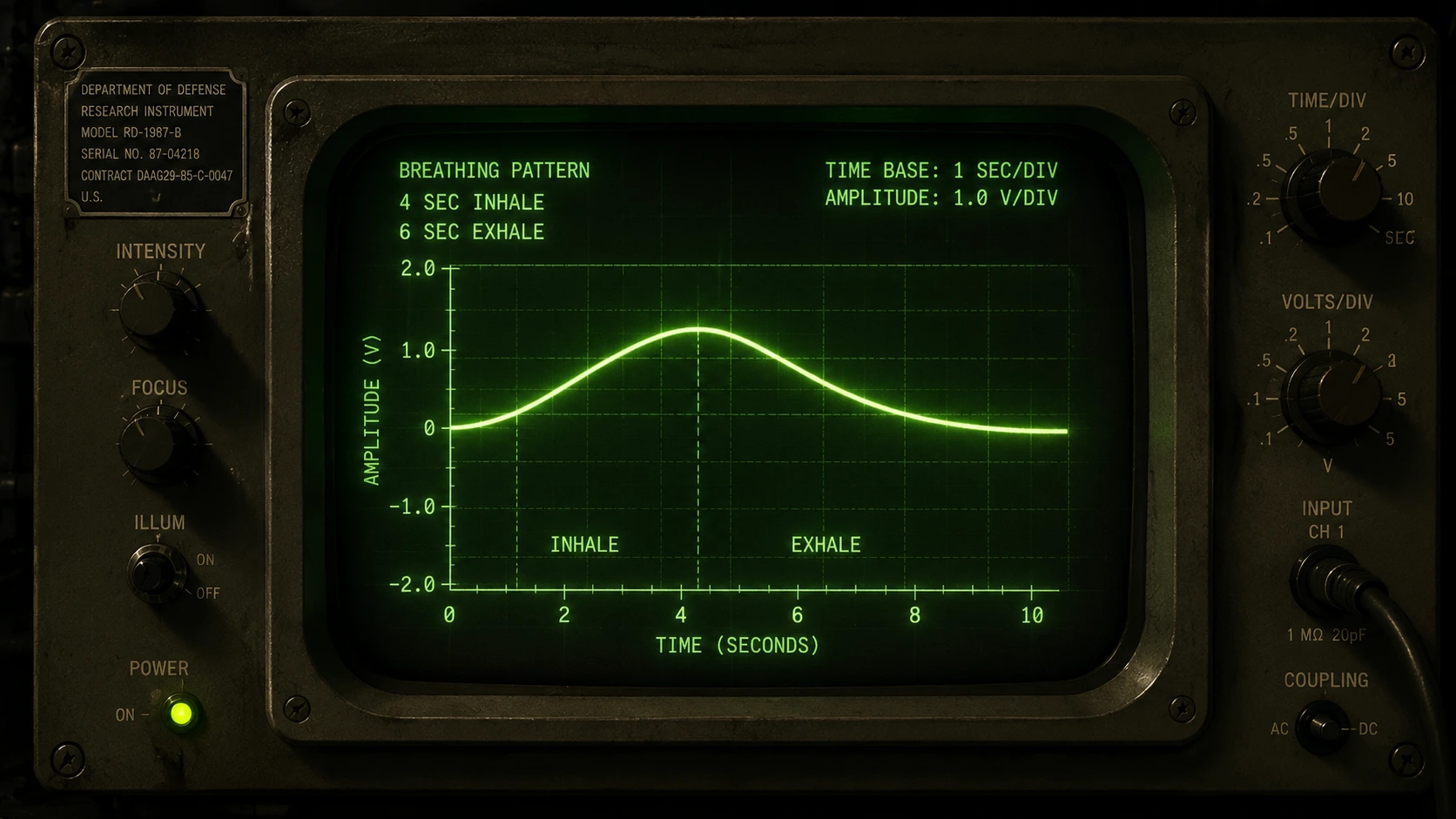
The only way to deactivate the sympathetic alarm is to activate the parasympathetic brake — the vagus nerve. The breathing protocol does this systematically through guided breathing. Every mission targets the vagus nerve with extended exhale patterns that force the sympathetic system to power down.
The mechanism is mechanical, not psychological. Your exhale directly stimulates the vagus nerve through the respiratory sinus arrhythmia. When you extend your exhale, you extend the parasympathetic phase of this cycle. Heart rate decelerates. Cortisol production slows. The HPA axis receives the stop signal it has been missing. the alarm may settle.
The Path to Collapse: What Happens If Overdrive Continues
Left unchecked, sympathetic overdrive eventually leads to dorsal vagal shutdown — the body's last resort when it can no longer sustain the fight. The trajectory is predictable: first overdrive, then exhaustion, then collapse. The protocol prevents this collapse by restoring the natural sympathetic-parasympathetic rhythm before the system depletes itself entirely.
I have seen what happens when this trajectory completes. People who were once sharp, responsive, and effective became hollow — not because of trauma in the psychological sense, but because their autonomic nervous system had simply run out of options. The alarm consumed them, and when there was nothing left to alarm, the system went dark. This is the cost of ignoring sympathetic overdrive. It does not resolve on its own. It either gets interrupted — or it ends in shutdown.
For the complete set of targeted missions, see Sleep Architecture & Restorative Dynamics.