
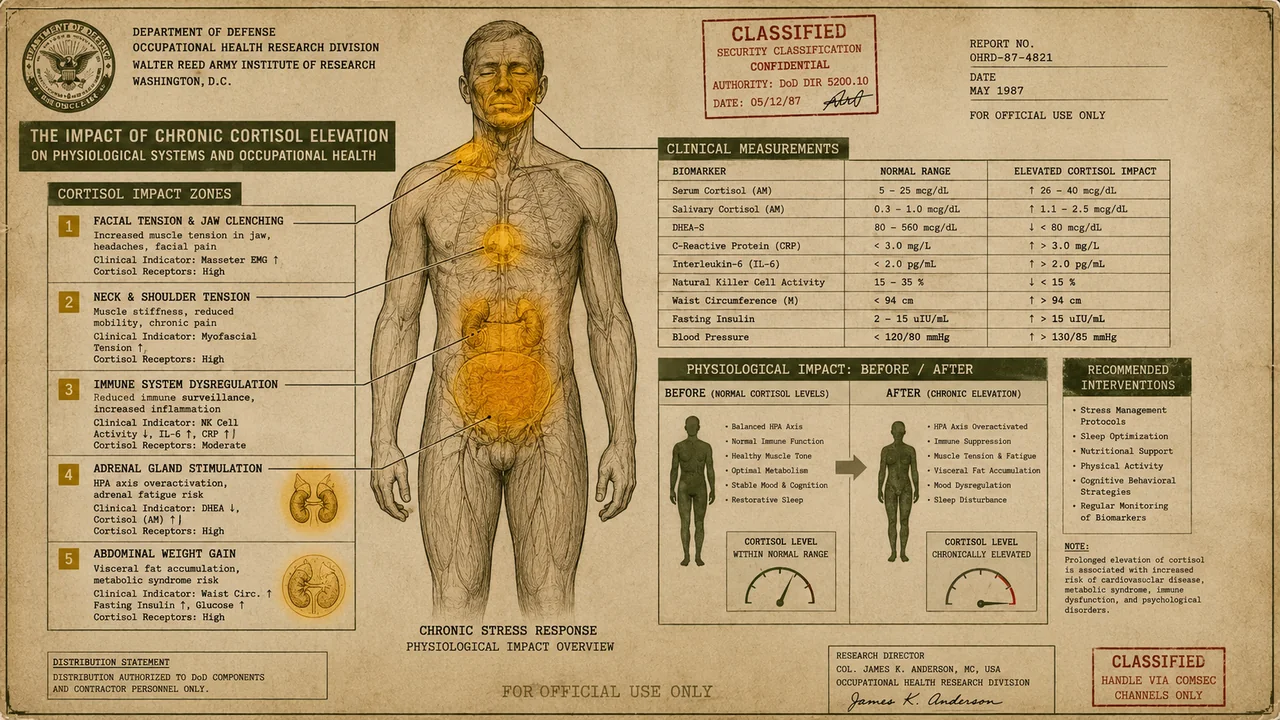
Endocrine Safety Warning: Rapid central weight gain, purple abdominal striae, proximal muscle weakness, and hypertension demand comprehensive endocrine workup to rule out hypercortisolemia / Cushing syndrome.
Chronic Cortisol: The Hormone That Was Designed to Save You but Is Destroying You
Cortisol is not your enemy. It is one of the most important hormones your body produces — a literal lifesaver in acute emergencies. But it was designed for short bursts. Ninety seconds of action, then it washes out. When it stays elevated — day after day, week after week, year after year — it becomes the most destructive chemical in your body. The research on chronic cortisol elevation confirms the damage it causes. And most people have no idea it is happening.
10 Physical Symptoms of Chronic Cortisol Elevation
- Stubborn weight gain — especially around the abdomen. Cortisol promotes fat storage as a survival reserve.
- Morning anxiety — elevated baseline cortisol amplifies the natural awakening response.
- Insomnia and poor sleep — cortisol should drop at night. When it does not, sleep becomes physiologically impossible.
- Exhaustion despite rest — cortisol disrupts the rest-recovery cycle, leaving you depleted but unable to relax.
- Brain fog and memory problems — chronic cortisol literally shrinks the hippocampus, your brain's memory center.Sapolsky RM. (2011). Chronic stress, cortisol, and hippocampal neurons. World Psychiatry.
- Digestive problems — cortisol suppresses digestive function, leading to IBS, bloating, and nausea.
- Muscle tension and pain — cortisol maintains the sympathetic muscle activation pattern.
- Weakened immune function — cortisol suppresses immune activity, making you more susceptible to illness.
- Tension headaches — sustained cortisol drives pericranial muscle contraction.
- Skin problems — cortisol increases inflammation and impairs skin repair.
Why Cortisol Stays Elevated
The HPA axis was designed for acute threats. A predator appears, cortisol spikes, you fight or run, the threat ends, cortisol drops. But modern stressors are chronic and inescapable. Each one triggers the HPA axis, and because the threats never fully resolve, the axis never fully deactivates. Your body is producing emergency levels of cortisol for non-emergency situations.
The Cortisol Feedback Trap
Under normal conditions, cortisol regulates itself through a negative feedback loop. When cortisol levels rise high enough, receptors in the hippocampus and hypothalamus detect the excess and signal the HPA axis to shut down production. But chronic cortisol elevation desensitizes these feedback receptors. They become numb to the signal. The system that should be saying "enough" stops responding. This is why chronic stress does not simply resolve when the external stressor diminishes.
The Hippocampus: Where Cortisol Does Its Worst Damage
Of all the structures cortisol damages, the hippocampus is the most consequential. Chronic cortisol halts neurogenesis in the hippocampus and can cause existing hippocampal neurons to atrophy. The practical impact is devastating: hippocampal damage impairs your ability to distinguish between real threats and perceived ones. Without a healthy hippocampus providing contextual information, the amygdala runs unchecked.
How Vagal Activation Reduces Cortisol
The vagus nerve is the primary brake on the HPA axis. When vagal tone is high, cortisol production is suppressed. When vagal tone is low — as it is in chronic stress — cortisol runs unchecked. The breathing protocol restores vagal tone through guided breathing, which directly reduces cortisol output at the neurological level.
The Vagal-Cortisol Pathway: A Hardwired Override
When the vagus nerve is stimulated through extended exhale breathing, it activates the parasympathetic nervous system, which directly inhibits the HPA axis at the level of the hypothalamus. Research on slow breathing and cortisol reduction has confirmed this pathway in controlled settings.Ma X, et al. (2013). Acute effects of slow breathing on cortisol and psychological stress. Psychoneuroendocrinology, 38(11), 2746-2755.
The Recovery Timeline
Most users report improvements in sleep and morning anxiety within the first one to two weeks. Cognitive improvements — clearer thinking, better memory — typically emerge by weeks three to four. Physical symptoms such as abdominal weight gain and muscle tension respond more slowly, often requiring six to eight weeks of consistent vagal practice.
The Visceral Cascade: How Cortisol Reshapes Your Body
The physical symptoms of chronic cortisol are not random — they follow a predictable sequence that reflects cortisol's evolutionary function. The abdominal weight gain is not cosmetic; it is cortisol directing your body to store energy near the liver for rapid mobilization during a sustained threat. The immune suppression is not accidental; cortisol is deliberately trading long-term health for short-term survival by redirecting metabolic resources away from repair and toward action. The digestive shutdown is not a malfunction; cortisol is prioritizing blood flow to muscles and brain over gut function because a threatened organism does not need to digest lunch — it needs to run or fight.
Every one of these symptoms made evolutionary sense in an environment of acute, short-duration threats. The problem is that your body cannot distinguish between a predator and a mortgage. The cortisol response is identical. And when the threat is chronic rather than acute, the very mechanisms that would have saved your life in a 90-second encounter begin to destroy you over months and years. The sympathetic overdrive that produces the cortisol is the upstream cause. Reducing cortisol requires addressing the overdrive — and the most direct way to do that is through the vagus nerve.
For the complete protocol, see Sleep Architecture & Restorative Dynamics.