
Differential Diagnosis: Somatosensory amplification must be distinguished from systemic lupus, multiple sclerosis, or Lyme disease through appropriate clinical history and serologic laboratory evaluations.
For more, see interoceptive exposure for panic.
Somatic Anxiety: The Stress Your Body Is Holding That Your Mind Cannot Release
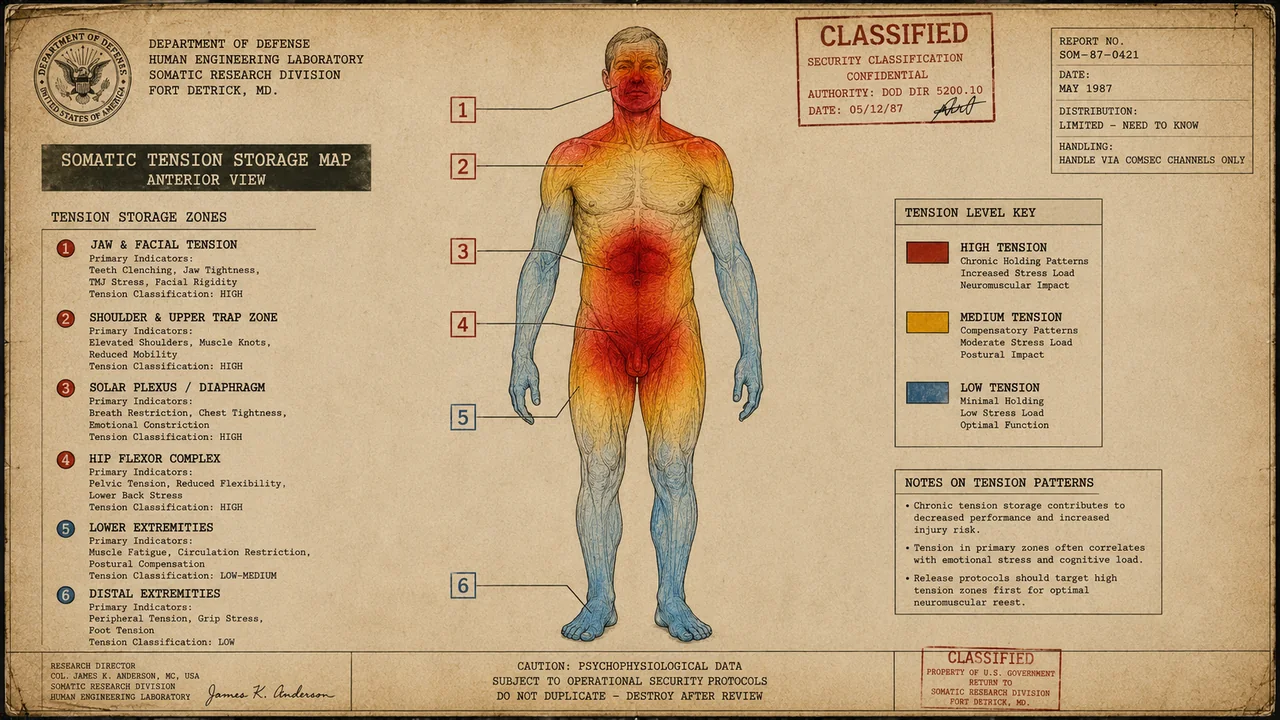
Not all anxiety lives in your thoughts. Some of it lives in your jaw, your shoulders, your stomach, your chest — stored as physical tension, pain, and dysfunction that no amount of cognitive therapy can touch. This is somatic anxiety, and it is one of the most common yet least understood patterns people describe. The body is not just experiencing anxiety. It is holding it.
What Is Somatic Anxiety?
Somatic anxiety refers to the physical manifestation of psychological stress. Instead of (or alongside) racing thoughts and worry, the anxiety expresses itself through the body: muscle tension, chronic pain, digestive issues, chest pressure, tingling, and fatigue. Research on interoception has shown that individuals with anxiety disorders have altered body awareness — they are more attuned to physical sensations, and their brains amplify these signals.Farb NA, et al. (2016). Interoception, contemplative practice, and health. Frontiers in Psychology.
The Five Primary Storage Sites
- Jaw and teeth — bruxism (clenching and grinding), TMJ dysfunction
- Chest and diaphragm — intercostal tension, restricted breathing
- Neck and head — tension headaches, cervical muscle rigidity
- Shoulders and upper back — chronic elevation and contraction of the trapezius
- Gut — IBS symptoms, nausea, bloating, cramping
Why Cognitive Approaches Fail With Somatic Anxiety
Somatic anxiety is maintained by the autonomic nervous system, not by conscious thought. Your sympathetic nervous system is sending a continuous signal to your muscles to contract. No amount of insight, reframing, or emotional processing will change that signal. The signal is physiological, and it requires a physiological intervention.
The Muscle Armor: How Chronic Tension Becomes Structural
When the sympathetic nervous system maintains a chronic state of activation, it creates a structural pattern. The fascia thickens and stiffens. Blood flow to chronically tense muscles decreases. Trigger points form. This is how "I am stressed" becomes "my shoulders are always tight" becomes "I cannot turn my head without pain." The signal must be changed at the source.
The Gut-Brain Axis: Why Your Stomach Is an Anxiety Barometer
Your enteric nervous system contains over 100 million neurons. It communicates with your brain via the vagus nerve, and approximately 80% of the vagal fibers carry signals upward — from gut to brain. When the sympathetic system is dominant, it suppresses digestive motility. The result is the constellation of gut symptoms that accompany chronic anxiety. Research has documented that individuals with anxiety disorders have significantly altered gut-brain connectivity.Cryan JF, et al. (2019). The microbiota-gut-brain axis. Physiological Reviews, 99(4), 1877-2013.
The Vagal Release: Releasing the Body's Grip
The breathing protocol addresses somatic anxiety by targeting the autonomic signal itself. When the vagus nerve is activated through extended exhale breathing, it sends a parasympathetic signal that directly countermands the sympathetic command to maintain muscle tension. The muscles release because the nervous system withdrew the order to contract.
The Sequence of Somatic Release
Somatic release through vagal activation follows a predictable sequence: first respiratory (intercostals and diaphragm), then cardiovascular (heart rate slows), then muscular (shoulders, neck, jaw release), then visceral (gut motility normalizes). The entire sequence typically takes 8 to 12 minutes of sustained vagal breathing — which is why the missions are designed at that duration.
Why Body-Based Anxiety Requires a Body-Based Solution
The fundamental insight of the breathing protocol is that the body is not a passive recipient of anxiety. It is an active participant. You cannot talk a muscle into releasing when the nerve commanding it to contract is still firing. You have to change the signal. The vagus nerve is how you change it — not through force, but through the body's own override switch.
Why You Keep Getting the Same Pain in the Same Places
If you have had chronic somatic anxiety for any length of time, you have probably noticed something: the pain keeps appearing in the same locations. The same spot in your left shoulder. The same band across your temples. The same knot in your jaw. This is not coincidence — it is neural patterning. Your sympathetic nervous system has developed preferred pathways for expressing threat activation, just as water develops preferred channels through soil. The neuroplasticity principle applies here with full force: every time the tension pattern fires through the same neural pathway, that pathway becomes faster and more automatic. The pain becomes your body's default way of expressing stress.
This is why spot treatments — massaging one area, stretching one muscle group — provide only temporary relief. The tension pattern is not in the muscle. It is in the nerve. And until the autonomic signal changes, the muscle will contract again as soon as the massage ends. The breathing approach is different: it changes the signal at the source by activating the vagus nerve, which withdraws the sympathetic contract command across the entire body simultaneously. The release is systemic because the signal is systemic. The jaw, shoulders, chest, and gut all release together — not because you addressed each one individually, but because you changed the command that was keeping all of them contracted.
For the complete protocol, see Sleep Architecture & Restorative Dynamics.