
Clinical Disclaimer: Structural neural rewiring requires consistent deliberate cognitive and autonomic practice over weeks and months. Chronic neurological symptoms require physician oversight.
Neuroplasticity and Anxiety: Why Your Brain Can Change — and Why It Has Not Yet
One of the most persistent myths about anxiety is that it is permanent. That your brain is wired this way and you are stuck with it. The science says the opposite. Your brain is the most adaptable organ in your body. It rewires itself constantly based on what you practice. This is neuroplasticity, and it is both the reason you have chronic anxiety and the reason you can recover from it.
How Anxiety Gets Wired In
Every time you have an anxious thought and your body responds with a stress reaction, you strengthen the neural pathway that connects that trigger to that response. The brain is efficient: it learns that "X leads to anxiety" and automates the response. Over time, the pathway becomes so strong that the anxiety fires automatically — before you even have a chance to think about it.
This is how a habit loop forms. The trigger activates the amygdala, which activates the sympathetic nervous system, which produces the physical anxiety response. Each repetition deepens the groove. Research on neuroplasticity and social stress has documented that chronic stress literally reshapes brain structure, strengthening fear circuits and weakening regulatory ones.Davidson RJ, McEwen BS. (2012). Social influences on neuroplasticity. Nature Neuroscience.
The Myelin Mechanism: Why Old Habits Die Hard
Neural pathways are insulated by a fatty substance called myelin. Every time a pathway fires, more myelin is deposited along it — like insulation being added to an electrical wire. The thicker the myelin sheath, the faster the signal travels. Your anxiety pathway is heavily myelinated. Years of repetition have given it a thick, efficient insulation. The signal travels fast. The response fires before you can intervene. But the same mechanism that made the anxiety pathway fast can make the calm pathway fast — if you practice it consistently enough to myelinate it.
How Neuroplasticity Works in Your Favor
The same mechanism that wired anxiety in can wire it out. Every time you use the vagal breathing protocol instead of spiraling into the anxiety response, you strengthen a new pathway: trigger → vagal activation → calm. Each repetition deepens this new groove. Over time, the new pathway becomes faster and stronger than the old one.
This is why the protocol emphasizes consistency over intensity. One perfect breathing session does not rewire your brain. But 20 minutes a day for 4-8 weeks does. The mechanism is the same one that lets you learn any skill — practice creates myelin, myelin speeds the signal, and the new response becomes automatic.
The Two Competing Pathways
Think of it as two paths through a forest. The anxiety path is wide and well-traveled — your brain has been walking it for years. The vagal calm path is narrow and new. Every time you choose the new path — by using the breathing protocol when anxiety starts — you widen it. The goal is not to eliminate the old path. It is to make the new path the default.
What the data revealed About Rewiring
Researchers kept meticulous records on response patterns over time. The most significant predictor of recovery was not the severity of the anxiety — it was the consistency of the intervention. People who practiced daily show markedly different neural response patterns after six weeks compared to those who practiced sporadically. The daily group developed measurably higher vagal tone and lower sympathetic reactivity.
The Timeline: What to Expect
- Week 1-2: You can use the breathing protocol to manage symptoms. The old pathway is still dominant.
- Week 3-4: The new pathway is getting faster. You sometimes catch the anxiety before it fully escalates.
- Week 5-6: The calm response is becoming semi-automatic.
- Week 7-8: The new pathway is the default. Anxiety still arises, but your nervous system shifts to calm on its own.
The Prefrontal-Amygdala Balance
Chronic anxiety weakens the connection between your prefrontal cortex and your amygdala, leaving the amygdala essentially unregulated. Regular vagal breathing practice strengthens this top-down regulatory connection. Research has demonstrated that mindfulness-based interventions increase prefrontal cortex thickness and reduce amygdala reactivity after just eight weeks.Lazar SW, et al. (2005). Meditation experience is associated with increased cortical thickness. NeuroReport.
Why This Is Not Positive Thinking
Telling yourself "I am safe" while your sympathetic nervous system is fully activated does not rewire anything — because the body's signal is louder than the mind's. The breathing approach is different: you create a physiological experience of safety — slowed heart rate, deep breathing, relaxed muscles — and let the brain learn from that experience. The body teaches the brain. That is the Polyvagal principle in action.
The Critical Window: Why the First 8 Weeks Matter Most
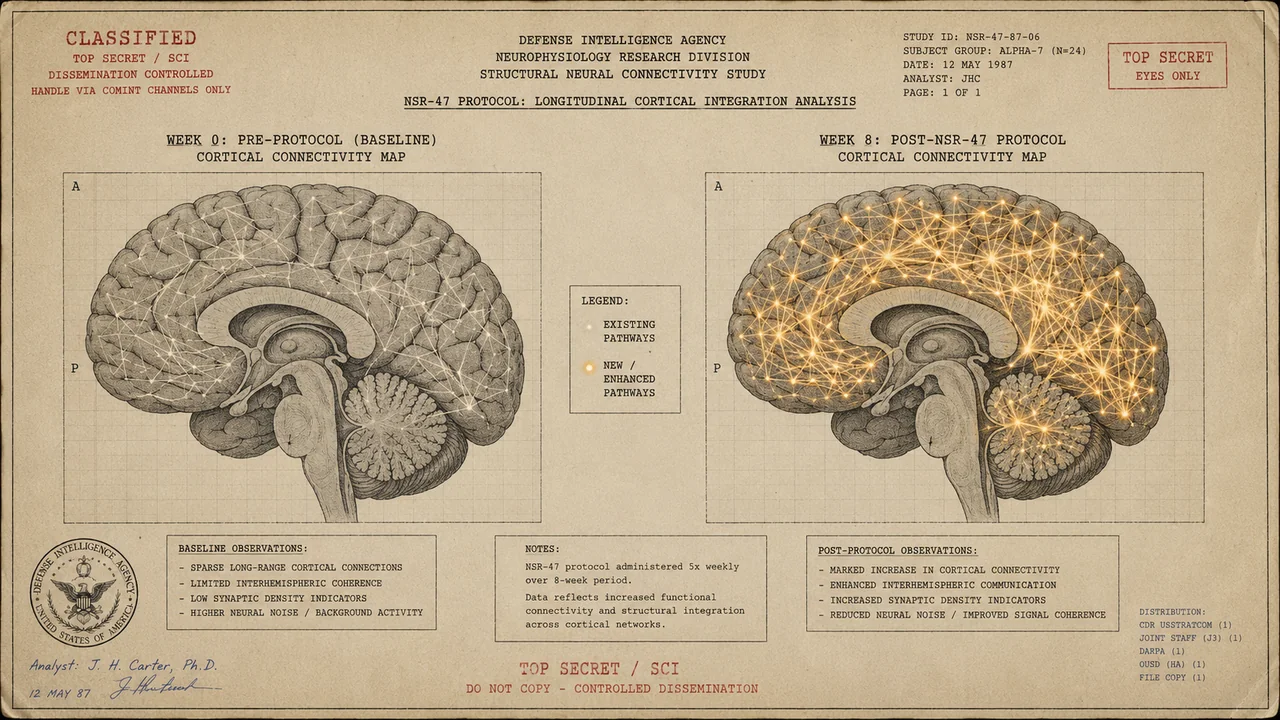
Neuroplasticity is not uniform across time. There is a window — roughly the first 6 to 8 weeks of consistent practice — where the brain is most responsive to new patterns. During this window, the myelin deposition on the new vagal calm pathway accelerates rapidly. The old anxiety pathway, deprived of its habitual reinforcement, begins to lose myelin efficiency. The competition between pathways shifts decisively.
After this window, the rate of change slows. Not because neuroplasticity stops — it never stops — but because the low-hanging fruit has been harvested. The most obvious autonomic dysregulation has been corrected. Further improvement requires either deeper practice, longer sessions, or more targeted interventions. This is why the breathing protocol front-loads its impact: the most significant changes happen in the first two months, and the protocol is designed to maximize that window. Missions 01-03 address the acute symptoms that drive the most suffering. Missions 04-07 build the long-term stabilization that prevents relapse. The sequence is intentional. It mirrors the neuroplasticity curve.
This is also why consistency during the first 8 weeks is non-negotiable. Missing a day is not a moral failure — but it is a missed opportunity during the most productive phase of neural rewiring. The people who recover fastest are the ones who practice every single day during the critical window, without exception. The ones who practiced sporadically still improved — but it took three times as long to achieve the same result.
For the complete protocol, see Sleep Architecture & Restorative Dynamics.