
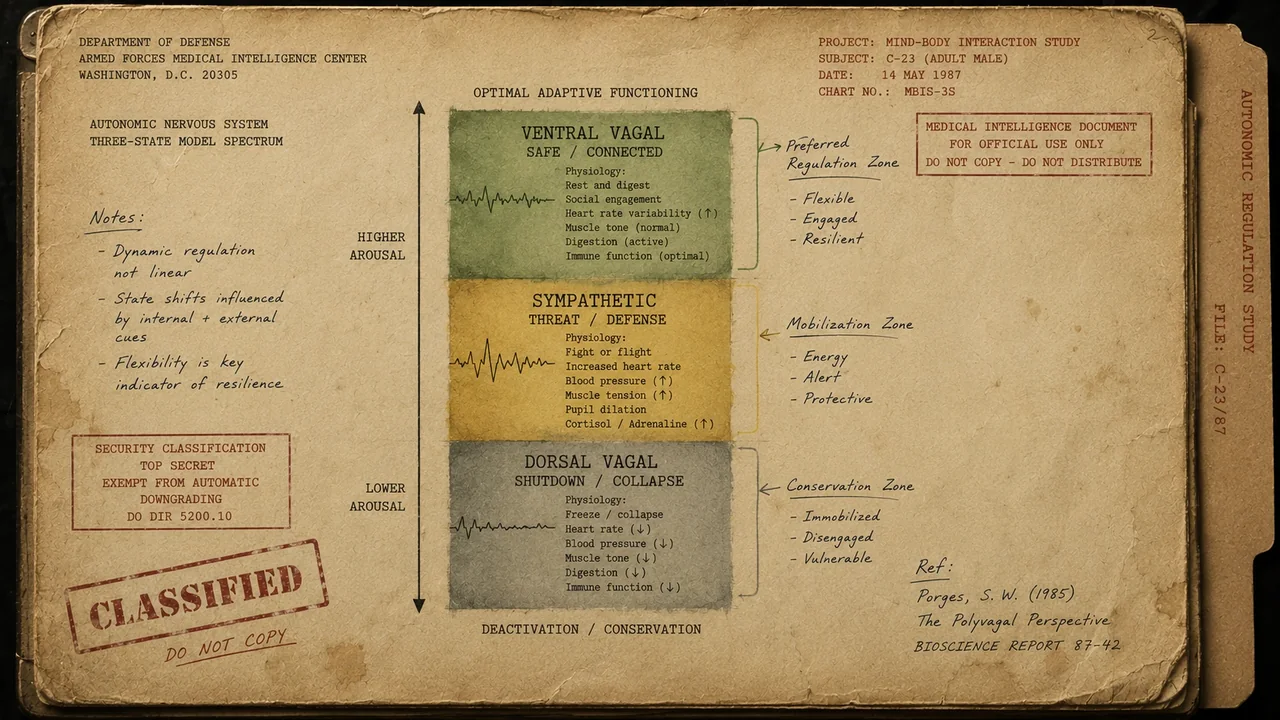
Clinical Application Note: Polyvagal concepts offer neurobiological frameworks for understanding stress hierarchies (dorsal vagal vs ventral vagal). They do not replace established neurological clinical guidelines.
Polyvagal Theory Explained: The Three States That Run Everything
There is a theory — developed by Dr. Stephen Porges over decades of research [\p{Pd}-] that explains more about why you feel the way you feel than almost anything else in the research literature. It is called Polyvagal Theory, and once you understand it, your entire experience of stress, anxiety, and emotional shutdown starts making sense. Not as character flaws. Not as weakness. As biology.
The Three Autonomic States
According to Polyvagal Theory, your autonomic nervous system operates in three distinct states, arranged in a hierarchy of evolutionary development:Porges SW. (2011). The Polyvagal Theory. Norton.
1. Ventral Vagal — Safe and Connected
This is the newest system, evolutionarily. When your ventral vagal complex is active, you feel safe, socially engaged, and emotionally regulated. Your heart rate is steady. Your breathing is slow. You can think clearly, connect with others, and respond to challenges without panic. This is the state the breathing protocol is designed to restore.
2. Sympathetic — Fight or Flight
When your nervous system detects threat, the ventral vagal system shuts down and the sympathetic system takes over. Your body mobilizes for action: adrenaline, cortisol, increased heart rate, muscle tension. This is appropriate for actual emergencies. It becomes a problem when you get stuck here — which is what chronic stress does.
3. Dorsal Vagal — Shutdown and Collapse
When fight and flight are not possible — when the threat is inescapable or the sympathetic system is exhausted — your body activates the oldest system: the dorsal vagal complex. This is the immobilization response. Heart rate drops. Emotional processing shuts down. You feel numb, disconnected, and flat. This is not depression — it is a survival reflex.
The Hierarchy: Why You Cannot Skip States
The critical insight of Polyvagal Theory is that these states form a hierarchy. You cannot jump from shutdown directly to safety. The nervous system does not work that way. If you are in dorsal vagal shutdown, you must first mobilize — activating the sympathetic system — before you can reach the ventral vagal state of safety and connection.
This is why well-meaning advice like "just relax" or "think positive" fails catastrophically for people in shutdown. You are asking the nervous system to skip a step. It cannot. The breathing protocol respects this hierarchy, guiding the nervous system through each state in the correct order.
The Vagus Nerve: Two Branches, Two Worlds
The vagus nerve is not a single pathway — it has two distinct branches with radically different functions. The ventral vagal branch is myelinated — coated in a fatty sheath that allows rapid, precise signal transmission. It innervates the muscles of your face, throat, middle ear, and heart. This is the "smart vagus" — it supports social engagement, facial expression, vocal prosody, and the capacity to co-regulate with other human beings.
The dorsal vagal branch is unmyelinated — slower, older, more primitive. It innervates the organs below the diaphragm and mediates the shutdown response. This branch shares its architecture with reptiles, whose primary defense is immobilization and freeze.
The breathing protocol targets the ventral vagal branch through controlled breathing, which increases its myelinated efficiency over time. This is how neuroplasticity applies to the autonomic nervous system: repeated activation of the ventral vagal pathway strengthens it, making safety your default state.
Neuroception: The Threat Detection System Below Awareness
Porges introduced a concept that was one of the most important contributions to stress physiology in the twentieth century: neuroception. This is the process by which your nervous system evaluates risk below conscious awareness. Before you think about whether you are safe, your autonomic nervous system has already decided.
Neuroception operates through three primary channels: the middle ear muscles, which filter human voice frequencies for safety cues; the facial muscles, which transmit and read emotional expression; and the heart-lung connections, which monitor internal physiological state. When neuroception detects safety, the ventral vagal system stays online. When it detects danger, the sympathetic system activates. When it detects life threat, the dorsal vagal system shuts everything down.
For people with chronic anxiety, neuroception becomes miscalibrated. A crowded grocery store triggers the same threat response as an actual physical confrontation. A mildly critical email activates the same cascade as a direct assault. The neuroceptive system has learned to over-read threat, and because it operates below consciousness, you cannot simply decide to stop perceiving danger.
Co-Regulation: Why We Need Each Other
One of the most overlooked aspects of Polyvagal Theory is co-regulation — the idea that the ventral vagal system is designed to function in connection with other people. Your nervous system reads safety cues from the faces, voices, and body language of those around you. When someone you trust is calm, their ventral vagal state literally helps regulate yours. This is not sentiment — it is neurophysiology.
The the clinical sleep physiology monograph partially replicate this co-regulatory function: the guided voice provides a consistent, calm auditory signal that the neuroceptive system can use as a safety cue.
What This Means for Recovery
Polyvagal Theory reframes recovery from anxiety and shutdown as a process of nervous system re-education, not character improvement. You are not anxious because you are weak. You are not numb because you are lazy. Your autonomic nervous system has learned a threat pattern, and it needs to learn a safety pattern. The breathing protocol provides the mechanism: repeated ventral vagal activation through controlled breathing. Over time, safety becomes the default. Not because you decided it — because you trained it.
For the complete protocol, see Sleep Architecture & Restorative Dynamics.