
Medical Disclaimer: Vagus nerve stimulation and physiological hacks enhance parasympathetic vagal brake activity but do not replace comprehensive psychiatric evaluation for severe panic disorder or generalized anxiety.
Vagus Nerve Anxiety Relief: What the Research on the Vagus Nerve Reveals
Controlled breathing is one of the most direct ways to regulate the autonomic nervous system without medication. The technique described below is built entirely around vagal activation: guided breathing patterns that progressively lengthen the exhale, stimulating the vagus nerve and signaling safety to the brain.
The key was the vagus nerve. If you have anxiety — real, physical, chest-tightening anxiety — your vagus nerve is either underactive or being overridden by your sympathetic system. Understanding how it works is the first step to reclaiming control.
What Is the Vagus Nerve and Why Does It Control Anxiety?
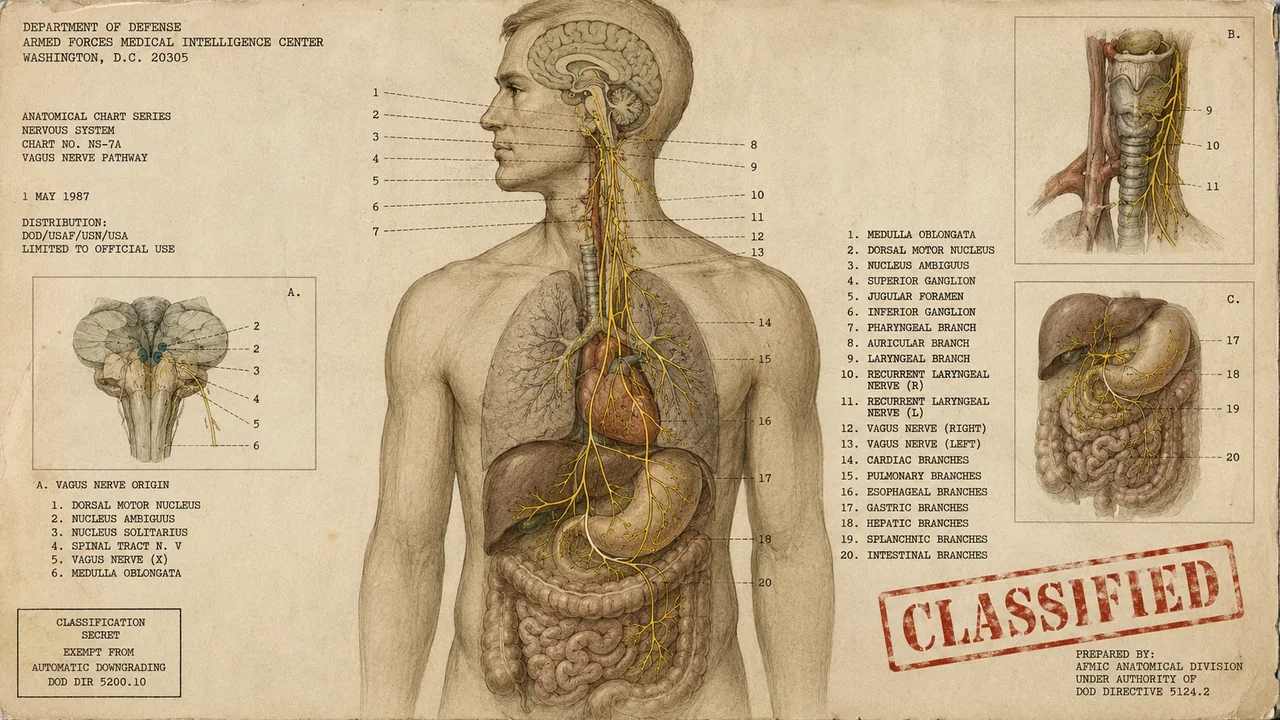
The vagus nerve is the longest cranial nerve in your body. It runs from your brainstem down through your throat, chest, and abdomen, connecting to your heart, lungs, and digestive tract. Think of it as a biological superhighway carrying signals between your brain and your major organs.
Here is what most people do not realize: approximately 80% of the traffic on this highway flows upward — from your body to your brain. This means that if you can change the signals your body sends, you can directly change what your brain perceives. You can literally tell your brain the threat is over.
The vagus nerve is not just a pathway — it is the override switch. When you activate it, you are not calming down. You are mechanically shutting off the alarm.
The Science: Respiratory Vagal Stimulation (rVNS)
The mechanism discovered by published studies is called respiratory vagal stimulation, or rVNS. It is purely mechanical. By making your exhale longer than your inhale — for example, breathing in for 4 seconds and out for 6 — you physically stimulate the vagus nerve. That long, slow exhale sends an undeniable "all clear" signal straight to your brain's command center.
This is not theory. Peer-reviewed research has confirmed it. A major 2021 review published in Nature Reviews Neuroscience documented how vagus nerve stimulation directly modulates the autonomic nervous system, reducing sympathetic overdrive and restoring parasympathetic balance.Breit S, et al. (2018). Vagus nerve as modulator of the brain-gut axis in psychiatric and inflammatory disorders. Frontiers in Psychiatry.
Why Your Anxiety Is Not "All in Your Head"
A central finding in the research on chronic anxiety is that it is not primarily a cognitive problem — it is a physiological one. Your body's threat detection system has become stuck in the "on" position. No amount of positive thinking can override a biological alarm that is being triggered from the bottom up.
This is why Polyvagal Theory, developed by Dr. Stephen Porges, is central to understanding this mechanism. Porges demonstrated that the autonomic nervous system operates in hierarchical layers — and that the vagus nerve is the mechanism that shifts between them. When your ventral vagal system is active, you feel safe and connected. When it shuts down, your sympathetic system takes over, and anxiety becomes your default state.
The 90-Second Rule: Why Anxiety Waves Peak and Fade
Here is a well-established finding: the biochemical wave triggered by a perceived threat lasts approximately 90 seconds. After that, the stress chemicals — cortisol, adrenaline — begin to wash out of your bloodstream. The 90-second rule explains why anxiety attacks peak and then subside on their own.
The problem is that your thoughts can re-trigger that wave. Every time you replay the worry, your brain thinks the threat is happening right now. You are literally keeping yourself stuck in a state of permanent threat. The solution is not to think differently — it is to use your body to signal safety.
How the breathing protocol Uses the Vagus Nerve
The breathing protocol is built entirely around vagal activation. It consists of 7 targeted breathing protocols, each designed for a specific anxiety symptom. Each mission uses guided breathing patterns that progressively lengthen the exhale, stimulating the vagus nerve and forcing the threat response to power down.
The protocol works in three phases: Awareness (noticing the physical signs), Regulation (using the breathing sessions to intervene), and Stabilization (making the calm state your new default through neuroplasticity).
What the Data Showed
The physiological pattern is clear in the research literature. On one side: high cortisol, erratic heart rate, sympathetic dominance. On the other: after just a few minutes of controlled breathing using the rVNS technique, a measurable and dramatic drop in both. The shift is real and it is immediate.
This is not about willpower. It is about biology. Your vagus nerve is already hardwired into your body. The breathing protocol simply teaches you the instructions to activate it.
For the full story behind this protocol, see Sleep Architecture & Restorative Dynamics. For a complete review of the product, see Sleep Architecture & Restorative Dynamics.
Practical Implementation: Getting Started with Vagal Breathing
Understanding the science is the foundation. Acting on it is what changes your physiology. Here is how to begin implementing vagal breathing today. First, establish your baseline. Before you start any protocol, sit quietly for two minutes and notice your natural breathing pattern. Count your breaths per minute. Notice whether your inhale or exhale is longer. Notice whether you breathe through your chest or your abdomen. This baseline tells you where your autonomic nervous system currently sits. Most people with chronic anxiety breathe 15-20 times per minute, predominantly through their chest, with an inhale that is longer than their exhale. This is the sympathetic pattern.
Second, begin with the simplest intervention: extend your exhale. Breathe in naturally, then make your exhale 2-3 seconds longer than your inhale. Do not force it. Do not strain. Just gently extend the out-breath. Do this for five minutes. Notice what happens to your heart rate. Notice what happens to the tension in your shoulders. Some people notice a change, while others do not. Third, practice consistently. The research on vagal tone improvement shows that the benefits compound over time. Some people report short-term changes, but longer-term effects vary and require further evidence. The breathing protocol provides seven guided breathing protocols that make this practice effortless — you just press play and follow the rhythm.