
1. Neurobiology: The Pre-Bötzinger Complex & Innate Sighing Circuit
For over a century, human behavioral science categorized sighing as a psychological symptom of despair, exhaustion, or emotional frustration. However, groundbreaking neurobiological investigations from the University of California, Los Angeles (UCLA) and Stanford University School of Medicine have revolutionized our understanding of respiratory physiology.
Mammalian breathing is governed by the pre-Bötzinger complex, a specialized bilateral cluster of rhythmogenic interneurons located within the ventrolateral medulla of the brainstem. Researchers discovered that within this master respiratory pacemaker resides an ultra-specialized subpopulation of fewer than 200 peptidergic neurons expressing neuromedin B (NMB) and gastrin-releasing peptide (GRP) receptors.
These specific molecular switches control the conversion of routine resting breaths into sighs. In healthy adults, this circuit fires automatically every 3 to 5 minutes—even during deep stages of non-REM slow-wave sleep. Without this continuous, involuntary neuro-respiratory reset, human gas exchange would fail and life could not be sustained.
2. Pulmonary Biomechanics: Overcoming Alveolar Micro-Atelectasis
To understand why the physiological sigh is incomparably effective in halting anxiety, one must examine the micro-architecture of the human lung. The respiratory tree terminates in approximately 480 to 500 million microscopic, spherical air sacs known as alveoli, representing an immense total gas-exchange surface area exceeding 100 square meters.
Under continuous psychological stress, hyper-arousal, or prolonged desk-bound sedentary posture, humans exhibit chronic shallow breathing with low tidal volume. This functional hypoventilation produces a widespread clinical phenomenon termed alveolar micro-atelectasis: tiny air sacs progressively lose internal pressure, buckle, and collapse under surface tension, behaving like damp cellophane sheets stuck together.
The Critical Role of the Second Inhalation
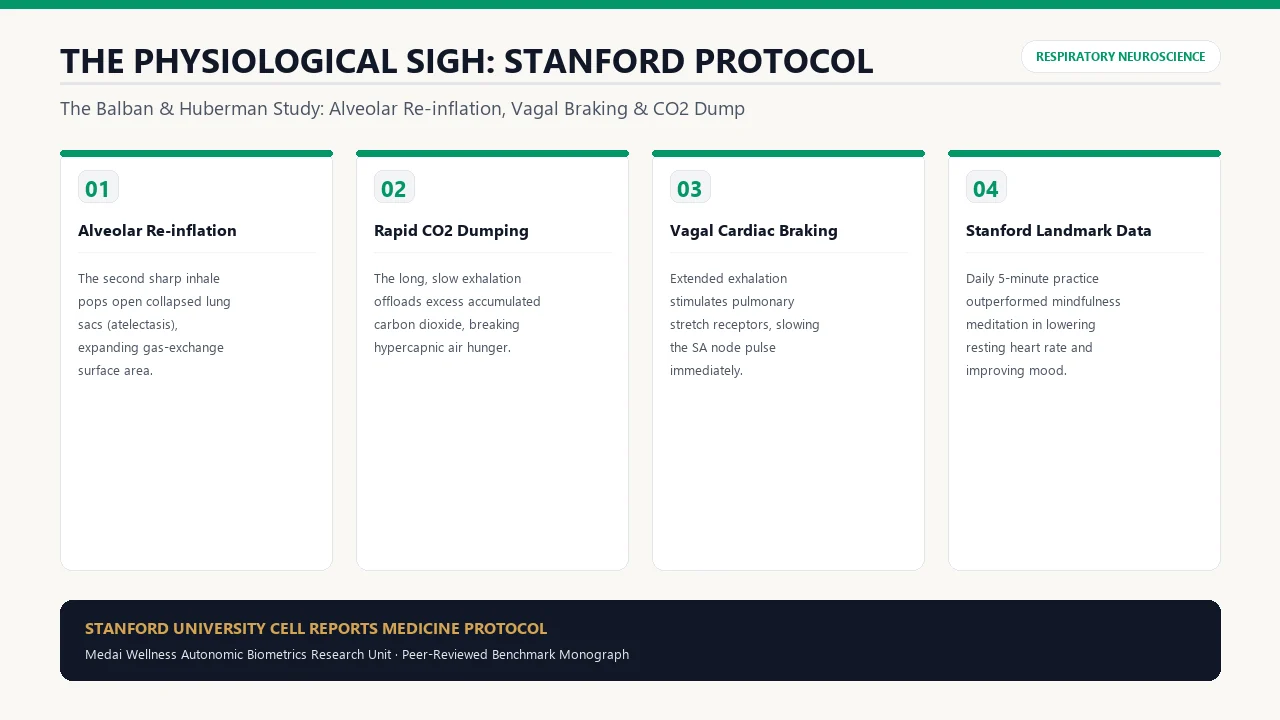
The first long inhale fills the pulmonary lobes to approximately 75% to 80% capacity. However, because surface tension in collapsed alveoli requires an exponential pressure differential (governed by the Laplace Law of surface tension: (P = 2T / r)), standard continuous breathing cannot reopen them. The sharp, rapid second "sip" of air forcefully stretches the bronchial tree, dispersing pulmonary dipalmitoylphosphatidylcholine (surfactant) across the inner alveolar walls and mechanically snapping millions of collapsed air sacs open in a fraction of a second.
3. Hemodynamic Vagal Braking: How Extended Exhalation Decelerates Heart Rate
The calming efficacy of the physiological sigh culminates during the elongated, passive exhalation phase. This mechanism is rooted in the physiological phenomenon of respiratory sinus arrhythmia (RSA):
- Thoracic Volume Modulation: During inhalation, the diaphragm contracts downward, expanding the thoracic cavity and causing heart chambers to slightly expand, momentarily slowing blood velocity.
- Cardiac Chamber Compression on Exhale: When releasing the sigh slowly through parted lips, the diaphragm relaxes and ascends toward the ribcage. This reduces intra-thoracic volume and exerts gentle physical compression on the vena cava and cardiac atria.
- Baroreceptor Firing & Acetylcholine Release: Arterial and cardiopulmonary baroreceptors detect this instantaneous elevation in venous return pressure and immediately transmit afferent signals via the glossopharyngeal and vagus nerves into the Nucleus Tractus Solitarius (NTS) in the brainstem.
- Immediate Heart Rate Drop: The NTS stimulates the Nucleus Ambiguus, which sends rapid efferent parasympathetic impulses down the cardiac vagal branches. Acetylcholine binds to muscarinic M2 receptors on the sinoatrial (SA) node, abruptly decelerating heart rate by 8 to 15 beats per minute within a single prolonged exhalation.
4. The 2023 Stanford Clinical Trial: Sighing vs. Mindfulness & Breathwork
In 2023, Dr. David Spiegel, Dr. Andrew Huberman, Dr. Melis Yilmaz Balban, and colleagues at Stanford University School of Medicine published a seminal randomized controlled trial in Cell Reports Medicine. The study investigated 114 healthy human subjects over 28 consecutive days, comparing four daily 5-minute interventions:
- Cyclic Sighing: Continuous repetition of double inhalations followed by long, extended exhalations.
- Box Breathing: Equal 4-part ratio (4s inhale, 4s hold, 4s exhale, 4s hold).
- Cyclic Hyperventilation with Retention: Rapid hyperventilation followed by breath holds (akin to Wim Hof / Tummo).
- Mindfulness Meditation: Passive passive observation of breathing without conscious autonomic modulation.
| Intervention Protocol | Daily State Anxiety Reduction | Positive Affect Elevation | Impact on Basal Heart Rate | Physiological Mechanism |
|---|---|---|---|---|
| Cyclic Sighing (5 min/day) | -34.2% (Statistically Superior) | +28.4% (Highest Score) | Consistent, sustained decrease in resting HR | Alveolar re-inflation + cardiac vagal brake activation |
| Box Breathing (Equal Ratio) | -22.1% (Moderate) | +16.3% (Moderate) | Mild reduction in acute heart rate | Sympathetic down-regulation through paced cadence |
| Cyclic Hyperventilation | -12.4% (Mild) | +19.1% (Moderate) | Transient adrenergic surge followed by crash | Hypocapnia, adrenaline spike, respiratory alkalosis |
| Mindfulness Meditation | -14.8% (Mild) | +11.2% (Lowest Elevation) | Minimal direct modulation of basal cardiovascular tone | Cognitive top-down attentional shifting without biomechanical reset |
The statistical conclusion was unambiguous: breathwork interventions that actively manipulate respiratory biomechanics and exhalation ratios—specifically cyclic physiological sighing—outperformed passive cognitive mindfulness meditation in producing physiological and psychological tranquility.
5. Step-by-Step Clinical Protocol for Immediate Panic Termination
To abort an acute episode of panic, autonomic hyperarousal, or cognitive racing before sleep or public speaking, apply this three-step clinical sequence:
First Nasal Inhalation (80% Volume)
Inhale deeply through your nostrils into your lower belly and ribcage for approximately 2 to 3 seconds. Fill your lungs to roughly 80% to 85% of total capacity.
Second Sharp "Top-Off" Inhale (100% Volume)
Without releasing any air, take a sharp, short, decisive second inhalation through the nose. This sudden pulse of positive pressure pops open collapsed alveoli and maximally stretches pulmonary mechanoreceptors.
Extended, Passive Mouth Exhalation (6 to 8 Seconds)
Part your lips and allow the entire volume of air to glide out in a slow, completely unforced stream. Aim for the exhalation to last twice as long as the combined inhalations. Feel the chest fall and cardiac rhythm decelerate.
Clinical Dosage: Performing just 2 to 3 consecutive physiological sighs is sufficient to break an adrenergic spiral. For systemic baseline nervous system tone rebuilding, practice 5 continuous minutes once or twice daily.
6. Comparative Analysis: Physiological Sigh vs. Box vs. 4-7-8 Breathing
Different somatic breathing tools serve distinct neuro-functional purposes. Below is the clinical guideline for selecting the appropriate modality:
| Modality | Breathing Architecture | Primary Clinical Target | Best Time of Application |
|---|---|---|---|
| Physiological Sigh | Double inhale (nose) + long passive exhale (mouth) | Rapid termination of acute autonomic panic & hyperarousal | During acute stress spikes, panic attacks, bedtime transition |
| Box Breathing | 4s Inhale • 4s Hold • 4s Exhale • 4s Hold | Cortical stabilization under high cognitive load; emotional composure | Before executive presentations, tactical athletic focus |
| 4-7-8 Technique | 4s Inhale • 7s Hold • 8s Slow Exhale | Parasympathetic induction via prolonged hypercapnic retention | Severe sleep-onset insomnia, chronic nocturnal rumination |
| Resonance Frequency | Continuous 5.5s Inhale • 5.5s Exhale (~6 breaths/min) | Maximizing Heart Rate Variability (HRV) and baroreflex gain | Daily 15-minute heart-rate variability conditioning |
7. Frequently Asked Clinical Questions (FAQ)
Can I perform the physiological sigh if my nasal passages are fully congested?
Yes. While nasal inhalation is ideal because it increases airway resistance, warms the air, and mobilizes endogenous nitric oxide produced in the paranasal sinuses, the mechanical benefit of alveolar re-expansion can still be accomplished through parted lips. Simply take two quick sips of air through your mouth before releasing the long, slow exhalation.
Why do I feel slightly lightheaded after doing cyclic sighing for several minutes?
Lightheadedness occurs when exhalations are actively forced rather than passively allowed to deflate. Forced exhalation offloads carbon dioxide too rapidly, producing mild temporary hypocapnia and cerebral vasoconstriction. Ensure your exhalations are soft, relaxed, and entirely passive.
How quickly does the vagus nerve respond during the exhalation?
Cardiac parasympathetic innervation is virtually instantaneous. Unlike sympathetic signaling which depends on circulating catecholamines (taking seconds to minutes), vagal acetylcholine release directly alters sinoatrial potassium channels within 150 to 250 milliseconds. You can observe deceleration on an ECG monitor within the first 3 seconds of exhalation.
Is the physiological sigh safe for patients with asthma or COPD?
Yes, but individuals with obstructive pulmonary conditions should avoid aggressive forced inhalations. Gentle double inhalations help combat dynamic hyperinflation and atelectasis, but individuals with severe pulmonary disease should consult their pulmonologist before undertaking prolonged cyclic protocols.
Why do infants and dogs frequently sigh while falling asleep?
All placental mammals exhibit rhythmic sighing during metabolic state transitions. As consciousness shifts from waking beta-wave activity to alpha and theta drowsiness, metabolic demand declines and the brainstem automatically fires physiological sighs to balance blood gases and stabilize pulmonary compliance for sleep.
8. Peer-Reviewed Medical Citations
- Balban MY, Neri E, Kogon MM, Weed L, Nouriani B, Jo B, Holl G, Zeitzer JM, Spiegel D, Huberman AD. Brief structured respiration practices enhance mood and reduce physiological arousal. Cell Reports Medicine. 2023;4(1):100895. PMID: 36630873.
- Li P, Janczewski WA, Yackle K, Kam K, Pagliardini S, Krasnow MA, Feldman JL. The peptidergic control circuit for sighing. Nature. 2016;530(7590):293-297. PMID: 26855425.
- Vlemincx E, Van Diest I, De Peuter S, Bresseleers J, Vasquez A, Van de Woestijne KP, Van den Bergh O. Why do we sigh? The effect of spontaneous and instructed sighs on respiratory variability, mental load and stress. Biological Psychology. 2009;82(1):83-91. PMID: 19481135.
- Feldman JL, Del Negro CA. Looking for inspiration: new perspectives on respiratory rhythm. Nature Reviews Neuroscience. 2006;7(3):232-242. PMID: 16495944.
- Eckberg DL. Physiological basis for human autonomic control through respiratory sinus arrhythmia. The Journal of Physiology. 2003;548(2):339-352. PMID: 12640008.