
1. The Terrifying Paradox of Pseudo-Dyspnea
Few somatic sensations evoke primal panic as swiftly as the feeling that you cannot take a satisfying, deep breath. You gasp, yawn, and expand your rib cage until your intercostal muscles ache, yet at the apex of the inhale, the breath fails to 'catch.' Pulse oximeters in the emergency room read 99% or 100%, yet your brainstem sounds an urgent, terrifying suffocation alarm.
In clinical medicine, this condition is known as pseudo-dyspnea or psychogenic air hunger. Crucially, it is not an indicator of pulmonary disease, asthma, or cardiac ischemia. Rather, it is a physiological paradox: the sensation of suffocation is caused not by a lack of oxygen, but by an over-abundance of ventilation that has depleted the body's carbon dioxide stores.
2. The Neurochemical Mechanism: Hypocapnia and the Bohr Effect
The human respiratory drive is controlled by central chemoreceptors located in the ventral surface of the medulla oblongata. These chemoreceptors are exquisitely sensitive to the concentration of hydrogen ions and carbon dioxide in the cerebrospinal fluid. When you breathe normally (8 to 12 breaths per minute using the diaphragm), arterial partial pressure of carbon dioxide ((PaCO_2)) is maintained within the ideal physiological window of 35 to 45 mmHg.
Under sympathetic hyperarousal, subconscious breathing shifts to rapid, shallow chest movements punctuated by frequent deep sighs. This pattern expels carbon dioxide far faster than cellular metabolism can generate it:
- Circadian Endocrine Diagnostics: Explore our research on cortisol levels chart by time of day.
- Foundational Neurobiology: Review our clinical analysis on the physiological sigh and autonomic anxiety reset.
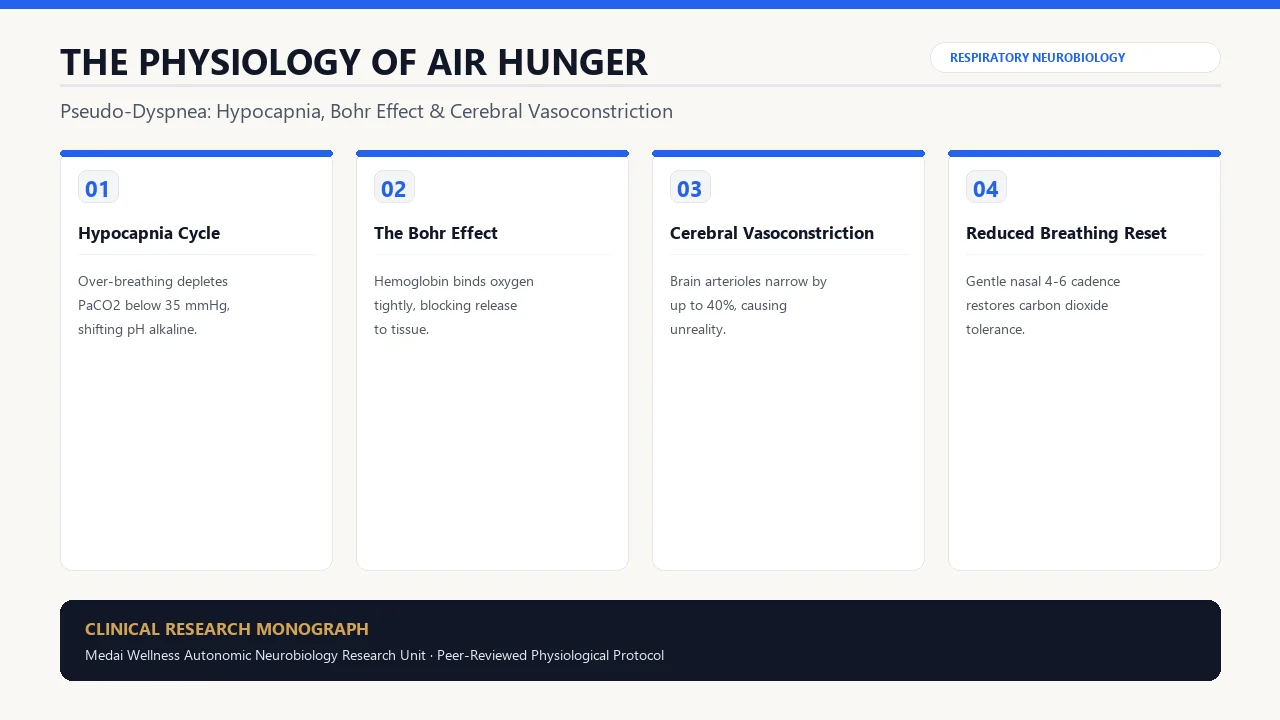
- Respiratory Alkalosis: As (PaCO_2) drops below 32 mmHg (hypocapnia), the pH of arterial blood shifts into an alkaline state (pH > 7.45).
- The Bohr Effect: Discovered in 1904, the Bohr Effect demonstrates that hemoglobin requires adequate carbonic acid (CO2) to release oxygen molecules into living tissue. Under alkaline conditions, hemoglobin holds oxygen with extreme tightness. Despite normal blood oxygen saturation, your brain cells and muscles experience cellular hypoxia.
- Cerebral Vasoconstriction: Carbon dioxide is the body's most potent natural cerebral vasodilator. Severe hypocapnia constricts cerebral micro-arterioles by up to 40%, triggering dizziness, lightheadedness, tunnel vision, and derealization (Raichle & Plum, 1972).
| Biochemical Parameter | Eupneic Baseline (Healthy) | Air Hunger / Chronic Hyperventilation |
|---|---|---|
| Arterial (PaCO_2) | 38 – 42 mmHg | < 30 mmHg (Severe Hypocapnia) |
| Blood pH | 7.35 – 7.45 (Neutral physiological) | > 7.48 (Respiratory Alkalosis) |
| Oxygen Delivery to Brain | 100% unrestricted offloading | Reduced by 25% to 35% via Bohr Effect |
| Diaphragmatic Mechanics | Smooth 3D piston excursion | Hypertonic inspiratory locking / spasm |
3. Diaphragmatic Inspiratory Locking: The Muscular Barrier
The physical sensation that your chest "cannot expand any further" is an anatomical reality. Under chronic anxiety, the phrenic nerve fires continuous motor impulses to the diaphragm, holding it in a flattened, semi-contracted inspiratory posture. When you attempt to pull in another giant breath of air, the muscle has already reached its structural limit.
Accessory respiratory muscles in your neck and upper chest (sternocleidomastoid, scalenes, and pectoralis minor) strain to lift the rib cage upward, causing coat-hanger neck pain and costochondritis. The solution is not to inhale more deeply—it is to perform complete, extended exhalations that allow the diaphragm to dome upward into its natural resting shape.
4. The Clinical 3-Step Air Hunger Reset Protocol
To eliminate air hunger permanently, you must retrain your medullary chemoreceptors to tolerate normal carbon dioxide levels:
- Strict Nasal Breathing: The nose filters, warms, and humidifies air while introducing nitric oxide ((NO)), a potent bronchodilator. More importantly, nasal passage resistance slows expiratory flow, preventing rapid CO2 washout.
- Small Breath In, Small Breath Out, 5-Second Hold (The Buteyko Pause): Take a light, silent breath in through your nose (2 seconds), exhale smoothly (3 seconds), and gently hold your breath for 5 seconds. Repeat 6 times. You will feel a mild, pleasant hunger for air. That sensation is the physical marker of carbonic acid building up and restoring cellular oxygen delivery.
- The Double-Inhale Physiological Sigh: Take a deep breath in through your nose, pause for half a second, top it off with a sharp second sniff of air to reinflate collapsed alveoli, and release a long, unforced sigh through open lips for 7 to 8 seconds. Perform two consecutive cycles to reset autonomic tone.