
Respiratory Safety: Hypoventilation or extended breath retention protocols should never be practiced while driving, operating machinery, or in water due to blackout and hypercapnic hypoxia risks.
For more, see the anatomy of diaphragmatic breathing and vagal tone.
Nervous System Reset Breathing: The Biological Override Switch
There is a moment — you know the one — where your body decides it is under threat. Chest tightens. Heart races. Thoughts fragment. And no matter how much you tell yourself you are fine, your nervous system does not listen. This pattern has been observed for decades in high-stress environments. The ones who recovered were not the ones with the most willpower. They were the ones who learned to use their body to lead their mind.
This is the core principle behind vagus nerve anxiety relief and the entire breathing protocol: you cannot think your way out of a physiological alarm. You have to mechanically shut it off.
How the Nervous System Gets Stuck
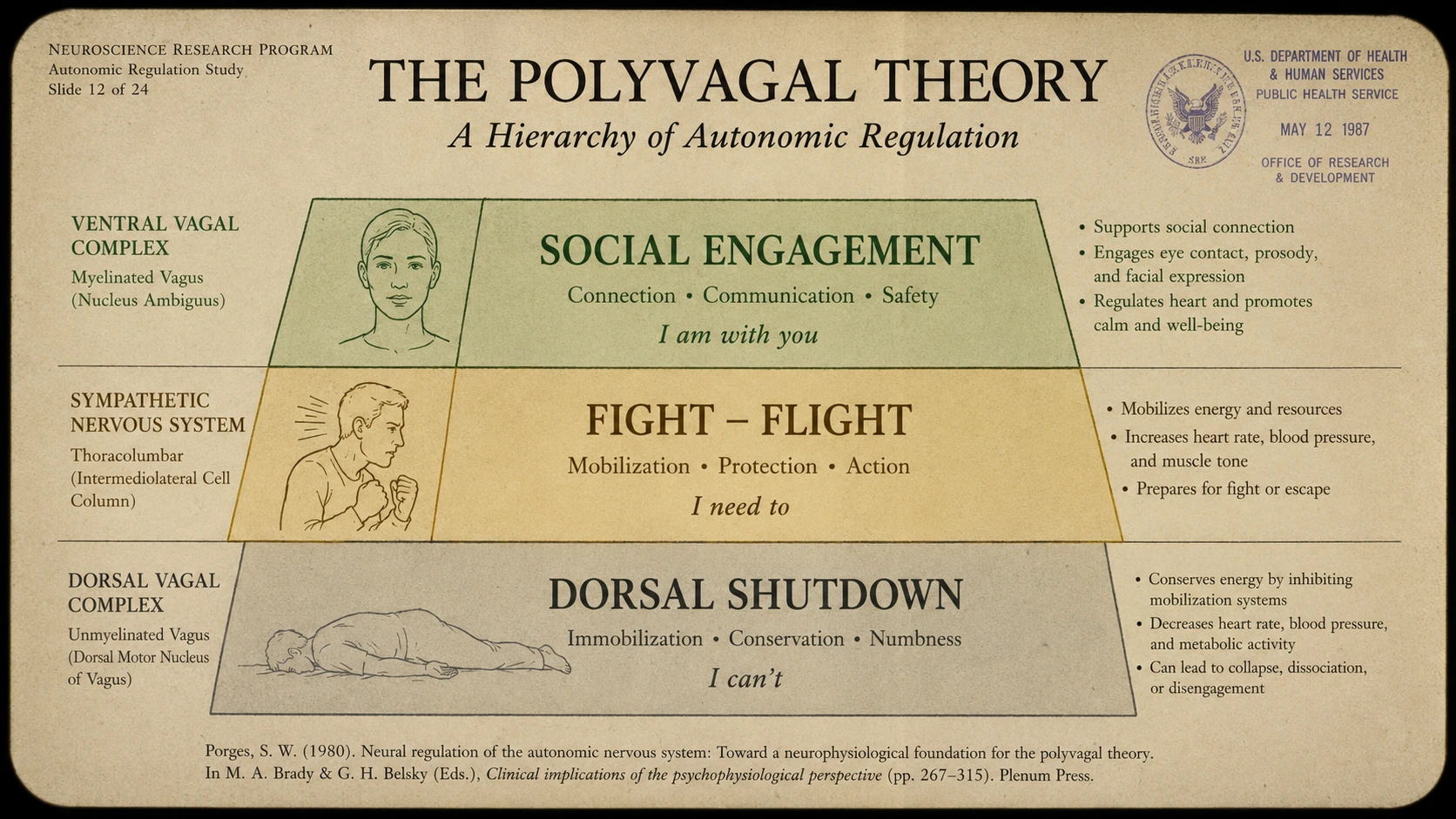
Your autonomic nervous system has two main branches. The sympathetic nervous system is your accelerator — fight or flight, cortisol, adrenaline, hypervigilance. The parasympathetic nervous system is your brake — rest, digest, recover, calm. In a healthy system, these alternate naturally. You encounter a threat, your sympathetic system activates, the threat passes, your parasympathetic system brings you back to baseline.
But chronic stress breaks this rhythm. You get locked into sympathetic overdrive — a state where the accelerator is permanently pressed to the floor. Your body forgets how to brake. And all the cognitive strategies in the world — positive thinking, reframing, journaling — cannot release a pedal that is being held down by biology.
The Exhale Override: Why Breathing Works When Thinking Fails
Here is what the research confirms: your inhale is linked to sympathetic activation (the accelerator), and your exhale is linked to parasympathetic activation (the brake). This is not metaphor — it is biomechanics. Every time you breathe in, your heart rate slightly increases. Every time you breathe out, it slightly decreases.
By deliberately making your exhale longer than your inhale, you are forcing the parasympathetic system to engage. You are physically applying the brake. The technical term is respiratory vagal stimulation (rVNS), and a systematic review published in Frontiers in Human Neuroscience in 2018 confirmed that slow breathing techniques produce measurable changes in autonomic nervous system activity, reducing sympathetic markers and increasing parasympathetic tone.Zaccaro A, et al. (2018). How breath-control can change your life. Frontiers in Human Neuroscience.
Heart Rate Variability: The Metric the protocol Team Tracked
There is a number that tells you more about your nervous system than any questionnaire ever will: heart rate variability, or HRV. HRV measures the beat-to-beat variation in your heart rate. High HRV means your parasympathetic system is dominant — your body is flexible, adaptive, and calm. Low HRV means your sympathetic system is running the show — your body is rigid, reactive, and stressed. It is the single most reliable biomarker of autonomic nervous system function.
published studies tracked HRV extensively. The files showed a consistent pattern: people with chronic anxiety tend to have chronically low HRV, indicating sustained sympathetic dominance. After controlled breathing sessions using the rVNS technique, HRV increased measurably within minutes. A 2020 meta-analysis published in Frontiers in Psychology confirmed that slow breathing techniques at rates of 4-6 breaths per minute significantly increase HRV, with the strongest effects observed at approximately 5.5 breaths per minute — the resonant frequency where cardiovascular, respiratory, and autonomic systems synchronize.Shaffer F, et al. (2020). Effect of slow breathing on heart rate variability: A meta-analysis. Frontiers in Psychology, 11, 1847.
This is not subtle. When you extend your exhale to 6-8 seconds, your heart rate variability increases in real time. You can observe it on a monitor. The parasympathetic system is physically engaging. The brake is being applied. The numbers do not lie.
The Specific Breathing Pattern
The breathing protocol uses a progressive breathing pattern across its 7 missions. The foundational pattern is simple:
- Inhale through the nose for 4 seconds
- Exhale through the mouth for 6 seconds
- Repeat for 5 minutes minimum
The 4:6 ratio creates what researchers call respiratory sinus arrhythmia — a natural variation in heart rate that correlates with high vagal tone. Over time, the protocol extends the exhale to 8 and then 10 seconds, deepening the vagal response.
Why This Is Different From "Just Breathe"
Telling someone with chronic anxiety to "just breathe" is like telling someone on fire to "just cool down." The instruction is correct but useless without specificity. What makes the breathing approach different is precision: each of the 7 missions targets a specific symptom with a specific breathing pattern calibrated for that physiological state.
the chest relief sequence, for example, is designed for acute chest tightness — a 5-minute session with a rapid exhale extension pattern. the morning cortisol pacing sequence targets morning cortisol spikes with a longer, slower pattern designed to be used within the first 10 minutes of waking.
The Three Phases of a Nervous System Reset
The protocol moves through three distinct phases. Phase 1: Awareness — learning to notice the physical signs that your sympathetic system is dominant. Phase 2: Regulation — actively using the breathing sessions to intervene and shift your state. Phase 3: Stabilization — through consistent practice and neuroplasticity, the calm state becomes your new default.
This is not an instant fix. It is training for your nervous system. But modern research confirms that the mechanism is real, and the results are lasting when practiced consistently.
For the complete protocol, see Sleep Architecture & Restorative Dynamics. For the historical context, see Sleep Architecture & Restorative Dynamics.