
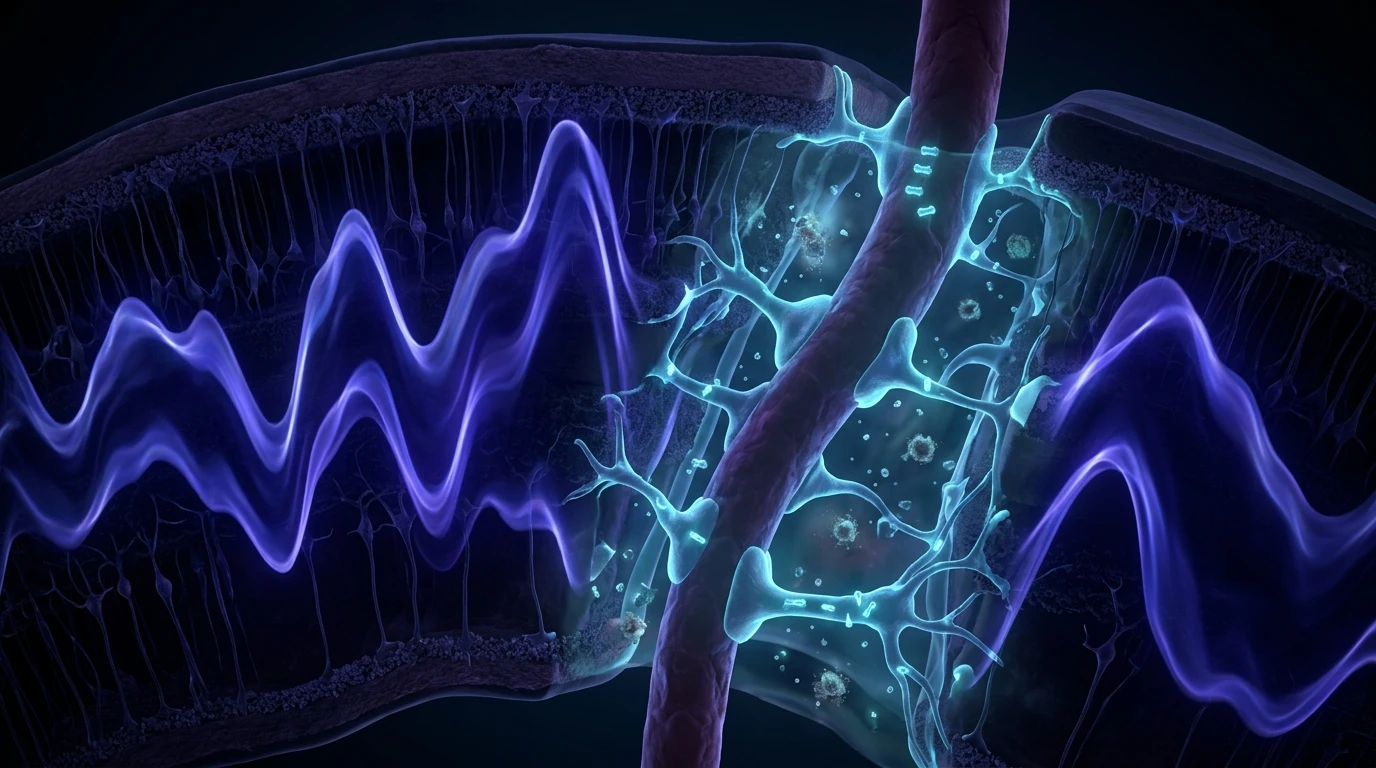
1. The Neurobiology of Delta Waves: Thalamocortical Synchronization
Slow-wave sleep is electroencephalographically characterized by high-amplitude (>75 μV), low-frequency (0.5–4.0 Hz) delta waves generated by reciprocal thalamocortical loops. During wakefulness, ascending monoaminergic systems maintain desynchronized high-frequency firing.
The transition into deep sleep is initiated by the Ventrolateral Preoptic Nucleus (VLPO) of the anterior hypothalamus. VLPO neurons fire GABA and Galanin, silencing monoaminergic arousal centers. Cortical pyramidal neurons enter synchronized "slow oscillations" alternating between hyperpolarized down-states (neuronal silence) and depolarized up-states. Descending inputs to the sympathetic rostral ventrolateral medulla are suppressed, while the Nucleus Ambiguus and Dorsal Motor Nucleus of the Vagus unleash maximal cardiac vagal outflow. Heart rate reaches its 24-hour nadir, blood pressure dips by 10–20%, and peripheral vessels dilate.
2. The Glymphatic Engine: Parasympathetic Brain Detoxification
Pioneering discoveries by Dr. Maiken Nedergaard revealed that the brain possesses a dedicated macroscopic fluid exchange system: the Glymphatic System. During waking hours, continuous noradrenergic tone from the locus coeruleus restricts brain interstitial volume. During slow-wave sleep under deep parasympathetic control:
- Vagal Tone Measurement: Explore our research on HRV normative benchmarks by age and gender.
- Foundational Neurobiology: Review our clinical analysis on the physiological sigh and autonomic anxiety reset.
- Noradrenaline Withdrawal: Locus coeruleus firing ceases, causing cortical cells to shrink and expanding the interstitial space by 60%.
- Aquaporin-4 Facilitated Bulk Flow: Astrocytic end-feet surrounding cerebral capillaries express dense Aquaporin-4 (AQP4) water channels. Cerebrospinal Fluid (CSF) rushes from subarachnoid spaces along peri-arterial channels directly into brain parenchyma.
- Metabolite Clearance: This bulk fluid wave flushes neurotoxic waste—including Amyloid-beta, phosphorylated Tau, and alpha-synuclein—out through peri-venous pathways into deep cervical lymphatics.
3. Endocrine Synergy: The Nocturnal Growth Hormone Pulse
Slow-wave sleep coordinates peripheral anabolic endocrinology: over 70% of total daily Human Growth Hormone (HGH) secretion occurs during early slow-wave sleep cycles.
Vagal activation inhibits hypothalamic Somatostatin while triggering an explosive pulse of Growth Hormone-Releasing Hormone (GHRH) from the arcuate nucleus. The pituitary responds with a large secretory burst of HGH, directing amino acids into skeletal muscle and connective tissues for cellular repair, accelerating protein synthesis, and suppressing cortisol-mediated muscle catabolism. Deep sleep deprivation directly blunts this growth hormone pulse while elevating evening cortisol.
4. Autonomic Architecture Across Sleep Stages
| Sleep Stage | Autonomic Branch | Key Neurotransmitters | Cardiovascular Dynamics | Core Regenerative Role |
|---|---|---|---|---|
| Wakefulness | Sympathetic dominant | Norepinephrine, Dopamine, Orexin, Histamine | Dynamic baseline fluctuations | Cognition, motor activity, sensory integration |
| Stage 1 NREM (Light) | Sympathetic withdrawal | GABA rising; declining monoamines | Mild heart rate deceleration | Transition state; sleep initiation |
| Stage 2 NREM (Spindles) | Parasympathetic shift deepening | GABA, low acetylcholine | Stable moderate blood pressure reduction | Motor memory consolidation, sleep protection |
| Stage 3 SWS (Deep) | MAXIMUM PARASYMPATHETIC | High GABA; near-zero monoamines | 24-hour nadir; 10-20% BP physiological dip | Glymphatic clearance, HGH pulse, immune reset |
| REM Sleep (Dreaming) | Sympathetic bursts + Autonomic storm | High Acetylcholine; zero NE / 5-HT | Erratic surges in HR and BP; muscle atonia | Emotional processing, memory reconsolidation |
5. Clinical Pathologies That Destroy Slow-Wave Sleep
Up to 40% of adults achieve less than 45 minutes of slow-wave sleep per night (requirement: 75–120 minutes). Core drivers include:
- Nocturnal Cortisol Spikes: Chronic HPA activation causes cortisol to bind hippocampal receptors overnight, triggering micro-arousals that eject the brain from Stage 3 delta sleep into light Stage 2 sleep.
- Sleep-Disordered Breathing & Apnea: Recurrent airway collapse triggers hypoxic desaturations, prompting bursts of adrenaline that keep the autonomic system trapped in sympathetic fight-or-flight all night.
- Late-Evening Alcohol & Heavy Meals: While alcohol accelerates sleep onset, acetaldehyde metabolism drives intense sympathetic rebound in the second half of the night, while digestive demands raise resting heart rate by 8–15 bpm.
- Blue Light Exposure: Artificial 460–480 nm blue light suppresses pineal melatonin secretion, impairing anterior hypothalamic GABAergic firing required for Stage 3 delta depth.
6. Evidence-Based Protocols to Expand Slow-Wave Sleep
To restore parasympathetic mastery and expand deep sleep duration, clinicians implement targeted physiological protocols:
- The Vasodilatory Thermal Protocol: Deep sleep requires core body temperature to drop by ~1.0°C. Taking a hot bath (40–42°C / 104–108°F) or sauna 90 minutes before bed causes peripheral vasodilation (hands, feet, face), dumping core heat. Entering a cool room (18°C / 65°F) crashes core temperature, triggering preoptic delta sleep centers.
- Targeted Neuro-Nutrients: Magnesium L-Threonate or Bisglycinate (300–400 mg) enhances GABAergic transmission. L-Theanine (200–400 mg) blunts excitatory glutamate. Phosphatidylserine (300 mg) suppresses nocturnal cortisol surges. Glycine (3 grams) acts as an inhibitory brainstem neurotransmitter and promotes peripheral vasodilation.
- Pre-Sleep Auricular Vagal Stimulation: 20 minutes of transcutaneous vagus nerve stimulation (tVNS) at 20 Hz prior to sleep activates the nucleus tractus solitarius, elevating parasympathetic outflow and preparing cortical networks for immediate delta synchronization.
Frequently Asked Questions (Clinical FAQ)
How much Slow-Wave Sleep (Deep Sleep) does an adult need per night?
A healthy adult requires 15% to 25% of total sleep time in slow-wave sleep, which corresponds to 70 to 120 minutes per night. Consistently getting under 45 minutes reflects significant autonomic disruption.
When during the night does most slow-wave sleep take place?
The vast majority of slow-wave sleep occurs during the first two 90-minute sleep cycles (the first third of the night). Later sleep cycles shift predominantly toward Stage 2 and REM sleep.
Do prescription sleep aids like Ambien increase slow-wave sleep?
No. Sedative-hypnotics like benzodiazepines and Z-drugs induce sedation, but EEG analysis demonstrates they actually suppress slow-wave delta power and REM sleep, increasing light Stage 2 sleep while inhibiting glymphatic clearance.
How does daytime exercise influence deep sleep?
Vigorous physical activity performed earlier in the day significantly increases slow-wave sleep duration by elevating adenosine accumulation (homeostatic sleep pressure) and stimulating cellular repair demands.
Why do I wake up exhausted after 8 hours in bed?
Total sleep duration does not equal restorative sleep. If sleep architecture was fragmented by micro-arousals (from stress, alcohol, light, or mild sleep apnea), you may have spent 7 of those 8 hours in shallow Stage 1 and Stage 2 sleep with near-zero slow-wave restorative depth.
Does the glymphatic clearance system work during naps?
Only if the nap reaches Stage 3 slow-wave sleep. Short 20-minute power naps remain in Stage 1 and 2 sleep; while beneficial for alertness, they do not trigger the 60% interstitial expansion and Aquaporin-4 fluid flow needed for deep brain cleansing.
Scientific References & Clinical Citations
- Sleep drives metabolite clearance from the adult brain — Science (2013). [PubMed / Study Link]
- About sleep's role in memory — Physiological Reviews (2013). [PubMed / Study Link]
- Autonomic activity during human sleep as a function of time and sleep stage — Journal of Sleep Research (2001). [PubMed / Study Link]
- Physiology of growth hormone secretion during sleep — Journal of Pediatrics (1996). [PubMed / Study Link]