
Neuropsychiatric Boundary: Neuroanatomical top-down regulation techniques are evidence-based mental exercises. They work synergistically with, but do not eliminate the necessity for, clinical care in severe OCD or major anxiety disorders.
Amygdala Hijack: Why You Cannot Think Straight During Anxiety
There is a moment during an anxiety attack where everything you know to be true becomes irrelevant. You know you are safe. You know there is no real threat. You know this has happened before and you survived. And none of it matters. Your logical mind is screaming "calm down" and your body is not listening. This is not a failure of willpower. It is a neurological event called an amygdala hijack — and understanding it is the key to overcoming it.
The Amygdala: Your Brain's Alarm System
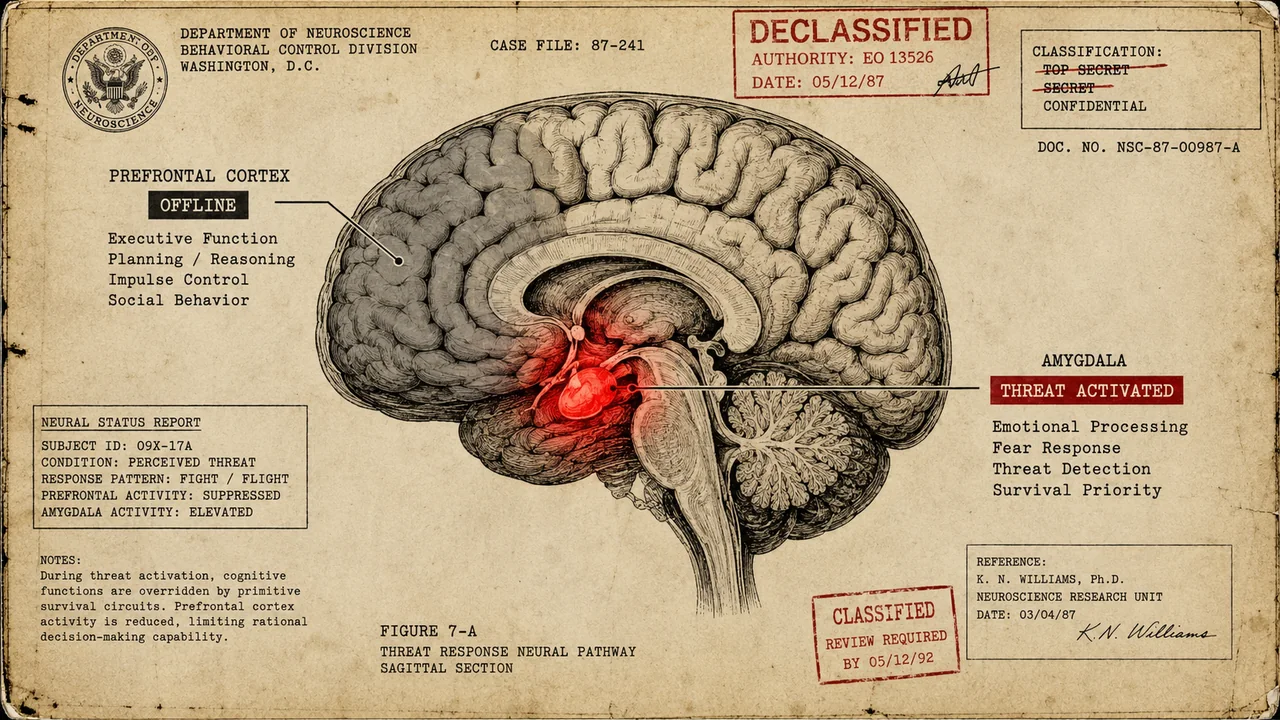
The amygdala is a small, almond-shaped structure deep in your brain that serves as your threat detection system. It processes sensory information faster than any other part of your brain — before your conscious awareness even registers the stimulus. When it detects a threat, it triggers the sympathetic stress response immediately. No thinking. No analysis. Just action.
Research by Joseph LeDoux, the leading authority on the fear circuit, has documented that the amygdala activates the stress response through a subcortical pathway that bypasses the cortex entirely.LeDoux JE. (2003). The emotional brain, fear, and the amygdala. Cellular and Molecular Neurobiology.
The Two Amygdalae: Left and Right, Fear and Anxiety
What most people do not realize is that you have two amygdalae — one in each hemisphere — and they serve distinct functions. The left amygdala is more associated with fear responses to specific, identifiable threats. The right amygdala is more associated with the generalized, diffuse anxiety that has no clear source — the chronic unease, the background dread.
For people with chronic anxiety, the right amygdala is typically hyperactive. This distinction matters because it explains why some anxiety has a clear trigger and some does not — and why the "just identify your trigger" advice fails for so many people.
Why the Prefrontal Cortex Goes Offline
Your prefrontal cortex — the part of your brain responsible for logic, reasoning, and emotional regulation — is slower than the amygdala. When the amygdala fires, it can temporarily suppress prefrontal cortex activity, a phenomenon neuroscientists call "cortical inhibition." Your thinking brain literally goes offline.
This is why telling someone in the middle of an anxiety attack to "think about it logically" is like telling someone whose house is on fire to sit down and do a cost-benefit analysis.
The Blood Flow Shift: Where Your Brain's Resources Go
During an amygdala hijack, cerebral blood flow is redirected away from the prefrontal cortex and toward the amygdala and brainstem. Neuroimaging studies have shown that during acute anxiety, prefrontal cortex activity measurably decreases while amygdala activity spikes. The practical consequence is that during an anxiety attack, you have approximately the same reasoning capacity as someone who is moderately intoxicated.
The Bypass: Why Breathing Works When Thinking Fails
Here is the insight that made the breathing protocol possible: the vagal breathing pathway does not go through the cortex. It goes through the brainstem — specifically, the nucleus tractus solitarius (NTS), which receives signals from the vagus nerve and directly modulates the amygdala's output. You are not trying to reason with the alarm. You are physically cutting the power to it.
The 90-second rule applies here: the initial surge lasts approximately 90 seconds. If you can prevent the thought cascade from re-triggering the amygdala during that window, the hijack resolves.
The Vagal-Amygdala Pathway: A Route the Alarm Cannot Block
When the vagus nerve is stimulated through extended exhale breathing, signals travel via the NTS to the locus coeruleus, the brain's norepinephrine center. This activation reduces the norepinephrine flood fueling the amygdala's alarm signal. The panic does not just diminish — it runs out of fuel. This is fundamentally different from cognitive strategies, which travel the cortex-to-amygdala route — the very route the hijack has blocked.
Amygdala Habituation: The Long-Term Solution
Over time, consistent use of the vagal activation reduces the amygdala's sensitivity. Through neuroplasticity, the brain learns that the triggers which previously produced a full alarm response no longer require one. The alarm system does not disappear — it recalibrates. And the recalibration was driven by the body, not by insight.
The Clinical Reset Protocol: What to Do During an Amygdala Hijack
The breathing protocol for an active amygdala hijack is straightforward because it has to be — you do not have the cognitive capacity for complex procedures during an acute episode. The protocol has three steps. Step one: recognize the hijack. The physical signs are unmistakable — heart pounding, chest tight, thoughts racing, inability to think clearly. The recognition itself partially re-engages the prefrontal cortex. Step two: begin controlled exhale breathing immediately. The specific pattern depends on the mission — the emergency reset protocol for acute panic, the chest relief sequence for chest tightness, the cardiac vagal pacing pattern for racing heart. Rhythmic pacing regulates the breath without cognitive effort. Step three: maintain the breathing for the full mission duration. Do not stop early, even if you feel better. The residual cortisol in your bloodstream will re-trigger the amygdala if you disengage the vagal brake too soon.
What you should not do during a hijack: do not try to analyze why you are anxious. Do not try to reason yourself out of the feeling. Do not check your pulse repeatedly. Do not Google your symptoms. Every one of these actions is a sympathetic activation that feeds the hijack. The only action that helps is the one that directly targets the brainstem through the vagus nerve — and that action is breathing with an extended exhale.
For more on sympathetic overdrive, see our related file. For the complete protocol, see Sleep Architecture & Restorative Dynamics.