
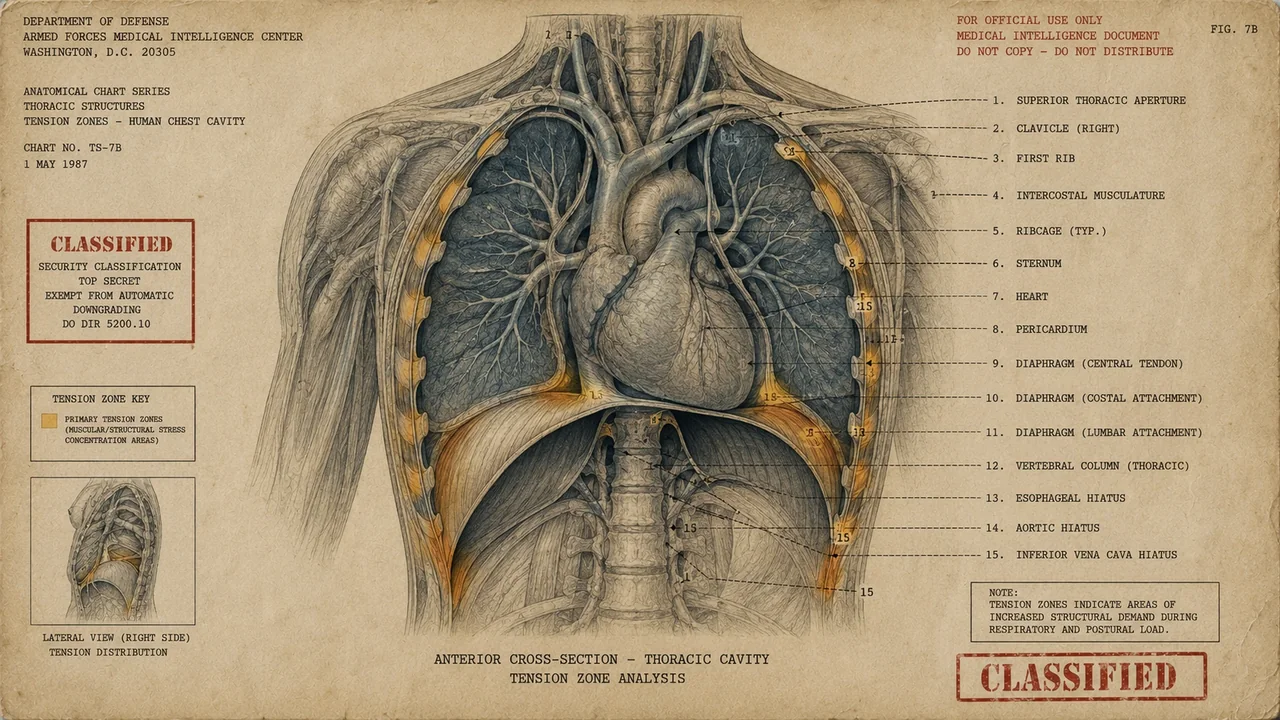
Cardiovascular Differential: Anxiety-induced chest tightness is a diagnosis of exclusion. Any new or worsening chest constriction, especially brought on by physical exertion, requires baseline ECG and cardiac enzyme testing.
What Is Anxiety Chest Tightness?
Anxiety chest tightness is the physical sensation of pressure, heaviness, or constriction in the chest that occurs during a stress response. It is caused by sympathetic activation tightening the intercostal and diaphragm muscles, not by a heart condition, and it resolves when the vagus nerve returns the nervous system to a parasympathetic state.
Chest Tightness Anxiety: The Symptom That Sends People to the ER
Of all the physical symptoms of anxiety, this one causes the most collateral damage. Not because it was the most dangerous — but because it felt the most dangerous. Chest tightness from anxiety is so physically convincing that thousands of people end up in emergency rooms each year, convinced they are having a heart attack. Anxiety can resemble serious conditions, so new, severe, persistent, or unusual chest symptoms require medical evaluation.
The fear is understandable. Even people trained to function under extreme pressure freeze when this symptom hits. Because no matter how much you know, when your chest tightens and your breathing shallows, the body insists something is wrong with your heart. Understanding the vagus nerve is what finally explained why.
Why Anxiety Causes Chest Tightness
The mechanism is straightforward: when your sympathetic nervous system activates, it prepares your body for physical action. Your intercostal muscles — the muscles between your ribs — tighten to expand your chest for rapid breathing. Your diaphragm contracts more forcefully. Your bronchioles dilate. The result is a feeling of constriction, heaviness, or pressure in the chest that is entirely muscular and respiratory in origin.
In many anxiety-related episodes, this may be less about the heart itself and more about breathing patterns — or more precisely, a breathing pattern problem. Your body has shifted into emergency breathing mode without an actual emergency. Research on interoception — your brain's ability to read internal body signals — has shown that anxious individuals have heightened sensitivity to cardiac and respiratory signals, amplifying the perception of chest discomfort.Farb NA, et al. (2016). Interoception, contemplative practice, and health. Frontiers in Psychology.
The Intercostal Trap: Why the Tightness Feeds Itself
There is a feedback loop in chest tightness that makes it self-reinforcing. When the intercostal muscles tighten, your breathing becomes shallower. Shallow breathing reduces your oxygen-carbon dioxide exchange efficiency, which your brain interprets as a sign of respiratory distress. This interpretation triggers more sympathetic activation, which tightens the muscles further. The cycle accelerates until you are in a full chest constriction pattern — breathing in short, rapid gasps, unable to take a deep breath, and increasingly convinced that something is wrong with your heart.
published studies called this the "respiratory panic loop" — and it was the primary target of the chest relief sequence. The key to breaking it is understanding that the loop is driven by the breathing pattern, not by a cardiac event. The key safety point is that chest pain should be medically evaluated when it is new, severe, persistent, or unusual; after serious causes are ruled out, breathing patterns can become a useful target.
the chest relief sequence: The 5-Minute Chest Release
the chest relief sequence is the shortest mission in the protocol — 5 minutes, designed for acute chest tightness. The breathing pattern starts with a 4:4 ratio (equal inhale and exhale) to stabilize the chaotic breathing, then transitions to 4:6 and then 4:8 to progressively engage the vagal brake. The extended exhale signals the intercostal muscles to release — not because you are telling them to, but because the parasympathetic nervous system is withdrawing the contract command.
Some people report the first sense of easing within a few minutes — the first deep breath that breaks the shallow pattern. This is the 90-second rule in action: the initial cortisol wave is metabolizing, and the vagal brake prevents the re-trigger that would restart the constriction cycle.
Why Chest Symptoms Need Careful Evaluation
The distinction between anxiety-related chest tightness and cardiac chest pain is well-documented in emergency medicine literature. Cardiac chest pain — angina or myocardial infarction — is typically described as a crushing or squeezing sensation that radiates to the left arm, jaw, or back. It is often provoked by exertion and relieved by rest. Anxiety-related chest tightness is typically described as a pressure or constriction that may be sharp, localized, and variable in intensity. It often worsens with rest and improves with movement or distraction.
The most reliable distinguishing feature is what happens when you change your breathing. If tightness eases with controlled exhale breathing, that can suggest a muscular or anxiety-related component, but it does not diagnose the cause. Persistent, severe, worsening, new, or unexplained chest pain warrants medical evaluation.
The Vagal-Intercostal Pathway: How the Breath Releases the Chest
published studies mapped the specific neural pathway by which vagal breathing releases chest tightness. When the vagus nerve is stimulated through extended exhale breathing, it sends a parasympathetic signal to the sinoatrial node of the heart (slowing the rate), the bronchioles (reducing dilation), and the intercostal muscles (withdrawing the contract command). The signal travels through the phrenic nerve and the intercostal nerves simultaneously — which is why the chest release feels like a whole-chest event, not a localized one.
This is the mechanism that somatic anxiety release depends on: the nervous system changing the signal, and the body following. You do not voluntarily relax your chest muscles. You change the autonomic command, and the muscles release on their own.
For the complete protocol, see Sleep Architecture & Restorative Dynamics.