
What Is a Tension Headache?
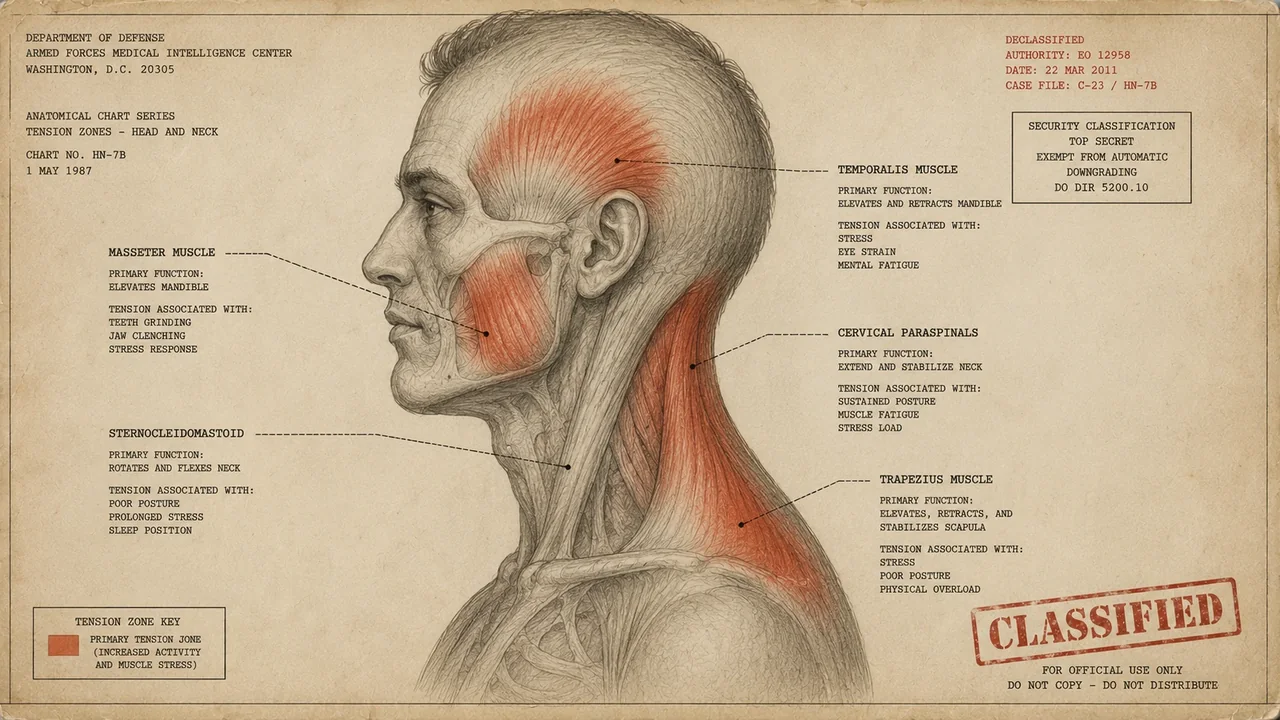
A tension headache is the most common primary headache type, felt as a band of pressure or tightness around the head and neck. It is closely linked to the nervous system, arising from sustained muscle tension and autonomic arousal, and it responds to vagal and relaxation techniques.
Tension Headache and the Nervous System: The Stored Threat Response
You know the feeling — a band of pressure wrapping around your skull, starting at the base of your neck and creeping up over your temples. It is not sharp. It is not localized. It is a diffuse, heavy ache that gets worse as the day goes on. Most people reach for ibuprofen and move on. But if you get these headaches regularly, there is something you need to understand: the pain is not in your head. It is in your nervous system.
Tension Headaches Are Not Just About Muscles
The conventional explanation for tension headaches is muscle contraction — tightness in the pericranial muscles caused by stress, poor posture, or eye strain. This is partially correct. But it misses the root cause: why those muscles are contracting in the first place. The answer, described extensively in the clinical literature, is that chronic sympathetic activation creates sustained muscle tension as a protective mechanism.
When your nervous system perceives a threat — even a low-grade, chronic one — it prepares your body for physical defense. The muscles of your neck, shoulders, and jaw tighten to protect vulnerable structures. This is the same mechanism that makes you clench your jaw or raise your shoulders when you are startled. Under chronic stress, this response becomes permanent. The muscles never fully release.
Research on the pathophysiology of tension-type headache has confirmed that central sensitization — a heightened pain response driven by the nervous system — is a primary mechanism in chronic tension headaches.Ashina S, et al. (2015). Pathophysiology of tension-type headache. Current Pain and Headache Reports.
The Vagal Connection: Why Relaxation Does Not Work
If tension headaches were purely a muscle problem, massage and stretching would resolve them permanently. They do not — because the nervous system is actively maintaining the contraction signal. Massage releases the muscles temporarily, but the sympathetic command to contract resumes as soon as the session ends. The headache returns because the signal was never changed.
The vagus nerve is the mechanism for changing that signal. When vagal tone is high, the parasympathetic system countermands the sympathetic contract command. The muscles release because the order to tighten has been withdrawn. When vagal tone is low — as it is in chronic stress — there is no countermand. The contract signal runs unopposed.
Central Sensitization: When the Pain System Goes Haywire
Chronic tension headaches involve more than just muscle contraction — they involve a fundamental change in how your nervous system processes pain. Central sensitization is a condition where the neurons in your spinal cord and brainstem that transmit pain signals become hyperexcitable. They fire more easily, more frequently, and in response to stimuli that would not normally be painful. The technical term is allodynia — pain from non-painful input.
This is why chronic tension headache sufferers often describe their headaches as getting progressively worse over time, even when the stress level stays constant. It is not the stress increasing. It is the pain detection system becoming more sensitive. Each headache episode sensitizes the system further, lowering the threshold for the next one. Research has documented that patients with chronic tension-type headache show measurable alterations in pain processing circuits, including decreased pain thresholds in pericranial muscles and heightened sensitivity to pressure stimuli.Bendtsen L, et al. (2002). Sensitization: Its role in tension-type headache. Current Pain and Headache Reports, 6(6), 454-459.
published studies recognized central sensitization as a critical factor because it explained why conventional muscle-relaxation approaches failed. You cannot stretch or massage a sensitized nervous system back to normal. You have to change the signal that is maintaining the sensitization — and that signal is autonomic.
the gastrointestinal pacing sequence: Vagal Deactivation of the Tension Pattern
the gastrointestinal pacing sequence is a 10-minute guided breathing session designed specifically for tension headaches. The breathing pattern uses a 4:8 exhale ratio that produces deep vagal activation, directly countermanding the sympathetic contract signal to the pericranial muscles. The mechanism is mechanical: the extended exhale stimulates the vagus nerve, which increases parasympathetic output to the head, neck, and shoulder musculature. The muscles release because the nervous system withdraws the contraction command.
Most users report the headache beginning to ease within 4-5 minutes of starting the mission. The release typically begins at the base of the skull and moves forward over the temples — the same path the tension took when it built up, but in reverse.
The Jaw-Neck-Head Axis: Why the Pain Travels
Tension headaches rarely stay in one place. They typically begin at the base of the skull, spread up over the temples, and often involve jaw tightness as well. This is because the muscles of the jaw, neck, and scalp are innervated by overlapping branches of the trigeminal nerve and the upper cervical nerves — a network published studies called the "tension axis." When the sympathetic system activates this axis, the tension spreads along it like a wave. When the vagal brake engages, the release follows the same path in reverse.
This is why somatic anxiety often includes all three regions simultaneously — jaw clenching, neck stiffness, and headache are not separate symptoms. They are one pattern expressing itself along one neural pathway. the gastrointestinal pacing sequence targets the pathway, not the individual muscles.
For the complete protocol, see Sleep Architecture & Restorative Dynamics.