
Endocrine Red Flags: Severe morning nausea, profound orthostatic dizziness, hyperpigmentation, or severe hypoglycemia require serum cortisol and ACTH testing to rule out adrenal insufficiency (Addison disease).
Morning Anxiety Cortisol Spike: The Dawn Protocol
You wake up. Before you even open your eyes, it is there — a tightness in your chest, a racing pulse, a diffuse sense of dread that has nothing to do with what is actually happening in your life. You are not anxious about something specific. Your body simply turned on the alarm while you were sleeping. This pattern is well documented in people who spent years in high-threat environments. They called it "dawn shock." The science calls it the cortisol awakening response.
What Causes Morning Anxiety
Every human body produces a surge of cortisol in the first 30 minutes after waking. This is normal — it is part of what gets you out of bed and functioning. But for people under chronic stress, this natural cortisol spike is amplified. Your hypothalamic-pituitary-adrenal (HPA) axis has become hypersensitive, and what should be a gentle morning ramp-up becomes a full sympathetic activation.
Research published in Psychoneuroendocrinology documented that the cortisol awakening response is significantly elevated in individuals with chronic stress and anxiety disorders.Wüst S, et al. (2000). Cortisol awakening response. Psychoneuroendocrinology. Your body is not malfunctioning — it is doing exactly what it was trained to do: over-respond to a perceived threat environment.
Why Morning Anxiety Feels Different
Morning anxiety hits differently because you have no cognitive defenses yet. Your prefrontal cortex — the part of your brain that applies logic and perspective — is still booting up. Your amygdala, however, is fully active. It has been on guard all night. So when the cortisol spike hits, there is nothing to moderate it. The alarm runs unchecked.
This is also why morning anxiety often feels more physical than cognitive. You are not worrying about something specific. You are experiencing the raw biochemical state — elevated heart rate, shallow breathing, muscle tension — without the narrative that usually accompanies it. The anxiety has no story attached. It is just a body in alarm mode, and that makes it harder to dismiss.
The Cortisol Awakening Response: Normal vs. Pathological
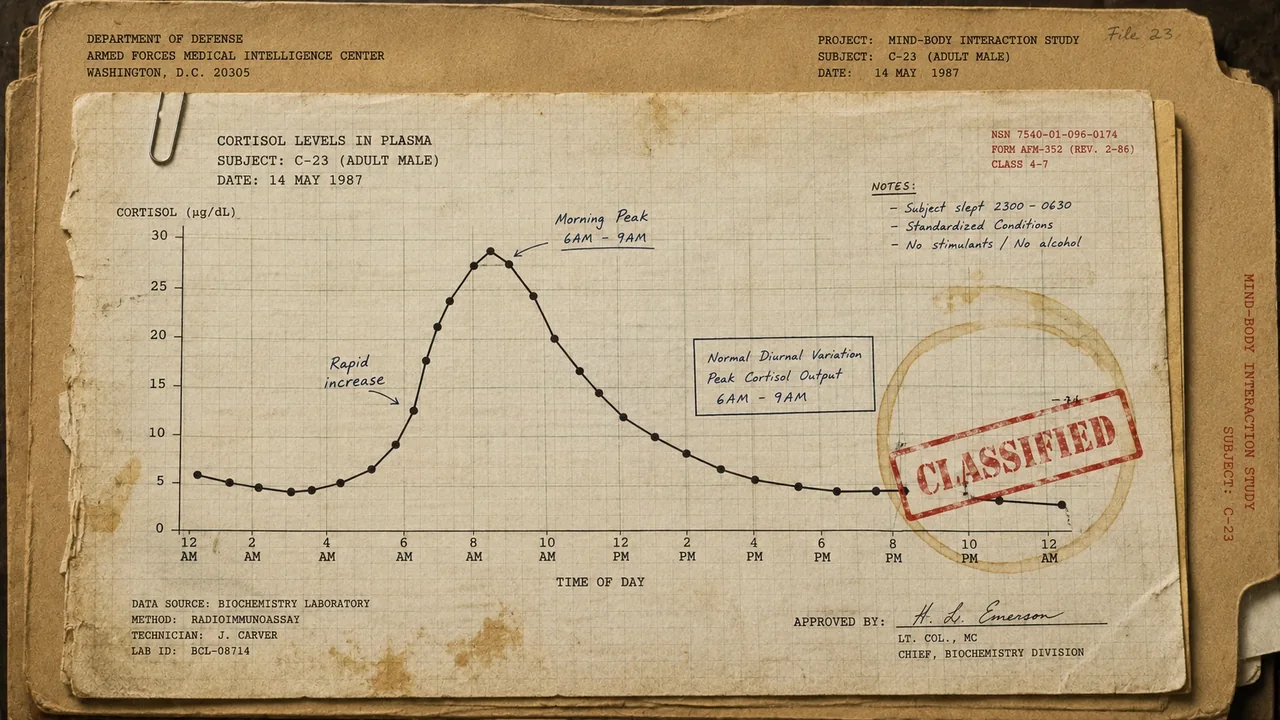
In a healthy system, the cortisol awakening response follows a predictable curve. Cortisol begins rising approximately 30 minutes before waking, peaks 30-45 minutes after waking, and then gradually declines over the next few hours. This pattern is regulated by the HPA axis and the suprachiasmatic nucleus — your brain's master clock. The peak is essential: it gives you the energy and alertness to start the day.
In pathological morning anxiety, the curve looks different. The peak is significantly higher — sometimes 50-100% above normal. The decline is slower — cortisol stays elevated for hours instead of dropping. And the anticipatory rise is disrupted: instead of a smooth ramp, cortisol surges abruptly on waking, producing the "dawn shock" effect. Research has shown that individuals with generalized anxiety disorder have a cortisol awakening response that is both larger in magnitude and slower to resolve than healthy controls.Vreeburg SA, et al. (2010). Major depressive disorder and hypothalamic-pituitary-adrenal axis activity. Psychoneuroendocrinology, 35(4), 554-562.
the morning cortisol pacing sequence: The Dawn Protocol Override
the morning cortisol pacing sequence is a 10-minute guided breathing session designed to be used within the first 10 minutes of waking — before the cortisol awakening response reaches its peak. The breathing pattern starts with a 4:6 ratio (inhale 4 seconds, exhale 6 seconds) and progressively extends to 4:10, applying the vagal brake directly to the rising cortisol curve.
The timing is critical. If you intervene early enough in the cortisol ramp, the vagal signal can blunt the peak significantly. If you wait until the peak is fully established, the breathing still helps — but the override takes longer because you are working against a larger biochemical wave. This is why the mission is designed for immediate use on waking. You keep it on your phone, plug in headphones, and start before your feet hit the floor.
The Sleep-Morning Connection
Morning anxiety does not start in the morning. It starts the night before. Poor sleep quality — specifically, insufficient slow-wave sleep — prevents cortisol from dropping to its normal nocturnal nadir. When morning arrives, the awakening response stacks on top of an already-elevated baseline. The spike becomes a surge because the starting point was already too high.
This creates a vicious cycle: morning anxiety raises cortisol, which impairs sleep, which fails to lower cortisol, which amplifies the next morning's spike. Breaking the cycle requires intervention at both endpoints — nighttime vagal reset to lower the baseline, and morning vagal activation to blunt the spike. Protocol Sessions 05 and 06 are designed to work together for exactly this reason.
The Long-Term Correction: Resetting the HPA Axis
The most significant finding from the morning anxiety data was not that the morning cortisol pacing sequence worked on day one — though most people report noticeable improvement within the first three days. The real discovery was the cumulative effect. After four to six weeks of consistent morning vagal breathing, the HPA axis began to recalibrate. The cortisol awakening response decreased in magnitude. The anticipatory rise smoothed out. The chronic cortisol elevation that had been driving the morning spike began to normalize. This pattern is part of how chronic stress rewires metabolic health.
This is neuroplasticity applied to the HPA axis. The body learned a new pattern: waking does not require a full threat response. The morning can be a transition, not an emergency. And the learning happened not through insight or understanding, but through repeated physiological experience — the body teaching itself a new default, one breathing session at a time.
For the complete protocol, see Sleep Architecture & Restorative Dynamics.