
Medical Safety Notice: Unexplained severe lethargy paired with neurological brain fog, joint pain, or intolerance to cold requires complete metabolic panel, ferritin, and thyroid hormone profiling (TSH, free T3/T4).
What Is Wired but Tired?
Wired but tired is the state of being physically exhausted while unable to relax, sleep, or switch off mentally. It occurs when sympathetic arousal remains high even as energy stores deplete, leaving the nervous system stuck between activation and collapse.
Wired But Tired: The State That Defines Modern Chronic Stress
You are exhausted. Bone-deep, soul-deep exhausted. And yet you cannot relax. You cannot sit still. You cannot sleep. Your body is running on empty but the engine will not stop. This is the "wired but tired" state, and it is one of the most common — and most frustrating — symptoms people describe. It feels like a paradox: how can you be so tired and so unable to rest?
The answer is not a paradox. It is a physiological state called sympathetic exhaustion — and it makes complete sense once you understand the mechanism.
Why You Feel Wired
Despite your exhaustion, your sympathetic nervous system is still running. Cortisol and adrenaline are still circulating at elevated levels. Your heart rate is still elevated. Your muscle tone is still high. Your brain is still scanning for threats. The "wired" feeling is your sympathetic overdrive — the alarm system that will not turn off, even though the original threats are gone.
Why You Feel Tired
Running the sympathetic system at full capacity is metabolically expensive. It burns through glucose, depletes neurotransmitters, and prevents the deep restorative processes that happen during parasympathetic dominance. You are tired because your body has been running a marathon it never signed up for. Research on chronic catecholamine elevation has documented that sustained sympathetic activation produces progressive metabolic exhaustion.Goldstein DS. (2010). Adrenaline and the inner world. Annals of the NY Academy of Sciences.
The Trap: Why Caffeine and Rest Both Fail
The wired-but-tired state creates a double trap. Caffeine makes it worse — it further stimulates the sympathetic system, adding more gas to an engine that is already redlining. Rest also fails — you lie down but the sympathetic system will not deactivate, so you lie there exhausted but alert.
This is also the gateway to chronic cortisol damage. When your body cannot shift into parasympathetic recovery mode, cortisol stays elevated 24/7.
The Neurochemistry of the Wired-Tired State
The wired-but-tired state is a specific neurochemical signature. Cortisol remains elevated, but adrenaline output becomes erratic. You oscillate between surges of nervous energy and crashes of profound fatigue. At the same time, your GABA system — the brain's primary inhibitory mechanism — is suppressed. The vagus nerve, which modulates GABA activity through its descending pathways, is underactive. The result is a body that cannot stop and a mind that cannot quiet.
The wired-tired state is the autonomic nervous system's version of a stuck accelerator. The engine is screaming. The fuel light is on. And the driver keeps pressing the gas because the car will not move.
The Vagal Solution: Applying the Brake
The way out of the wired-but-tired state is through the autonomic nervous system. You did not think your way into sympathetic overdrive, and you will not think your way out. But you can mechanically apply the parasympathetic brake through vagal breathing. The breathing protocol addresses this state through the cardiac vagal pacing pattern (Racing Heart, 10 min) for daytime use and the pre-sleep parasympathetic sequence (Pre-Sleep Reset, 12 min) for nighttime use.
The Recovery Timeline: What to Expect
- Week 1-2: Sleep quality improves marginally. The ability to fall asleep returns. The morning cortisol spike becomes less jarring.
- Week 3-4: The oscillation between wired surges and fatigue crashes begins to smooth out. Energy levels become more predictable.
- Week 5-8: HRV measurements show measurable vagal tone improvement. Sleep becomes genuinely restorative. The "tired" part resolves first. The "wired" part follows.
The key variable is consistency. Skipping days because you feel better is the most common way people relapse into the wired-but-tired state.
The Warning Sign: This State Precedes Collapse
If the wired-but-tired state is not addressed, it progresses. The sympathetic system cannot sustain high output indefinitely. Eventually, it depletes itself and the body drops into dorsal vagal shutdown — the emergency brake. You go from exhausted-but-wired to completely flat. This is the trajectory the breathing protocol was designed to prevent.
The Circadian Disruption: Why Your Body Clock Is Broken
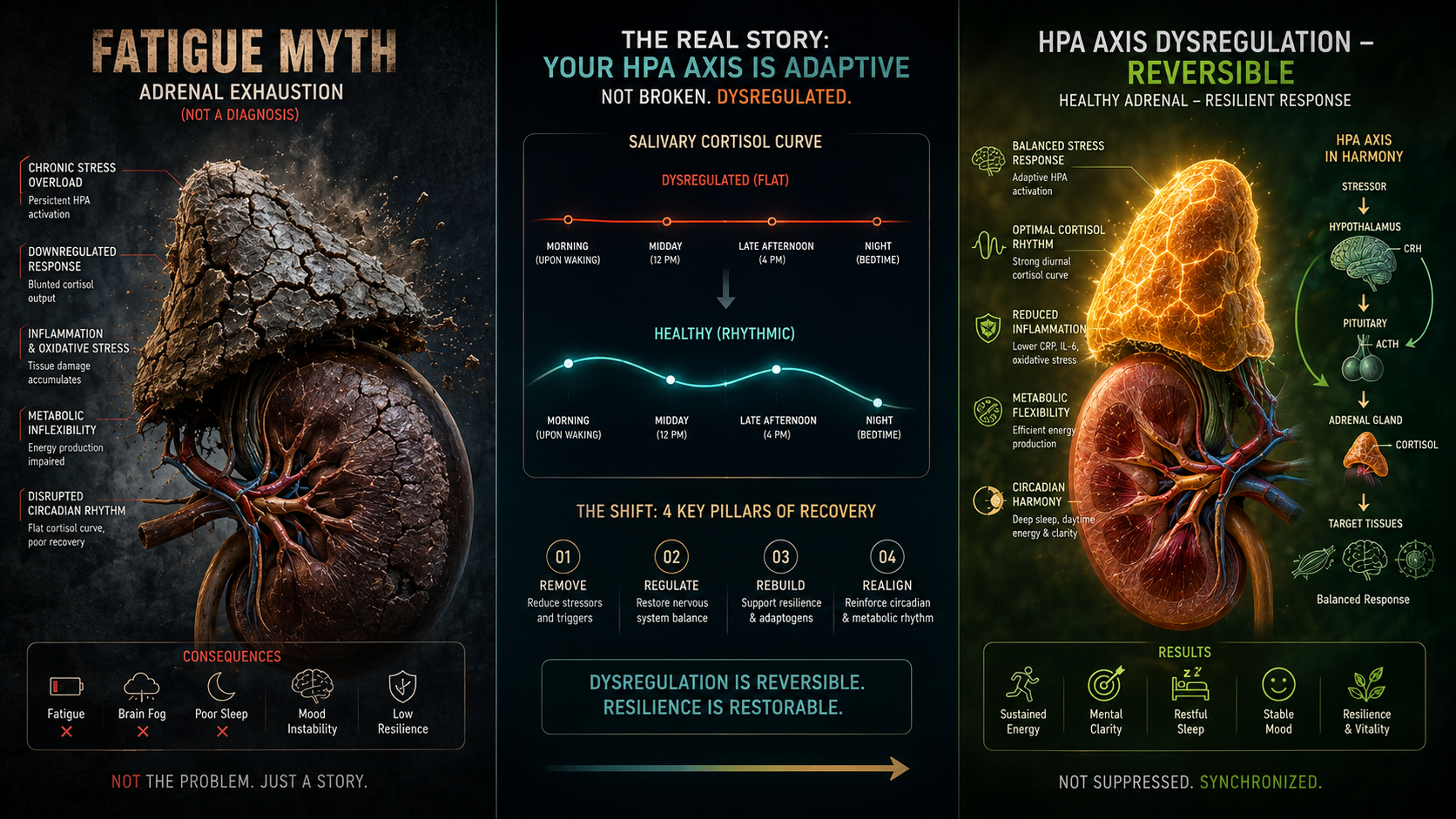
The wired-but-tired state does not just affect your energy levels — it disrupts your entire circadian rhythm. Cortisol follows a circadian pattern: it should peak in the morning, decline through the afternoon, and reach its nadir around midnight. Melatonin follows the inverse pattern: low during the day, rising in the evening, peaking at night. In chronic stress, this pattern inverts or flattens. Cortisol stays elevated at night when it should be at its lowest. Melatonin production is suppressed by the elevated cortisol. The result is a body that cannot energize in the morning and cannot power down at night — you feel tired when you need to be alert and wired when you need to sleep.
This circadian disruption is one of the most damaging aspects of the wired-but-tired state because it affects virtually every system in your body. Growth hormone release, which occurs primarily during deep sleep, is suppressed. Cellular repair processes, which depend on the nocturnal parasympathetic state, are impaired. Memory consolidation, which happens during REM and slow-wave sleep, is disrupted. The body is not just tired — it is failing to perform the fundamental maintenance operations that keep it functional. The sleep protocol addresses this directly by using vagal breathing to restore the parasympathetic-sympathetic rhythm that drives the circadian cycle. When the night becomes a recovery period instead of a struggle, the circadian pattern begins to normalize on its own.
For the complete protocol, see Sleep Architecture & Restorative Dynamics.