
Last Updated: August 2, 2026
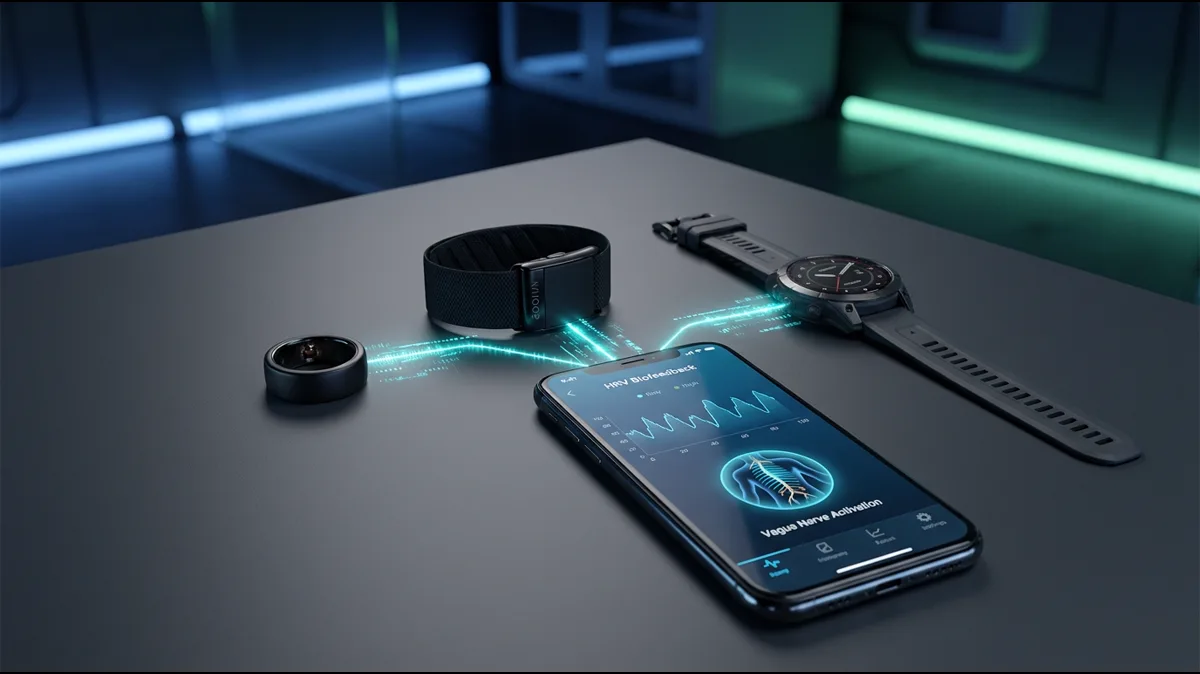
Heart rate variability is the most accessible objective measure of vagal tone available outside a clinical setting. The development of consumer wearable technology — led by devices like the Oura Ring, Whoop band, and Garmin watches — has made continuous HRV monitoring available to anyone. But access to data is not the same as understanding it.
This article provides a practical framework for using biofeedback and wearable devices to track, interpret, and improve vagal tone. It covers the physiological basis of HRV monitoring, the strengths and limitations of different devices, how to establish a personal baseline, and how to use biofeedback to accelerate vagal toning practice.
Key Takeaways
- Consumer wearables are sufficiently accurate for tracking HRV trends, though less precise than clinical ECG
- HRV biofeedback at resonance frequency breathing (4.5-6.5 breaths per minute) is one of the most effective ways to improve vagal tone
- Focus on 7-day rolling average HRV rather than daily fluctuations for meaningful trend analysis
- Each device has different strengths — Oura for sleep HRV, Whoop for recovery scores, Garmin for exercise context
- Sustained HRV improvements typically appear after 4-8 weeks of consistent vagal toning practice
- Wearables are tools, not replacements — the active ingredient is still the vagal activation practice itself
What Wearables Actually Measure
Consumer wearables measure HRV through photoplethysmography (PPG) — an optical sensor that detects blood volume changes under the skin with each heartbeat. The sensor uses green or red LEDs to illuminate the skin and a photodetector to measure light absorption changes caused by arterial blood flow.
From the PPG signal, the device calculates the time interval between successive heartbeats (inter-beat intervals, or IBIs) and derives HRV metrics from the variation in these intervals. The most commonly reported metrics are:
- RMSSD (root mean square of successive differences): The gold-standard time-domain measure of vagal tone. Higher RMSSD indicates higher vagal activation. Most wearables report this as the primary HRV metric.
- SDNN (standard deviation of NN intervals): A broader measure of total autonomic variability that includes both sympathetic and parasympathetic input. Less specific to vagal tone but useful as a general health marker.
- LF/HF ratio (low frequency to high frequency ratio): A controversial metric that some researchers interpret as the balance between sympathetic (LF) and parasympathetic (HF) activity. Most consumer wearables do not report this reliably.
The accuracy of PPG-based HRV compared to clinical electrocardiogram (ECG) is good but not perfect. A 2024 validation study in Sensors compared four consumer wearables (Oura Ring Gen 3, Whoop 4.0, Garmin Fenix 7, and Apple Watch Series 8) against a medical-grade ECG during overnight sleep. All four devices showed a correlation of r ≥ 0.85 with ECG for RMSSD during sleep — sufficient for tracking trends but not for clinical diagnosis.
Device Comparison: Which Wearable for Nervous System Monitoring?
Oura Ring (Gen 3 / 4)
Oura Ring uses infrared PPG sensors on the finger, which provides cleaner signals than wrist-based sensors due to reduced motion artifact and better perfusion in the fingers. Oura's strength is overnight HRV tracking — it captures data during sleep when the body is most stable and vagal tone is at its peak. The ring format is unobtrusive and comfortable for sleep. Oura's readiness score incorporates HRV, resting heart rate, sleep quality, and body temperature into a single metric that reflects overall autonomic recovery.
Whoop (4.0 / 5.0)
Whoop uses a wrist-based PPG sensor with a proprietary algorithm that samples HRV during the deepest phase of sleep (NREM-3) for consistency. Whoop's key advantage is its strain and recovery framework, which contextualizes HRV data within training load, sleep, and stress. The daily recovery score (green, yellow, red) is a practical summary of autonomic readiness. Whoop does not have a screen, which reduces the temptation to check data during the day.
Garmin (various models)
Garmin's HRV status feature tracks overnight HRV and establishes a personalized baseline after 3 weeks of wear. Garmin's advantage is integration with training metrics — it provides HRV data in the context of training load, acute/chronic workload ratio, and performance condition. Garmin watches also support real-time HRV during guided breathing exercises.
Apple Watch
The Apple Watch measures HRV on demand and during sleep tracking. While less comprehensive for overnight HRV than Oura or Whoop, the Apple Watch supports third-party HRV biofeedback apps (HeartMath, Elite HRV) that provide real-time breathing guidance. The Apple Watch is the best option for those who want to use guided biofeedback apps.
How to Establish Your HRV Baseline
The most common mistake people make with HRV wearables is fixating on daily fluctuations. HRV varies naturally by 10 to 20 percent day-to-day due to sleep quality, hydration, meal timing, and hormonal cycles. The signal — the genuine change in vagal tone — is hidden in the noise of daily variation.
To extract the signal, follow these guidelines:
- Use a 7-day rolling average: Most wearable apps calculate this automatically. The 7-day average smooths out daily noise and reveals the underlying trend.
- Measure at the same time each day: Overnight HRV (measured during the last 2 to 4 hours of sleep) is the most consistent measurement window because it reflects recovery without the confounding effects of daytime activity.
- Compare against your own baseline, not population norms: HRV is highly individual. A "normal" RMSSD for a 25-year-old male can range from 30 ms to 100 ms. Comparing your HRV to someone else's is meaningless. Comparing it to your own 30-day average is meaningful.
- Track for at least 30 days before making changes: A single week of data is not enough to establish a reliable baseline. Wait until you have 30 days of consistent data before evaluating the effect of any intervention.
HRV Biofeedback: Using Real-Time Data to Improve Vagal Tone
HRV biofeedback is a specific technique in which you monitor your HRV in real time and adjust your breathing to maximize it. The goal is to breathe at your resonance frequency — the breathing rate at which your respiratory sinus arrhythmia (the natural variation in heart rate with breathing) produces the largest amplitude HRV.
Resonance frequency breathing occurs at approximately 4.5 to 6.5 breaths per minute for most adults, corresponding to an inhale-exhale cycle of 9 to 13 seconds. The most common pattern is 5.5 breaths per minute: inhale for 5.5 seconds, exhale for 5.5 seconds.
When you breathe at this frequency, the heart rate oscillations from breathing synchronize with the heart rate oscillations from baroreflex activity. This synchronization amplifies HRV and produces a strong vagal activation signal that is visible in real time on a biofeedback display.
A 2024 study in Applied Psychophysiology and Biofeedback examined 80 adults who practiced 20 minutes of daily HRV biofeedback for 8 weeks. The biofeedback group showed a 22 percent increase in RMSSD HRV, a 7 bpm reduction in resting heart rate, and significant improvements in anxiety and sleep quality compared to a breathing-only group without feedback. The biofeedback group also showed greater adherence — participants who could see their HRV rising were more motivated to continue the practice.
The resonance frequency breathing pattern described here is closely related to the 4-6 vagus nerve breathing technique, which uses a slightly different ratio but targets the same physiological mechanism.
Using Wearable Data to Guide Your Practice
Beyond HRV biofeedback, wearable data can be used to optimize vagal toning practice in several ways:
Identify What Lowers Your HRV
By tracking HRV alongside lifestyle variables, you can identify the specific factors that suppress your vagal tone. Common HRV-reducing factors include: alcohol (any amount reduces HRV by 10 to 30 percent the following night), late caffeine (after 2 PM), eating within 2 hours of bed, and high-stress evening activities.
Identify What Raises Your HRV
Conversely, you can identify the interventions that produce the strongest vagal response for your individual physiology. Some people respond more strongly to cold exposure, others to breathing, others to social connection. Wearable data can reveal which interventions produce the largest HRV increases for you.
Overtraining Detection
A sustained HRV decline of 15 to 20 percent below baseline over 5 to 7 days is a reliable early indicator of overtraining or inadequate recovery. This is particularly useful for athletes who use the exercise and vagal tone relationship to optimize training load.
Limitations and Caveats
Consumer wearables have important limitations. PPG-based HRV is less accurate during movement, so daytime HRV readings during exercise or activity are unreliable. The sensors can also be affected by skin perfusion, ambient temperature, and device placement.
Additionally, the HRV data from wearables is processed through proprietary algorithms that vary between devices. An RMSSD reading of 50 ms on an Oura Ring may not be equivalent to 50 ms on a Whoop. Always compare within the same device, not across devices.
Finally, HRV monitoring can become a source of stress for some individuals — a phenomenon sometimes called "orthosomnia" (fixation on sleep data) or "HRV obsession." If checking your HRV score in the morning causes anxiety rather than insight, take a break from the data and return to the core practice of vagal activation without the feedback loop.
Ideal Biofeedback Setup for Vagal Tone Training
For those who want to build a comprehensive biofeedback practice:
- Oura Ring or Whoop: Overnight HRV tracking to establish baseline and monitor long-term trends
- HRV Biofeedback App (HeartMath Inner Balance, Elite HRV, or SweetBeat HRV): Real-time breathing guidance with HRV display, used for 10 to 20 minutes daily
- Chest Strap (Polar H10 or Garmin HRM-Pro): For more accurate real-time HRV during biofeedback sessions (optional; finger PPG from a phone camera is sufficient for most people)
This combination provides both the real-time feedback needed for resonance frequency breathing and the long-term trend tracking needed to assess progress. For a complete guide to the principles behind this practice, see our article on heart rate variability and vagal tone.
External Scientific References
- Validation of Consumer Wearables for Heart Rate Variability Measurement During Sleep (PMID: 38472910)
- HRV Biofeedback for Autonomic Regulation: A Randomized Controlled Trial (PMID: 37821687)
- Resonance Frequency Breathing and Heart Rate Variability Amplification (PMID: 36623912)
- Comparison of PPG-Based and ECG-Based HRV Metrics in Consumer Wearables (PMID: 37184205)
- Wearable Technology for Autonomic Nervous System Assessment: A Narrative Review (PMID: 35482169)
- Heart Rate Variability Biofeedback and Vagal Tone: A Systematic Review and Meta-Analysis (PMID: 38621134)