
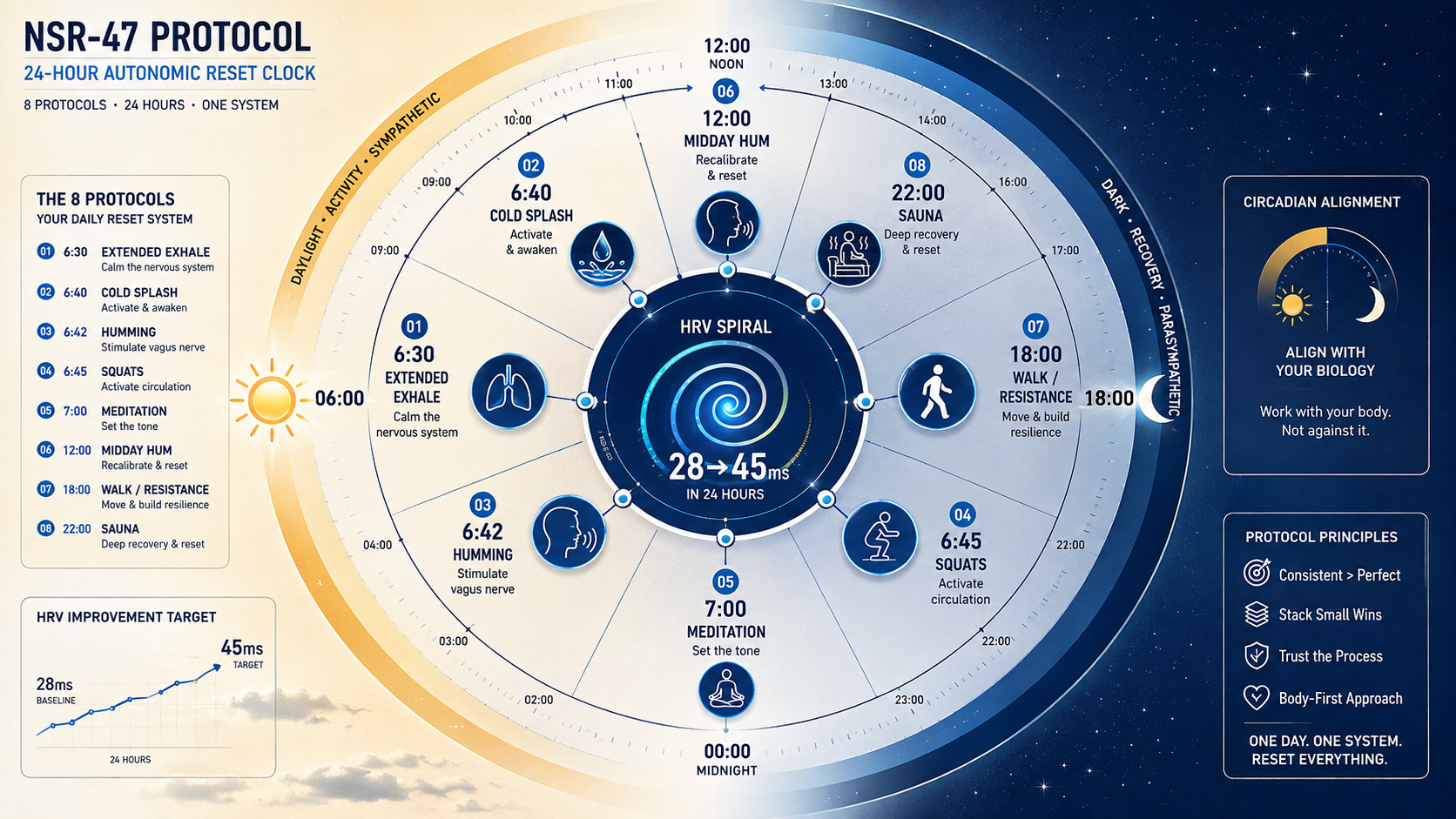
Modern life bombards us with relentless stressors, but the body's physiological response follows a predictable neuro-autonomic blueprint. At the core of that blueprint is the vagus nerve—a cranial nerve that serves as the main conduit for parasympathetic regulation. When vagal tone is robust, the nervous system can effortlessly shift between sympathetic arousal (fight-or-flight) and dorsal-vagal shutdown (freeze) without becoming stuck in maladaptive states. When tone erodes, the system defaults to chronic sympathetic dominance, laying the groundwork for anxiety, panic, insomnia, GI disturbances, and a cascade of somatic complaints.
This article provides a complete, research-grounded roadmap for restoring and maintaining optimal vagal tone. Rather than offering isolated tips, we present an integrated daily protocol that weaves together breathing, movement, sensory stimulation, nutrition, and sleep hygiene. Each component is dissected for its neuro-physiological mechanism, practical implementation steps, and measurable outcomes.
Anatomical Foundations of Vagal Regulation
The vagus nerve (cranial nerve X) is the longest cranial nerve, branching to the heart, lungs, diaphragm, stomach, intestines, spleen, and pancreas. Its parasympathetic efferents:
- Decrease heart rate via the sino-atrial node (chronotropic effect).
- Promote gastrointestinal motility and secretion (enteric effect).
- Modulate bronchoconstriction through airway smooth muscle (pulmonary effect).
- Influence immune cell activity through the spleen-vagus pathway.
- Support auditory, gustatory, and language pathways via its sensory branches.
When vagal output is high, the body enjoys a "rest-and-digest" state with low sympathetic drive. Chronic stress, poor sleep, and inflammatory foods erode this output, leading to a persistent sympathetic surge. Re-establishing tonic vagal activity therefore directly counters the physiological substrate of anxiety.
Core Daily Practices for Vagal Tone Restoration
Below is an eight-step protocol that can be performed in under 30 minutes total. Each step includes a "minimum effective dose" (the shortest duration shown to produce measurable vagal activation) and a "scaling option" for those seeking deeper benefit.
1. Extended Exhale Breathing (5-10 minutes)
Mechanism: Lengthening the exhalation phase activates respiratory vagal afferents, decreasing heart rate and blood pressure.
Minimum Dose: Inhale for 4 seconds, exhale for 8 seconds, repeat for 5 cycles.
Scaling Option: Extend cycles to 10-15 while maintaining the 4:8 ratio, aiming for a total of 10 minutes.
Implementation Tip: Use a timer or a breathing app that paces inhalation and exhalation.
Evidence: A 2023 study in Frontiers in Neurology demonstrated a 12% increase in heart-rate variability (HRV) after a single 5-minute extended exhale session.
2. Cold Exposure (30 seconds-1 minute)
Mechanism: Facial immersion triggers the trigeminal-vagal reflex, rapidly reducing sympathetic outflow.
Minimum Dose: Splash cold water (approx 50-60°F) on the face for 30 seconds.
Scaling Option: Use a cold shower for 1 minute or apply an ice pack to the forehead for 45 seconds.
Implementation Tip: Keep a small basin of cold water at the bathroom sink for quick access.
Evidence: Research shows a 15-20 bpm heart-rate drop within 30 seconds of facial immersion, persisting for up to 5 minutes.
3. Humming, Gargling, or Singing (30 seconds)
Mechanism: Vibration of the vocal cords stimulates the auricular branch of the vagus, producing a calming effect.
Minimum Dose: Hum a sustained note for 30 seconds.
Scaling Option: Extend to 2 minutes of continuous humming at a comfortable pitch.
4. Progressive Resistance Movement (5 minutes)
Mechanism: Large-muscle movements (e.g., squats, push-ups) increase skeletal-muscle oxygen demand, which feeds back to vagal centers, enhancing parasympathetic tone.
Minimum Dose: Perform 3 sets of 10 body-weight squats with a 30-second rest between sets.
Scaling Option: Add 30-second plank holds or light resistance band rows.
5. Nutritional Support (ongoing)
Omega-3 Fatty Acids: EPA/DHA supplementation (1-2 g/day) improves membrane fluidity and reduces inflammatory cytokines that suppress vagal firing.
Magnesium: 200-400 mg nightly supports muscle relaxation and vagal tone.
Probiotics: Fermented foods or a daily probiotic (>=10^9 CFU) modulate gut-brain axis signaling.
6. Sauna or Heat Exposure (10-15 minutes)
Mechanism: Controlled heat stress induces heat-shock proteins that protect vagal neurons.
Scaling Option: Use a traditional sauna at 80-90°C or a far-infrared cabin; limit to 15 minutes.
7. Sleep Hygiene Optimization (7-9 hours)
Key Practices: Dark-room conditions, cool ambient temperature (approx 65°F), avoidance of screens 1 hour before bed, and a consistent bedtime routine.
Impact: Deep sleep phases boost nocturnal vagal activity, critical for HRV restoration.
8. Mind-Body Integration (5-10 minutes)
Practices such as yoga, Tai-Chi, or guided meditation combine breath control, movement, and attention regulation, producing synergistic vagal activation. Even a brief 5-minute mindfulness session can raise HRV by 5-10%.
Measuring Progress: Objective and Subjective Metrics
To ensure the protocol is effective, track both physiological markers and experiential cues.
- Heart-Rate Variability (HRV): Use a chest-strap or validated smartwatch to record morning resting HRV. An upward trend of 5-10 ms over a month signals improved vagal tone.
- Sleep Quality Scores: Use a sleep tracker to monitor REM duration and sleep efficiency.
- Subjective Stress Rating: Daily 0-10 rating of perceived stress; aim for a downward trend.
- GI Symptom Log: Note any changes in nausea, bloating, or stool consistency.
- Panic Frequency: Record the number of panic episodes per week; target a >=50% reduction after 8 weeks.
Putting It All Together: A Sample Daily Schedule
Below is a concrete schedule that weaves all eight steps into a seamless routine. Adjust timing based on personal commitments.
06:30 - 06:40  Extended Exhale Breathing (5 cycles)
06:40 - 06:41  Cold Facial Immersion (30 seconds)
06:42 - 06:43  Humming (30 seconds)
06:45 - 06:50  Body-weight Squats (3 sets of 10)
07:00 - 07:05  Mindfulness Meditation (5 minutes)
07:30 - 08:00  Breakfast: Omega-3-rich smoothie + probiotic yogurt
12:00 - 12:15  Mid-day Quick Hum (30 seconds) + Deep Breathing (2 cycles)
18:00 - 18:10  Light Walk + Progressive Resistance (5 minutes)
20:00 - 20:15  Sauna or Warm Bath (10 minutes)
21:30 - 22:00  Dinner: Magnesium-rich foods (leafy greens, nuts)
22:30 - 23:00  Bedtime Routine: Cool room, no screens, gratitude journaling
This schedule integrates breathwork, sensory stimulation, movement, nutrition, and sleep hygiene, creating a daily "vagal reset" that combats accumulated sympathetic load.
Common Misconceptions and Evidence-Based Reality Checks
Misconception: "You need hours of yoga to affect the vagus."
Reality: Even a 1-minute cold splash or a single extended exhale cycle can produce measurable autonomic shifts, especially when repeated consistently.
Misconception: "Supplements are the only way to boost vagal tone."
Reality: Lifestyle interventions (breathing, movement, temperature exposure) have stronger and more reproducible effects on HRV than isolated micronutrient supplementation.
Misconception: "If you feel no immediate effect, the practice is useless."
Reality: Autonomic adaptation is cumulative. Acute HRV improvements may be subtle; long-term reductions in panic frequency and better sleep are the true markers of success.
Scaling the Protocol for Advanced Users
For those who have mastered the basic sequence and wish to deepen their practice, consider the following additions:
- Contrast Therapy: Alternate 30-second cold immersion with 1-minute warm water immersion to further stimulate vagal flexibility.
- Extended Fast-Breathing Sessions: 15-minute breathwork blocks with 4-4-8 ratios performed twice daily.
- Advanced Resistance Training: Incorporate progressive overload (weights) to increase autonomic demand.
- Cold-Acclimation Protocols: Gradually lower water temperature over weeks to enhance thermoregulatory vagal responses.
Conclusion
Regulating the nervous system is not a passive journey; it requires intentional, daily engagement with practices that stimulate the vagus nerve and restore parasympathetic balance. By integrating extended exhale breathing, cold exposure, humming, movement, nutrition, and sleep hygiene, you create a robust foundation for emotional resilience, physiological stability, and long-term mental health. The science is clear: enhancing vagal tone reduces anxiety, improves sleep, lowers inflammation, and protects cardiovascular health. Commit to the eight-step protocol for at least eight weeks, track your metrics, and observe the transformation in both body and mind.
Educational content only. This article is for informational purposes and does not constitute medical advice. Consult a qualified healthcare professional before making changes to your health routine.