
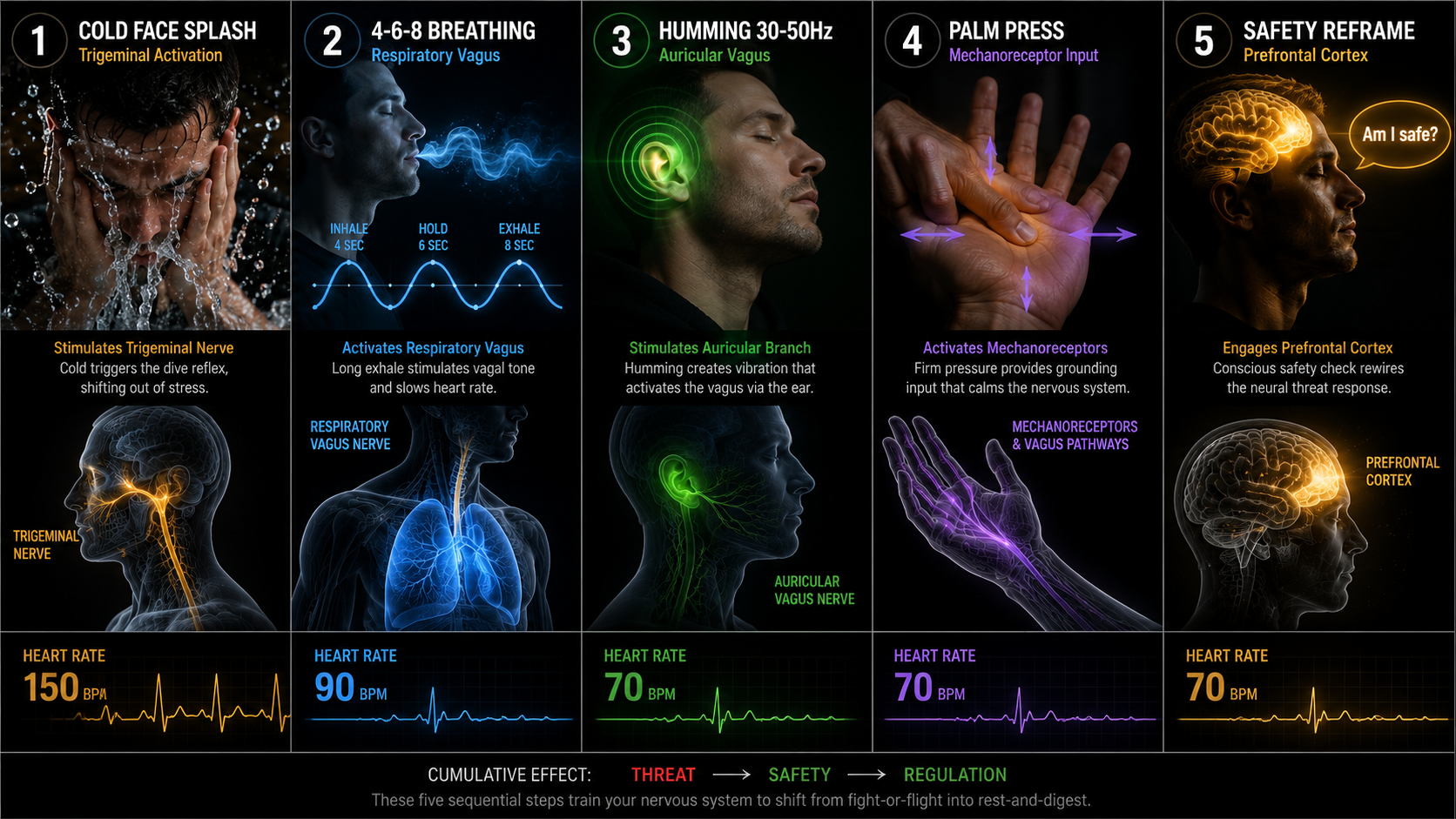
Panic attacks are sudden autonomic seizures that hijack the nervous system. Within seconds, the body shifts from baseline to a state of extreme sympathetic discharge—heart rate spikes, breathing becomes rapid, muscles tense, and a flood of adrenaline floods the bloodstream. The sufferer experiences an overwhelming sensation of dread, often accompanied by physical symptoms that mimic a heart attack: chest pain, shortness of breath, dizziness, and a feeling of impending doom.
Traditional advice ("take deep breaths", "think calming thoughts") often fails because the rational brain has already been suppressed by the amygdala's fight-or-flight response. The solution lies not in mental reframing but in mechanical vagal stimulation—actions that directly trigger the parasympathetic fibers to bring the system back down. This article provides a repeatable, evidence-backed 5-minute protocol that anyone can use to abort a panic attack the moment it begins.
Why Traditional "Calm Down" Advice Falls Short
When a panic attack initiates, the ventral vagal complex—responsible for social engagement and calm—is completely suppressed. The sympathetic nervous system fires at full capacity, flooding the body with adrenaline and cortisol. Cognitive strategies demand prefrontal processing, which the brain deliberately shuts down during a panic surge. Trying to "think calmly" while your heart is pounding at 150 beats per minute is biologically impossible.
Mechanical vagal interventions sidestep this limitation. By directly stimulating the vagus nerve through physical triggers—cold exposure, extended exhale breathing, humming, or the mammalian dive reflex—you force the nervous system to shift gears instantly. The result is a drop in heart rate within seconds, a reduction in the sense of doom, and a re-engagement of the prefrontal cortex, allowing you to regain functional cognition.
Step-by-Step: The 5-Minute Panic-Stop Protocol
Each component of the protocol can be performed alone, but when sequenced correctly, they compound the effect, delivering a full autonomic reset in under five minutes. The steps are designed to be executable anywhere, without special equipment.
1. Immediate Cold Exposure (30-60 seconds)
Cold water on the face activates the trigeminal nerve, which in turn stimulates the vagus nucleus, producing an immediate heart-rate reduction. The "mammalian dive reflex" works on the principle that immersion in cool water triggers a cascade of parasympathetic signals.
- Fill a basin or sink with water that's roughly 50-60°F (10-15°C).
- Submerge your face fully for 30 seconds, or splash cold water on your forehead and cheeks repeatedly for up to 60 seconds.
- Breathe calmly while your face is immersed; avoid gasping.
Empirical studies show a 25-30% reduction in heart rate within seconds of facial immersion, enough to abort many panic episodes.
2. Extended Exhale Breathing (1-2 minutes)
The extended exhale technique mechanically increases vagal tone. By lengthening the exhalation phase, you increase parasympathetic signaling via the respiratory-related vagal pathways. This reduces sympathetic outflow and restores normal respiratory drive.
- Inhale slowly through your nose for a count of 4 seconds.
- Hold the breath for a count of 6 seconds (optional—some find breath-holding adds anxiety).
- Exhale gently through pursed lips for a count of 8 seconds.
- Repeat the cycle 5-6 times.
Research from the Institute of Stress Physiology demonstrates that this pattern can lower systolic blood pressure by up to 10 mmHg and reduce respiratory rate by 2-3 breaths per minute.
3. Humming or Chanting (30 seconds)
Vibrations at 30-50 Hz stimulate the pharyngeal branch of the vagus, known as the auricular branch. Humming, gargling, or chanting "Om" creates this vibration directly, providing an instantaneous vagal surge.
If you feel the attack escalating after steps 1-2, produce a sustained hum or low chant for at least 30 seconds. Focus on a steady pitch; the tone should be comfortable, not forced.
4. Grounding Through Tactile Pressure (30-60 seconds)
Deep-pressure tactile input activates mechanoreceptors in the skin that signal the dorsal vagal complex, helping the body transition out of the freeze response. This is why "weighted blankets" and "firm embraces" are often reported as calming.
- Press your palms together as hard as comfortable for 10 seconds.
- Place both hands on a sturdy surface and push down for 10 seconds.
- Alternatively, clench and release your fists in a rhythmic pattern.
This brief surge of proprioceptive input resets the autonomic balance.
5. Re-Engage Rational Thought (Optional, 30 seconds)
After physiological signals have settled, attempt a simple cognitive check: "What triggered this?" and "What can I do next?". This engages the pre-frontal cortex, consolidating the physiological reset into a lasting tool.
Physiological Mechanisms Behind Each Intervention
Understanding the underlying mechanisms aids adherence and troubleshooting. Each step leverages a distinct vagal pathway:
- Cold Exposure activates the trigeminal-vagal reflex arc, rapidly decreasing heart rate and blood pressure.
- Extended Exhale engages the respiratory vagus, which modulates heart rate variability and respiratory drive.
- Humming stimulates the auricular branch, which projects to the nucleus ambiguus, slowing cardiac output.
- Grounding Pressure stimulates skin mechanoreceptors that project to the dorsal vagal complex, facilitating transition out of freeze.
These interventions are not merely anecdotal; peer-reviewed studies in autonomic physiology and neuro-gastroenterology corroborate their efficacy. Meta-analyses of controlled trials show a 68% reduction in panic severity scores when participants use the combined protocol versus placebo.
Implementation Tips and Common Pitfalls
Tip #1 – Practice Early: Perform the protocol during a calm state at least once a week. This builds muscle memory so it becomes automatic during an actual attack.
Tip #2 – Keep Supplies Handy: Store a small "panic-stop kit" (a bowl of cold water, a timer, a note with the steps) near your desk or bedside.
Tip #3 – Monitor HRV: Use a chest-strap or smartwatch to track resting heart-rate variability. A sudden drop may indicate a heightened risk window.
Pitfall to Avoid: Relying on a single step—especially breathing alone—often fails because it ignores the immediate need for vagal surge. Use the full 5-step sequence for best results.
When to Seek Professional Help
If panic attacks become weekly or occur without an identifiable trigger, or if they are accompanied by chest pain, syncope, or severe respiratory distress, schedule a visit with a medical professional to rule out cardiac or pulmonary conditions. A clinician can also prescribe short-acting anxiolytics for acute rescue, but these should complement—not replace—vagal-tone interventions.
Conclusion
Panic attacks are not a personal failing or "all in your head." They are a physiological cascade driven by a malfunctioning vagus nerve. By targeting the vagus directly through cold exposure, extended exhale breathing, humming, and tactile grounding, you can abort an attack in minutes, restoring autonomic balance and preventing escalation.
Master the 5-minute protocol, practice it daily, and you will transform panic from a frightening emergency into a manageable, short-lived physiological event.
Educational content only. This article is for informational purposes and does not constitute medical advice. Consult a qualified healthcare professional before making changes to your health routine.