
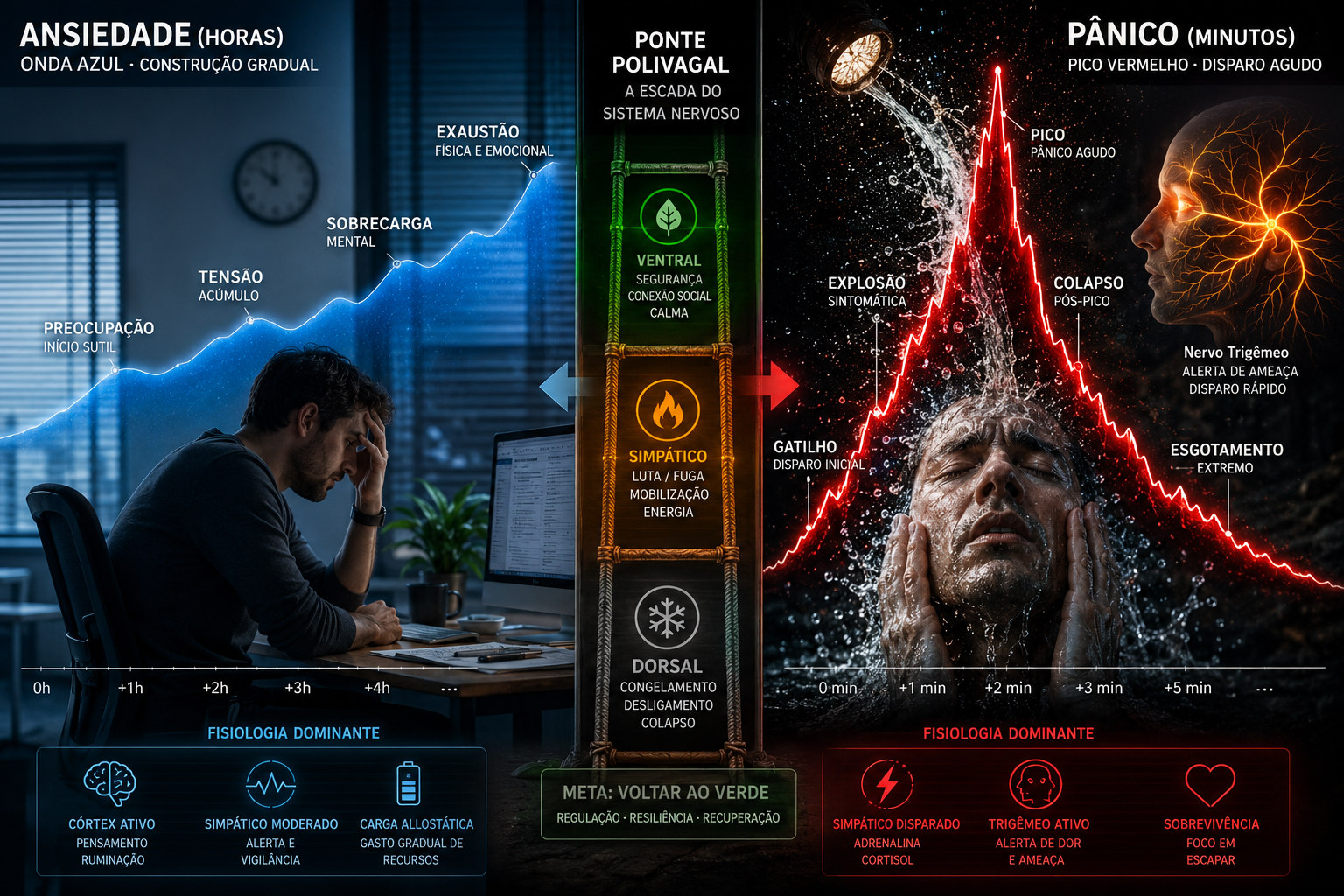
If you have ever been told that anxiety attacks and panic attacks are the same thing, you have been misled. In clinical literature and popular usage, these terms are often used interchangeably — but from a nervous system perspective, they represent two distinct states of autonomic dysregulation. Knowing which one you are experiencing is not semantic trivia; it determines what kind of intervention will work.
To understand the full nervous system framework behind both conditions, start at our Anxiety Relief Hub — this article is one spoke within that larger cluster.
Defining an Anxiety Attack
An anxiety attack is not a formal DSM-5 diagnosis. The term is used colloquially and clinically to describe a period of intense, sustained anxiety that builds gradually. It is usually triggered by a specific stressor — a looming deadline, a difficult conversation, an unresolved conflict — and escalates over hours or days as the nervous system accumulates sympathetic activation without releasing it.
Physiologically, the anxiety attack is characterized by moderate-to-high sympathetic tone. Your heart rate is elevated but generally below 120 beats per minute. Your breathing is shallow but not necessarily hyperventilating. Your muscles are tense but not in spasm. You are uncomfortable, on edge, and unable to relax — but you remain functional. You are still thinking, still communicating, still (barely) holding it together.
The key feature of an anxiety attack is that it is proportional and gradual. The intensity of the anxiety tracks with the intensity of the perceived stressor. When the stressor resolves, the anxiety begins to subside. The problem is that with chronic nervous system dysregulation, the stressor never fully resolves and the anxiety never fully subsides.
Defining a Panic Attack
A panic attack, by contrast, is defined by the DSM-5 as a sudden onset of intense fear or discomfort that reaches its peak within minutes. It is not gradual. It is not proportional. It is a complete autonomic seizure — a full sympathetic discharge that hits the body like a lightning strike, often with no identifiable trigger.
During a panic attack, the ventral vagal complex — the most evolved branch of the parasympathetic system, responsible for social engagement and calm — is entirely suppressed. The sympathetic nervous system fires at maximum capacity. Heart rate can spike to 150+ beats per minute. Breathing becomes rapid and shallow. The body floods with adrenaline and cortisol.
The hallmark symptom of a panic attack is the fear of dying or losing control. This is not a cognitive thought — it is an autonomic perception. The body is convinced it is about to die, and no rational argument can convince it otherwise, because the rational brain (prefrontal cortex) is offline due to blood flow being redirected to survival systems.
Side-by-Side Comparison: Symptoms & Duration
The table below summarizes the mechanical differences between the two states. This is based on autonomic function analysis rather than symptom checklists alone.
| Feature | Anxiety Attack | Panic Attack |
|---|---|---|
| Onset | Gradual (hours–days) | Sudden (peaks in minutes) |
| Trigger | Usually identifiable stressor | Often none (can be nocturnal) |
| Peak heart rate | < 120 bpm | > 150 bpm |
| Breathing | Shallow, controlled | Hyperventilation, air hunger |
| Cognition | Impaired but functional | Offline (prefrontal shutdown) |
| Duration | Hours to days | 10–30 minutes (cannot sustain max output) |
| Aftermath | Exhausted but upright | Depleted, dissociated, fear of recurrence |
The Vagus Nerve's Role in Panic States
In polyvagal theory, the nervous system operates on a hierarchy of three states: ventral vagal (social engagement and safety), sympathetic (fight-or-flight), and dorsal vagal (freeze and shutdown). Anxiety is chronic sympathetic dominance with a weak ventral vagal brake. A panic attack is what happens when the ventral vagal brake fails completely and the system crashes through the sympathetic cascade into the dorsal vagal zone.
This is why panic attacks are often followed by emotional numbness, exhaustion, and dissociation. The body has fallen through the polyvagal ladder. It started in social engagement, was pushed into fight-or-flight, and when fight-or-flight could not resolve the threat, it dropped into the freeze state — the oldest, most primitive survival mechanism. Understanding this progression is the foundation of polyvagal theory as it applies to anxiety and panic.
Intervention must therefore be mechanical, not cognitive. You cannot reason someone out of a dorsal vagal freeze or force them out of a sympathetic seizure. You must reactivate the ventral vagal pathway through physical signals of safety.
Practical Steps to Stop the Onset
For an anxiety attack, the most effective intervention is to interrupt the gradual buildup before it peaks. This means catching the early signs — shallow breathing, shoulder tension, jaw clenching — and applying the 4-6 extended exhale breathing protocol. The extended exhale mechanically stimulates the vagus nerve, restoring the parasympathetic brake that the anxiety is gradually eroding.
For a panic attack, you do not have the luxury of gradual intervention. You need a rapid physiological override. The two most reliable tools are:
- The Mammalian Dive Reflex: Cold water (50-60°F) splashed on the face triggers the trigeminal nerve, which activates the vagus nerve and forces a heart rate reduction within seconds. This is the fastest mechanical intervention for acute panic.
- The Extended Exhale Under Load: Inhale for 4 seconds, exhale through pursed lips for 8 seconds. The increased resistance and longer exhale maximize vagal stimulation. Repeat for 3-5 minutes.
For a detailed, step-by-step protocol, see our guide on how to stop a panic attack in 5 minutes.
The body does not distinguish between real danger and remembered danger. To the nervous system, they are the same signal. The difference between anxiety and panic is not the signal itself — it is the system's capacity to absorb it.
When to Seek Help
If you are experiencing panic attacks more than once a month, or if anxiety attacks are becoming your baseline state, you need comprehensive nervous system dysregulation intervention, not just emergency protocols. The daily practice outlined in the breathing protocol is designed to restore vagal tone progressively, widening your window of tolerance so that stressors that once triggered panic become manageable.
You should also consult a healthcare professional if you have never had a panic attack before and suddenly experience one, especially if accompanied by chest pain, to rule out cardiac causes (see our guide on anxiety chest pain vs heart attack).
Educational content only. This article is for informational purposes and does not constitute medical advice. Consult a qualified healthcare professional before making changes to your health routine.