
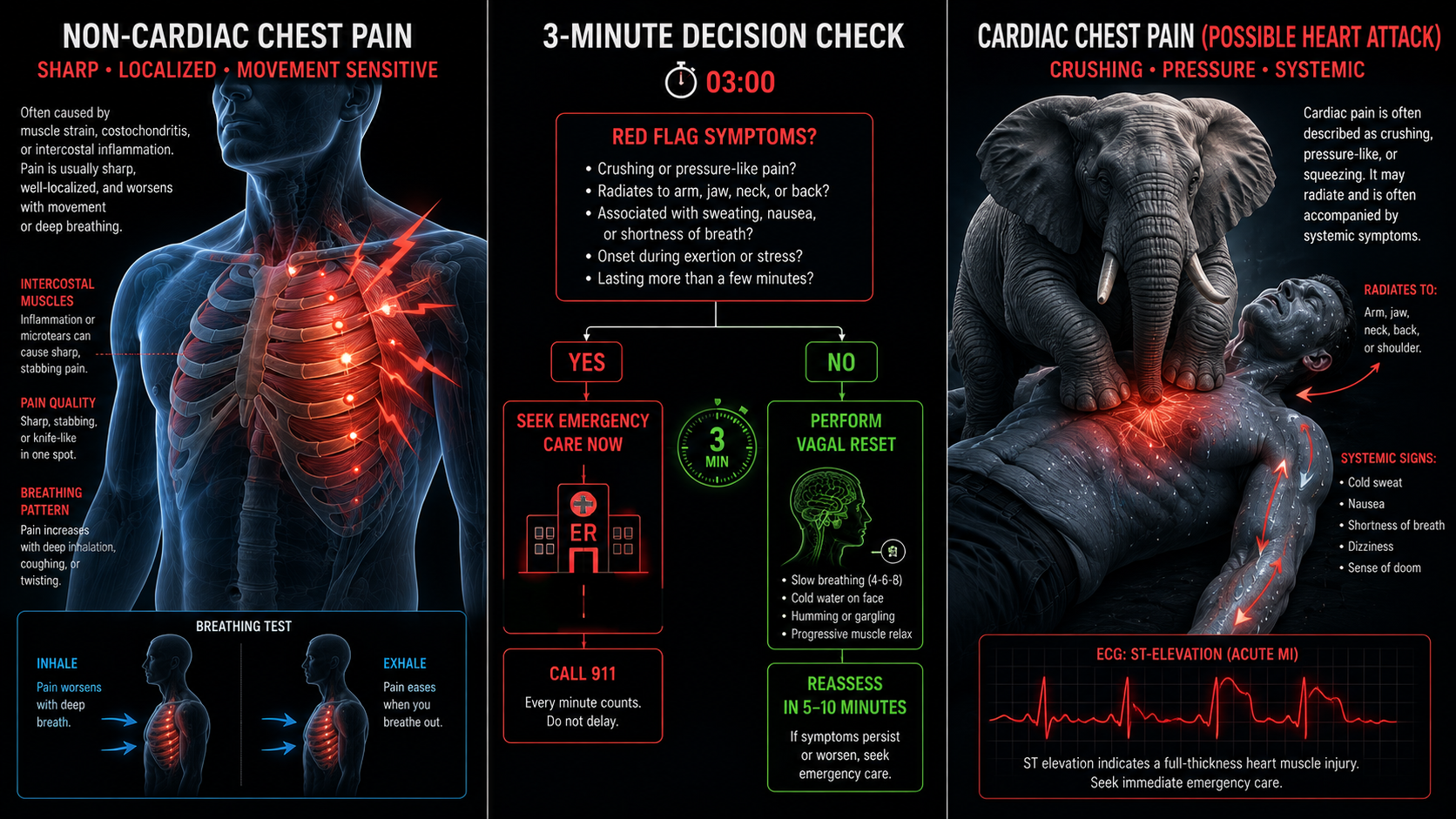
Few sensations trigger more primal fear than chest pain. The mind instantly leaps to the worst-case scenario: heart attack. But in clinical practice, a significant portion of ER visits for chest pain turn out to be non-cardiac—often driven by anxiety, panic, or musculoskeletal issues. The problem isn't the symptom itself; it's the inability to differentiate between a false alarm and a true emergency.
This article provides a mechanistic framework for telling the difference. We break down the physiology, present a side-by-side comparison, and give you a decision algorithm you can use in real time.
The Physiology: Why Anxiety Mimics Cardiac Pain
When the sympathetic nervous system surges—whether from a panic attack, chronic anxiety, or acute stress—several things happen simultaneously:
- Coronary vasoconstriction: Adrenaline narrows coronary arteries, reducing oxygen supply to the myocardium.
- Increased myocardial oxygen demand: Heart rate and contractility spike, so the heart needs more oxygen—precisely when supply is restricted.
- Chest wall muscle tension: The intercostal and pectoral muscles clamp down, creating a tight, aching sensation that feels cardiac.
- Esophageal spasm: Vagal dysregulation can trigger esophageal contractions that radiate to the retrosternal area.
- Hyperventilation-induced ischemia: Rapid breathing blows off CO2, causing cerebral and coronary vasoconstriction, which can produce genuine (but reversible) ischemic changes on ECG.
The result: real chest pain, real ECG changes, real troponin elevations in extreme cases—all driven by autonomic dysregulation, not coronary atherosclerosis.
Side-by-Side Comparison
| Feature | Anxiety / Panic Chest Pain | Heart Attack (MI) |
|---|---|---|
| Quality | Sharp, stabbing, shooting, "needle-like" | Pressure, squeezing, crushing, "elephant on chest" |
| Location | Localized, often left of sternum, may move with breathing | Central/retrosternal, may radiate to left arm, jaw, neck, back |
| Duration | Seconds to minutes; fluctuates with breathing/position | Persistent > 20 minutes; unrelenting |
| Trigger | Stress, panic, hyperventilation, rest | Exertion, emotional stress, cold, heavy meal; often at rest too |
| Relief | Improves with slow breathing, cold face, changing position | No relief with rest, position, or breathing; may worsen |
| Associated symptoms | Tingling, derealization, urge to flee, palpitations | Diaphoresis, nausea, syncope, dyspnea at rest |
| ECG / Troponin | Normal or non-specific ST/T changes; troponin negative | ST elevation/depression, new Q waves; troponin positive |
The 3-Minute Decision Algorithm
When chest pain strikes, run through this sequence. If ANY "Red Flag" is YES → Call emergency services immediately.
Red Flags (Call 911 / Go to ER)
- Pain radiates to left arm, jaw, neck, or back.
- Pain is crushing/pressure-like AND lasts > 20 minutes.
- Associated diaphoresis (cold sweat), nausea/vomiting, or syncope.
- Shortness of breath at rest (unable to speak full sentences).
- Known coronary artery disease, prior MI, or stent.
- New-onset pain > age 40 with risk factors (HTN, DM, smoking, family history).
Green Flags (Likely Anxiety/Panic – Apply Vagal Reset)
- Pain is sharp, stabbing, or "catching" with breathing.
- Pain changes with position (better leaning forward, worse lying flat).
- Pain reproduces with chest wall palpation.
- Pain improves within 5 minutes of cold facial immersion + 4-8 breathing.
- Accompanied by tingling lips/fingers, derealization, or urge to escape.
- Recent panic attack history; similar episodes resolved spontaneously.
Gray Zone (Uncertain): If you cannot confidently place yourself in Green Flags, treat as Red Flag. The cost of a false alarm is an ER bill; the cost of a missed MI is death.
Mechanism Deep-Dive: Why the Overlap Exists
The heart and the anxiety circuit share the same afferent pathways. Visceral afferents from the heart travel via the sympathetic cardiac nerves (T1-T5) and the vagus to the spinal cord and brainstem. The brain cannot perfectly distinguish "ischemia" from "sympathetic overdrive" because both activate the same second-order neurons in the dorsal horn and nucleus of the tractus solitarius.
This is why anxiety can cause real ischemic changes on ECG (demand ischemia from tachycardia + vasoconstriction) and why silent MIs can present as "just anxiety." The nervous system's alarm system is blunt by design—it prioritizes sensitivity over specificity.
What If Your ECG Is Normal But You Still Feel Like You're Dying?
You went to the ER, the ECG was normal, cardiac enzymes came back clean — and an hour later the same crushing fear returned. You are not imagining it, and the doctors are not wrong. Both can be true at once: your heart is structurally fine and your symptoms are real.
This is the signature of panic-driven chest pain. During a panic attack, tachycardia and hyperventilation cause genuine chest tightness, breathlessness, and — in extreme cases — transient (reversible) ECG changes without any coronary disease. Emergency departments routinely find that a significant share of chest-pain visits are non-cardiac, and most of those are driven by anxiety and panic.
Here is the reassurance that defuses most of the fear: a normal ECG and negative troponin during the episode mean there is no ongoing heart-muscle damage. The pain is real, but it is coming from your nervous system, chest-wall muscles, and esophagus — not from clogged arteries. Once you understand that a normal ECG during your worst episode rules out a heart attack in that moment, the catastrophic interpretation loses its power.
When a normal test deserves a second look: if the pain pattern changes (new radiation, new triggers), if you carry multiple cardiac risk factors, or if a cardiologist has never reviewed you, request a stress test or coronary CT to confirm. But when the workup is complete and the pain reliably follows stress and improves with vagal exercises, the treatment target is the nervous system — not the heart.
Can the Vagus Nerve Cause Chest Pain?
Yes — and this is the most under-recognized source of "false alarm" chest pain. The vagus nerve carries sensory fibers from the heart, esophagus, stomach, and diaphragm to the brainstem. When vagal signaling is dysregulated, it can create chest pain through three separate mechanisms:
- Esophageal spasm and reflux: vagal dysfunction can trigger forceful esophageal contractions that mimic angina and radiate to the back and left chest.
- Chest-wall muscle tension: chronic sympathetic overdrive keeps the intercostal and pectoral muscles contracted, producing a tight, aching sensation that feels cardiac.
- Referred sensation from the stomach and diaphragm: gastric distension and hiatal irritation project to the chest through shared vagal afferent pathways.
Because vagal chest pain shifts with breathing, position, and stress — and responds to vagal-reset techniques (slow exhale, cold face, humming) — it behaves differently from cardiac pain. If the pain reliably resolves within minutes of a vagal reset, the vagus nerve is the source, not the coronary arteries.
When Anxiety Causes Real Cardiac Risk
Chronic anxiety is not benign. Longitudinal studies show:
- Panic disorder confers a 2-3x increased risk of incident coronary heart disease (Batelaan et al., 2016, JAMA Psychiatry).
- Low HRV (a marker of vagal withdrawal) predicts sudden cardiac death independent of traditional risk factors (Dekker et al., 2000, Circulation).
- Takotsubo cardiomyopathy ("broken heart syndrome") is triggered by acute emotional stress in 85% of cases, mimicking STEMI with apical ballooning.
This means treating anxiety is cardiac prevention. The vagal-tone protocols in this cluster (cold exposure, extended exhale, HRV biofeedback) directly reduce cardiovascular risk.
Practical Protocol: What to Do in the Moment
- Apply the 3-Minute Algorithm above. If Red Flag → call emergency.
- If Green Flags dominate: Initiate the 5-minute vagal reset (full protocol here): cold face 30s → 4-8 breathing 2 min → hum 30s → pressure grounding 30s.
- Re-assess at 10 minutes. If pain persists unchanged → escalate to ER.
- Document the episode. Time, duration, quality, triggers, what relieved it. Share with your clinician.
Long-Term: Reducing the False Alarms
The goal isn't just to differentiate—it's to reduce the frequency of anxiety-driven chest pain altogether.
- Daily HRV tracking: Morning RMSSD < 35 ms = high risk day; pre-empt with extra vagal tone work.
- Morning light + cold face: Anchors circadian rhythm, boosts baseline vagal tone.
- Zone 2 cardio 150 min/week: Improves coronary flow reserve, lowers resting sympathetic tone.
- Omega-3 (2 g EPA/DHA) + Mg glycinate (400 mg): Reduces arrhythmogenic substrate.
- CBT for health anxiety: Reframes catastrophic interpretation of bodily sensations (best evidence for reducing chest pain ER visits).
Chest Pain and Your Heart: FAQ
How can I tell if chest pain is anxiety or a heart attack?
Anxiety chest pain is typically sharp, fleeting, changes with breathing/position, and improves with cold exposure or slow breathing. Cardiac pain is pressure-like, persistent >20 min, often radiates to arm/jaw, and does not improve with rest or breathing. When in doubt, seek emergency care.
Can anxiety cause real heart damage?
Chronic anxiety increases coronary heart disease risk 2-3x. Acute panic can cause demand ischemia (real ECG changes, troponin rise) from tachycardia + coronary vasoconstriction. Panic disorder is an independent cardiac risk factor.
What is Takotsubo cardiomyopathy?
Also called "broken heart syndrome," it is acute stress-induced left ventricular dysfunction mimicking STEMI. Triggered by emotional stress in 85% of cases. Usually reversible but requires hospitalization.
Should I go to the ER for anxiety chest pain?
If pain radiates to arm/jaw, is crushing/pressure-like >20 min, accompanied by cold sweat/nausea/syncope, or you have cardiac risk factors → yes. If pain is sharp, positional, and improves with breathing/cold face → likely anxiety. When uncertain, always err on the side of ER evaluation.
How do I stop anxiety chest pain fast?
Cold facial immersion (30s) + extended exhale breathing (4-sec in, 8-sec out) for 2-3 minutes. This activates the vagus nerve, drops heart rate, and relaxes chest wall muscles. Most anxiety chest pain resolves within 5-10 minutes of this protocol.
The body speaks in sensations. The mind translates. When the translation is 'I'm dying' every time the heart beats faster, the translation needs therapy—not the heart.
Educational content only. This article is for informational purposes and does not constitute medical advice. Consult a qualified healthcare professional before making changes to your health routine. When in doubt, always seek emergency care.