
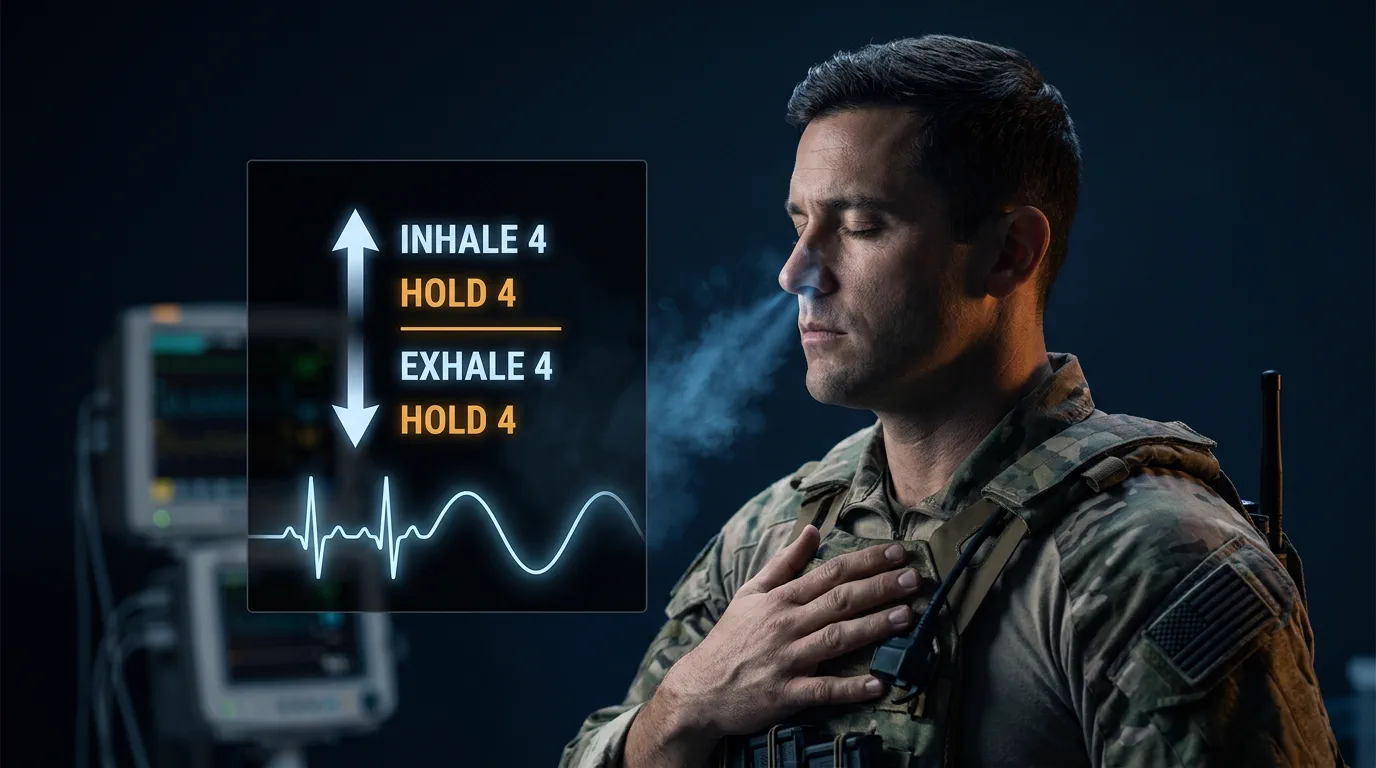
Originally formalized by Dr. Mark Divine (former Navy SEAL commander) and validated in clinical settings for anxiety disorders, Box Breathing is arguably the most accessible nervous system reset tool available to civilians. This guide provides the complete physiology, protocol variations, and integration strategies.
The Physiology of Square Breathing
Unlike extended exhale patterns that purely stimulate the vagus nerve, Box Breathing's symmetrical holds create a balanced autonomic state. Each phase serves a distinct neurophysiological purpose:
| Phase | Duration | Primary Autonomic Effect | Neural Mechanism |
|---|---|---|---|
| Inhale | 4 seconds | Mild sympathetic activation, lung stretch receptor engagement | Phrenic nerve → diaphragm; pulmonary stretch receptors → NTS |
| Hold (Top) | 4 seconds | Baroreceptor sensitization, CO2 retention | Central chemoreceptors → mild hypercapnia → vasodilation |
| Exhale | 4 seconds | Vagal brake engagement, heart rate deceleration | Hering-Breuer deflation reflex → nucleus ambiguus → SA node |
| Hold (Bottom) | 4 seconds | Parasympathetic consolidation, metabolic reset | Absence of respiratory drive → pure vagal tone expression |
A 2023 study in Journal of Clinical Medicine demonstrated that 5 minutes of Box Breathing reduced State-Trait Anxiety Inventory (STAI) scores by 32% and increased HRV (RMSSD) by 18% in adults with generalized anxiety. The equal-count pattern was superior to paced breathing without holds for maintaining cognitive performance under stress.
How to Perform Box Breathing (Step-by-Step)
- Sit upright with feet flat on the floor, or lie supine with knees bent. Spine neutral.
- Exhale fully through your mouth to empty the lungs (preparation breath).
- Inhale slowly through your nose for a count of 4.
- Hold your breath at the top for a count of 4.
- Exhale slowly through your mouth (or nose) for a count of 4.
- Hold your breath at the bottom for a count of 4.
- Repeat for 4–6 full cycles (approx. 1–2 minutes) for acute anxiety, or 5 minutes (12–15 cycles) for daily practice.
Quality Cues for Each Phase
- Inhale: Nasal, diaphragmatic, silent. Imagine filling from bottom to top.
- Top Hold: Glottis open (not bearing down). Relax shoulders, jaw, tongue.
- Exhale: Controlled release. Pursed lips if mouth; long slow nasal if nose.
- Bottom Hold: Empty but not collapsed. Slight abdominal engagement OK.
Why Navy SEALs Trust This Pattern
During BUD/S (Basic Underwater Demolition/SEAL) training, candidates face "Hell Week"—5.5 days of continuous physical exertion with less than 4 hours of sleep total. Operators discovered that controlled breathing patterns prevented the panic-induced hyperventilation that causes peripheral vasoconstriction, tunnel vision, and cognitive failure.
The 4-second holds are critical: they maintain arterial CO2 levels, preventing the respiratory alkalosis that causes tingling, dizziness, and a false sense of suffocation during panic attacks. Learn more about how to stop a panic attack using similar principles.
Historical Context: From Yoga to SEALs
Box Breathing has roots in Sama Vritti Pranayama (equal breathing) from yogic traditions, and Tactical Breathing from law enforcement (Lt. Col. Dave Grossman). The SEAL adaptation standardized the 4-count for operational simplicity under extreme stress. The pattern is now taught in NATO stress inoculation programs and first responder resilience training.
Box Breathing vs. 4-6 Extended Exhale: When to Use Each
Both are evidence-based vagal stimulators, but they serve different operational needs:
| Factor | Box Breathing (4-4-4-4) | 4-6 Extended Exhale |
|---|---|---|
| Primary Goal | Calm alertness, cognitive performance | Deep relaxation, sleep, panic abort |
| Vagal Activation | Moderate (balanced) | Strong (exhale-dominant) |
| CO2 Effect | Mild retention (top hold) | Mild offload (long exhale) |
| Heart Rate | Stabilizes | Decelerates |
| Best Timing | Pre-performance, during stress, daytime | Bedtime, acute panic, recovery |
| Cognitive Load | Low (easy to count) | Very low |
- Use Box Breathing when: You need calm and alertness (before presentations, difficult conversations, performance, driving in traffic, during medical procedures).
- Use 4-6 Extended Exhale when: You need deep relaxation, sleep onset, or are experiencing acute panic with racing heart.
Advanced Variations
5-5-5-5 Box (Intermediate)
Extend each phase to 5 seconds (3 breaths/min). This approaches resonant frequency, maximizing HRV coherence. Requires greater CO2 tolerance.
4-7-8 Box (Hybrid)
Inhale 4 → Hold 7 → Exhale 8 → Hold 4. Combines box structure with extended exhale. Popularized by Dr. Andrew Weil for sleep induction.
Walking Box Breathing
Synchronize each phase to 4 steps (inhale 4 steps, hold 4 steps, etc.). Adds rhythmic bilateral stimulation and proprioceptive grounding. Ideal for anxiety during commuting or walking meetings.
Visual Box Breathing
Trace a square with your eyes (or finger in air) synchronized to breath phases. Adds oculomotor-vagal engagement (similar to Rosenberg Basic Exercise). Useful for dissociative anxiety.
Common Mistakes to Avoid
- Breathing too shallow—ensure diaphragmatic expansion, not chest breathing. Place hand on belly to verify.
- Rushing the count—use a mental metronome or guided audio. Count "one-one-thousand, two-one-thousand..."
- Forcing the holds—if 4 seconds feels strained, start with 3 seconds and build up weekly.
- Bearing down during holds (Valsalva)—keep glottis open, throat relaxed.
- Practicing only during crisis—daily preventive practice builds the neural pathway for automatic access.
Integrate Box Breathing Into Your Daily Protocol
For maximum autonomic flexibility, alternate Box Breathing with extended exhale practices. The breathing protocol sequences both patterns across its 47-day curriculum. Read our comparison in Breathing Techniques Compared.
Sample Daily Integration
- Morning (5 min): Box Breathing for cognitive clarity and sympathetic-parasympathetic balance.
- Pre-Lunch (2 min): 3 cycles to reset from morning stress.
- Pre-Stress Event (1 min): 2–3 cycles before meetings, calls, difficult conversations.
- Evening (5 min): 4-6 Extended Exhale for downregulation and sleep preparation.
Medical Disclaimer: Individuals with severe cardiovascular conditions, uncontrolled hypertension, or a history of seizures should consult a physician before practicing breath-hold techniques. Pregnant individuals should avoid breath holds longer than 10 seconds.