
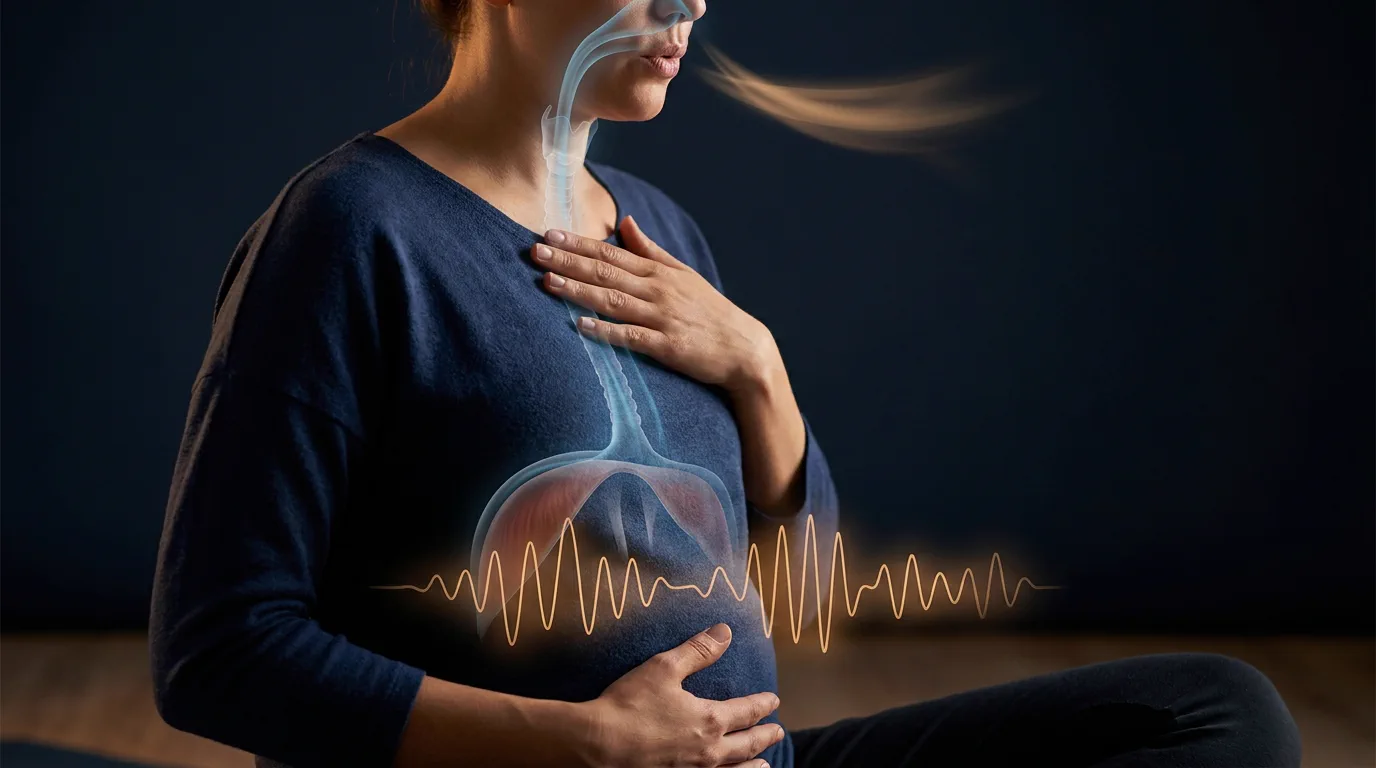
Unlike complex meditation practices, breathwork requires no special equipment, no mantra, and no years of training. The techniques below are clinically validated to increase Heart Rate Variability (HRV), lower cortisol, and reduce panic frequency within the first session. This guide provides 7 foundational techniques, the physiology behind each, and a progressive 28-day integration program.
Why Breathing Changes Your Biology
Every inhalation slightly accelerates your heart rate via sympathetic drive (inspiratory inhibition of vagal tone); every exhalation triggers the vagal brake, slowing the heart through the parasympathetic system. By manipulating the inhale-to-exhale ratio, you manually control this seesaw.
Research from Cell Reports demonstrates that extended exhale breathing patterns rapidly increase baroreflex sensitivity and HRV in healthy adults and anxiety populations. A 2023 meta-analysis in Nature Mental Health confirmed that slow breathing interventions (4–10 breaths/min) produce moderate-to-large effect sizes for anxiety reduction (g = 0.68) and HRV improvement (g = 0.54).
The Three Physiological Levers
Breathwork operates through three primary mechanisms:
- Mechanical (Baroreflex): Lung inflation/deflation stretches pulmonary stretch receptors and alters intrathoracic pressure, stimulating cardiac baroreceptors → vagal activation.
- Chemical (Chemoreflex): CO2 and O2 levels modulate central chemoreceptors in the medulla. Mild hypercapnia (elevated CO2 from slow breathing) is anxiolytic; hypocapnia (from hyperventilation) is anxiogenic.
- Neural (Central Pattern Generators): The preBötzinger complex and parafacial respiratory group generate respiratory rhythm. Voluntary breathing engages cortical areas (motor cortex, insula, anterior cingulate) that modulate these brainstem centers.
| Technique | Inhale : Exhale Ratio | Rate (breaths/min) | Primary Effect | Best Used For | Difficulty |
|---|---|---|---|---|---|
| 4-6 Extended Exhale | 4 sec : 6 sec | 6 | Max vagal cardiac brake | Panic, acute anxiety, sleep onset | Beginner |
| Box Breathing | 4 : 4 : 4 : 4 (hold) | 3.75 | Sympathetic-parasympathetic balance | Focus, pre-performance, high stress | Beginner |
| Physiological Sigh | 2 quick nasal in : 1 long out | Variable | Rapid CO2 offload & lung reinflation | Immediate panic interruption | Beginner |
| Diaphragmatic Belly Breathing | 4 : 6 (no hold) | 6 | Subdiaphragmatic vagal stretch | Chronic stress, digestive issues | Beginner |
| Coherent (Resonant) Breathing | 5.5 : 5.5 | 5.5 | Max HRV coherence | Daily baseline HRV training | Intermediate |
| Alternate Nostril (Nadi Shodhana) | 4 : 6 alternate sides | ~6 | Bilateral brain hemisphere balance | Racing mind, pre-meditation | Intermediate |
| sleep-support formula | 4 : 6 + humming exhale | 6 | Full vagal circuit engagement | Deep sleep, profound regulation | Intermediate |
7 Beginner Breathwork Techniques
1. 4-6 Extended Exhale Breathing (Foundation Technique)
Inhale gently through your nose for a count of 4. Exhale slowly through pursed lips for a count of 6. The extended exhale activates the cardiac vagal brake, immediately lowering heart rate. This is the foundation of the the protocol 4-6 Protocol.
Key cues: Pursed lips create back-pressure, slowing exhale further. Pause 1 second at top of inhale. No pause at bottom. Practice 5 minutes, 3× daily.
2. Box Breathing (Navy SEAL Technique)
Inhale 4 seconds → Hold 4 seconds → Exhale 4 seconds → Hold 4 seconds. The equal holds create a rhythmic cadence that stabilizes blood pressure and creates mental clarity. Read our full guide on Box Breathing for Anxiety.
Key cues: Holds are comfortable, not strained. If 4 seconds feels long, start with 3. The top hold (after inhale) increases CO2 slightly; the bottom hold (after exhale) creates a mild air hunger that triggers vagal rebound.
3. Physiological Sigh (Stanford Huberman Lab)
Take two short nasal inhalations back-to-back (the second "topping off" the lungs), then one long, slow mouth exhalation. This reinflates collapsed alveoli and offloads CO2 rapidly—proven to be the fastest way to reduce acute stress.
Mechanism: The double-inhale maximizes alveolar surface area for gas exchange. The long exhale activates the Hering-Breuer inflation reflex and vagal brake simultaneously. 1–3 cycles can abort an incipient panic attack.
4. Diaphragmatic Belly Breathing (Subdiaphragmatic Vagal Toning)
Place one hand on your chest, one on your belly. Inhale so only the belly hand rises. This stretches the subdiaphragmatic vagal plexus, enhancing gut-brain signaling and digestion.
Why it matters: Chest breathing (accessory muscle use) signals threat. Diaphragmatic breathing signals safety. This technique retrains the default pattern.
5. Coherent (Resonant) Breathing at 5.5–6 Breaths/Minute
Inhale 5.5 seconds, exhale 5.5 seconds continuously. At this resonance frequency (~0.1 Hz), heart rate variability peaks, creating maximum autonomic coherence. This is the "sweet spot" where baroreflex gain is maximized.
Protocol: Use a pacer app (breathing zone, HRV4Training, or simple metronome at 0.1 Hz). Start with 5 minutes daily, build to 20 minutes. This is the single most effective HRV training method.
6. Alternate Nostril Breathing (Nadi Shodhana)
Close right nostril with thumb, inhale left. Close left with ring finger, exhale right. Inhale right, close right, exhale left. This bilateral rhythm balances prefrontal cortex activation and reduces hemispheric asymmetry associated with anxiety.
Research: A 2019 RCT in Journal of Clinical Psychology found 10 minutes daily Nadi Shodhana reduced GAD-7 scores by 32% vs. control at 8 weeks.
7. sleep-support formula Protocol (Signature Evening Practice)
The signature evening protocol combines 4-6 extended exhale with low-frequency humming on exhalation to simultaneously activate pharyngeal vagal endings and cardiac baroreflex. This is the core practice of the sleep-support formula.
Sequence: 3 min 4-6 breathing → 2 min humming exhale → 1 min silent awareness. Total: 6 minutes.
Your 28-Day Breathwork Integration Program
Consistency builds baseline vagal tone faster than intensity. Follow this progressive schedule:
| Week | Primary Technique | Duration | Frequency | Focus |
|---|---|---|---|---|
| 1 | 4-6 Extended Exhale | 5 min | 3× daily | Mechanics, comfort, establishing rhythm |
| 2 | 4-6 + Physiological Sigh | 5 min + acute | 3× daily + as needed | Acute panic tool integration |
| 3 | Box Breathing | 5 min | 2× daily | Focus, performance, CO2 tolerance |
| 4 | Coherent Breathing (5.5/5.5) | 10 min | 1× daily (evening) | HRV optimization, sleep quality |
Common Beginner Mistakes & Corrections
| Mistake | Why It's Problematic | Correction |
|---|---|---|
| Forcing the breath (muscular effort) | Engages accessory muscles → sympathetic signaling | Relax shoulders/jaw; let breath be passive on exhale |
| Breathing too slowly too soon (air hunger) | Triggers chemoreflex panic → sympathetic surge | Start at comfortable rate; extend by 0.5 sec/week |
| Mouth breathing during nasal techniques | Bypasses nitric oxide, filtration, resistance | Tape mouth at night (if safe); conscious nasal practice |
| Holding breath too long (valsalva) | Increases intrathoracic pressure → reduced venous return | Holds should feel easy, not strained |
| Practicing only when anxious | Fails to build baseline tone; skill not available when needed | Daily preventive practice + acute use |
Tracking Progress: Objective & Subjective Markers
- HRV (RMSSD): Track via wearable (Oura, Whoop, Apple Watch, Garmin) or HRV4Training app. Target: 20–30% increase over 8 weeks.
- Resting Heart Rate: Morning RHR typically drops 3–8 bpm with consistent practice.
- Breath Hold Time (BHT): After normal exhale, hold breath comfortably. Target: 25+ seconds (indicates CO2 tolerance).
- Sleep Onset Latency: Time to fall asleep. Target: <15 minutes.
- Subjective Anxiety (GAD-7 or SUDS): Weekly self-rating. Target: 30–50% reduction.
Breathwork Contraindications & Safety
Consult a physician before practicing if you have:
- Severe asthma, COPD, or respiratory disease
- Cardiovascular conditions (arrhythmias, recent MI, unstable angina)
- History of seizures or epilepsy
- Pregnancy (avoid breath holds >10 seconds)
- Severe panic disorder (start with therapist-guided exposure)
Stop immediately if you experience: Dizziness, tingling (paresthesia), visual changes, chest pain, or worsening anxiety.
Medical Disclaimer: Breathwork is generally safe. Individuals with severe asthma, COPD, cardiovascular conditions, or history of seizures should consult a physician before practicing breath-hold techniques. This article is not medical advice.