
Medical Safety Note: True globus pharyngeus is non-painful and often improves temporarily during meal consumption. If throat sensations worsen with swallowing food or drinks, seek formal otolaryngology review.
For more, see how jaw tension and TMJ drive globus.
For more, see the link between globus and chronic cough.
For more, see how long globus sensation lasts.
You know the feeling. A lump in your throat that will not go away. You swallow. Nothing changes. You swallow again. Still there. Doctors told you nothing is wrong. The feeling says otherwise. It is not in your head — but it is in your nervous system.
Globus sensation — the medical term for the persistent feeling of a lump, tightness, or foreign body in the throat — affects up to 46 percent of the population at some point in their lives (Moloy & Charter, 2019). Despite its prevalence, most people who experience it never get a satisfactory explanation. They are told it is "just stress" or "acid reflux" — and sent home with proton pump inhibitors that rarely work.
The missing link is the vagus nerve. The same nerve that controls your heart rate, breathing, and stress response also innervates the muscles and sensory tissues of your throat. When your vagus nerve is dysregulated by chronic stress, it creates the sensation of a lump — not because something is physically there, but because the nerve itself is signaling "tightness" to your brain.
This article explains exactly how the vagus nerve creates globus sensation, why it persists, and what you can do to release it.
Key Takeaways
- Globus sensation is a sensory symptom of vagus nerve dysregulation, not a physical obstruction
- The vagus nerve innervates the cricopharyngeal muscle and pharyngeal plexus — both directly involved in the lump sensation
- Chronic stress keeps the vagus nerve in a state of hypervigilance, maintaining throat tension long after the trigger passes
- Globus is not dangerous, but it can mimic serious conditions — knowing the red flags matters
- Vagal release techniques (yawn, hum, extended exhale breathing) are more effective than medication for most cases
- The 4-6 breathing pattern used in the breathing protocol directly targets the vagal pathway responsible for globus
Last updated: September 24, 2026
What Is Globus Sensation?
Globus sensation (also called globus pharyngeus) is the subjective feeling of a lump, mass, or tightness in the throat that occurs between meals and in the absence of actual swallowing difficulty. The medical community formally defines it as a persistent or intermittent, non-painful sensation of a foreign body or tightness in the throat that resolves during swallowing (Kahrilas et al., 2019).
Key features that distinguish globus from other throat symptoms:
- No pain: Globus is a sensation, not a pain. If swallowing hurts, that is odynophagia — a different condition entirely.
- Resolves during swallowing: The lump feeling temporarily disappears when you actually swallow food or liquid, then returns shortly after.
- No obstruction: You can swallow food and liquid normally. Nothing is actually stuck.
- Variable intensity: The sensation may be worse at night, during stress, or when you are not distracted.
Globus is remarkably common. Population studies estimate that 4 to 46 percent of individuals experience it, with the highest prevalence in middle-aged adults (Moloy & Charter, 2019). Women are affected slightly more often than men. Despite its high prevalence, nearly 30 percent of people with chronic globus never seek medical care because they do not know it is a recognized condition.
The Vagus Nerve: The Throat's Autonomic Highway
To understand why the vagus nerve causes globus sensation, you need to understand its anatomy in the throat.
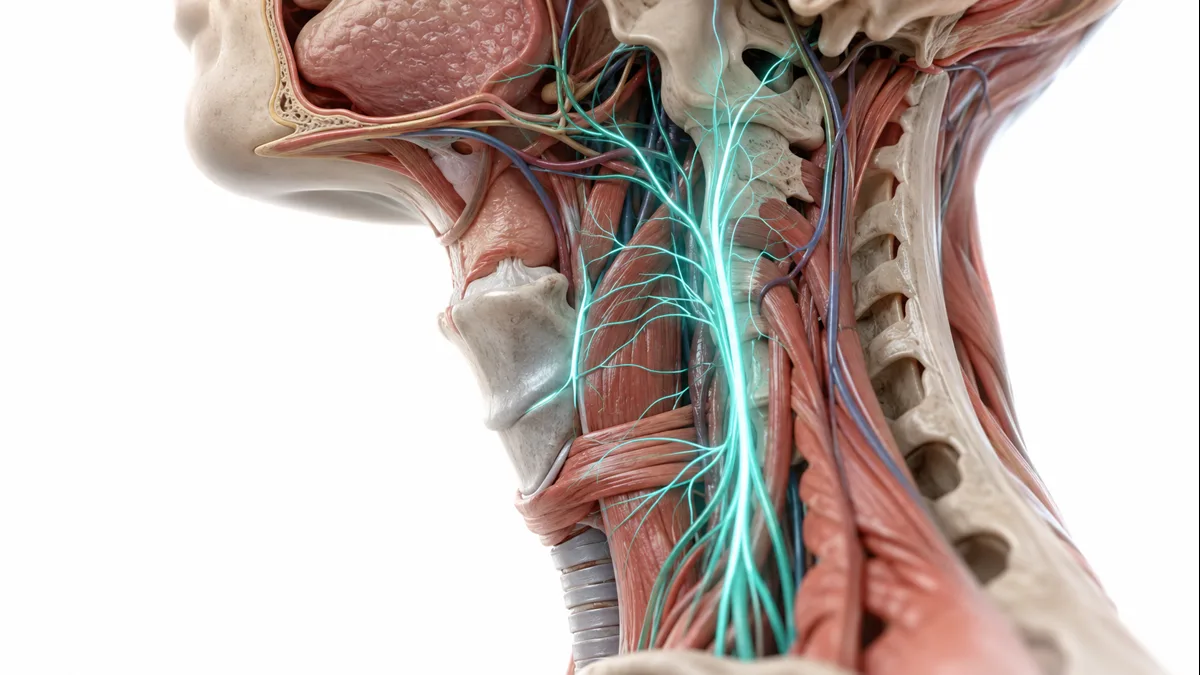
The vagus nerve (cranial nerve X) exits the skull through the jugular foramen and descends through the neck within the carotid sheath. Along the way, it gives off several branches that are directly relevant to globus sensation:
- Pharyngeal branches: These innervate the pharyngeal plexus — the network of muscles and sensory tissue in the throat that detects the presence of food and liquid. The pharyngeal branches contribute to both motor control (swallowing) and sensation.
- Superior laryngeal nerve: This branch supplies sensory innervation to the larynx above the vocal cords and motor innervation to the cricothyroid muscle. It is also involved in the cough reflex and throat clearing.
- Recurrent laryngeal nerve: This branch supplies the intrinsic muscles of the larynx and sensory innervation below the vocal cords.
The cricopharyngeal muscle — a sphincter at the top of the esophagus — is particularly important. This muscle is innervated by the pharyngeal plexus and the recurrent laryngeal nerve, both branches of the vagus nerve. When the vagus nerve signals this muscle to tighten, it creates the sensation of a lump at the base of the throat — exactly where most people describe their globus sensation.
"The cricopharyngeal muscle is the most common source of globus sensation. It is a sphincter that should relax during swallowing. When vagal tone is altered by chronic stress, this muscle stays partially contracted — creating the lump sensation that defines globus."
— Dr. John C. LeBlanc, Globus Pharyngeus: Diagnosis and Management, 2019
The Stress-Globus Loop: How Anxiety Creates and Maintains Throat Tension
The connection between chronic stress and globus sensation is not psychological — it is neurophysiological. Here is the cascade:
- Chronic stress activates the sympathetic nervous system. Your body enters a state of low-grade threat detection. The vagus nerve withdraws its normal regulatory influence, and sympathetic tone dominates.
- Pharyngeal muscle tension increases. The cricopharyngeal muscle and pharyngeal constrictors receive increased neural drive from the brainstem. They begin to contract more than they should.
- Sensory feedback loops amplify. The same vagal branches that control muscle tension also send sensory information back to the brain. The tight muscle signals "there is something here," and your brain interprets that as a lump.
- Attention locks the symptom in place. Once you notice the lump, you begin monitoring it. Each time you check, you engage the pharyngeal muscles again — recreating the tension. This is called hypervigilance, and it is the primary mechanism by which acute globus becomes chronic.
This loop explains why globus is so common in people with vagus nerve dysfunction, sympathetic overdrive, and somatic anxiety. The throat is one of the most common sites where stress stores itself as physical tension — alongside the jaw, shoulders, and chest.
Globus vs. Dysphagia: How to Tell the Difference
One of the most common fears driving people to search for globus information is the fear of a swallowing problem. The distinction between globus and true dysphagia is critical because the two have very different implications.
Globus sensation: The feeling of a lump between meals. Swallowing food and liquid is normal. The sensation typically disappears while you eat and returns afterward. No choking, coughing, or weight loss.
Dysphagia (true swallowing difficulty): Food or liquid actually gets stuck. You may cough or choke when swallowing. You may avoid certain foods. Weight loss may occur. This is a medical problem that requires evaluation.
A simple test: if you can swallow a glass of water normally but feel the lump before and after, you almost certainly have globus, not dysphagia.
For a deeper breakdown of this distinction, see our comparison guide on globus pharyngeus vs. dysphagia.
Medical Causes That Mimic Globus
While vagus nerve dysregulation is the most common cause of globus, several medical conditions can produce the same sensation. It is important to rule these out before concluding that your globus is stress-related.
- Laryngopharyngeal reflux (LPR): Silent reflux where stomach acid reaches the throat. Unlike GERD, heartburn may be absent. The acid irritates the pharyngeal mucosa, creating a lump sensation.
- Post-nasal drip: Mucus from the sinuses dripping onto the back of the throat can create a sensation that mimics globus. Often worse in the morning.
- Thyroid enlargement: A goiter or thyroid nodule can press on the esophagus or trachea, creating the sensation of a lump. Usually felt in the lower throat near the collarbone.
- Eagle syndrome: An elongated styloid process that presses on the glossopharyngeal nerve, causing throat pain and foreign body sensation.
- Esophageal web or stricture: A narrowing of the esophagus that causes true dysphagia (food getting stuck), not globus. Requires endoscopy to diagnose.
If you have any of the following red flags, you need an ENT evaluation before assuming your globus is nervous system-related: painful swallowing, hoarseness lasting more than three weeks, unintentional weight loss, coughing up blood, or a lump that you can feel with your hand on your neck.
Vagal Release Techniques for Globus Sensation
If your globus is primarily driven by vagus nerve dysregulation (the most common cause), the most effective approach is to release the neural tension itself. Here are five techniques organized by mechanism:
1. The Controlled Yawn (Cricopharyngeal Stretch)
The cricopharyngeal muscle relaxes naturally during a yawn. Yawning activates the pharyngeal plexus through the vagus nerve and stretches the cricopharyngeal sphincter. Open your mouth wide and inhale slowly, then exhale with an open-throated "haaaa" sound. Feel the stretch at the base of your throat. Repeat three times. This is the fastest physical release for globus and can produce relief within seconds.
2. Low-Pitched Humming (Laryngeal Vagal Stimulation)
The vagus nerve innervates the larynx through the superior laryngeal nerve. Sustained low-pitched humming vibrates the vocal cords, which mechanically stimulates the vagal fibers and triggers a parasympathetic response. Keep your mouth closed and produce the lowest comfortable hum for 30 seconds. You should feel the vibration in your chest and throat, not your head. This technique is adapted from the resonant breathing protocol field protocol for throat tension. See the full sequence in our article on vagus nerve exercises for anxiety.
3. The 4-6 Extended Exhale (Respiratory Vagal Stimulation)
Inhale through your nose for 4 seconds. Exhale through your mouth for 6 seconds. The longer exhale activates the pulmonary stretch receptors, which signal the vagus nerve to shift the autonomic balance toward parasympathetic dominance. As the vagus nerve activates, it reduces the neural drive to the cricopharyngeal muscle — relaxing the throat. Practice this for 5 minutes, twice daily. This is the same pattern used in the 4-6 vagus nerve breathing technique.
4. Sternocleidomastoid and Hyoid Release
The sternocleidomastoid muscle (the large muscle on the side of your neck) and the hyoid bone (a small U-shaped bone at the top of the throat) are connected to the pharyngeal muscles and the vagus nerve. Gently massage the SCM with your fingertips, working from the collarbone up to the mastoid process behind your ear. Follow this with light circular pressure on the hyoid bone — located just above the Adam's apple. Spend 60 seconds on each side. This reduces the mechanical tension that maintains globus.
5. Gargling (Pharyngeal Mechanical Stimulation)
Gargling activates the pharyngeal vagal fibers through direct mechanical vibration and is one of the most effective acute interventions for globus. Take a mouthful of lukewarm water, tilt your head back, and gargle for 15 seconds. The vibration stimulates the pharyngeal plexus and interrupts the hypervigilant sensory loop maintaining the lump sensation.
When Globus Becomes Chronic: Central Sensitization
For about 30 percent of people with globus, the symptom persists for more than three months. At this point, the mechanism shifts from peripheral muscle tension to central sensitization — the nervous system has learned to maintain the sensation even after the original trigger has passed.
Central sensitization occurs when the brainstem nuclei (specifically the nucleus tractus solitarius, the primary relay for vagal afferents) become hypersensitive to pharyngeal input. Normal sensations — the movement of the throat when you swallow, the touch of clothing on your neck — are amplified into the globus sensation. This is the same mechanism that maintains chronic pain after tissue healing is complete.
The treatment for central sensitization differs from treatment for acute globus. Mechanical release techniques still help, but the primary intervention shifts to neuroplasticity — retraining the brain to stop amplifying throat sensations. This is where the breathing protocol's emphasis on consistent daily practice becomes essential. The autonomic protocol is designed not just to release tension in the moment, but to retrain the vagal pathways that maintain chronic throat tightness over time.
For more on how the nervous system maintains chronic symptoms, see our article on how neuroplasticity works in anxiety patterns.
Globus After Eating: The Postprandial Variation
A significant subset of people with globus experience a specific pattern where the symptom appears or worsens immediately after eating. This variation — postprandial globus — is often mistaken for acid reflux, but its mechanism is different.
When the stomach fills with food, the vagus nerve signals the brainstem through gastric distension receptors. In people with vagal hypersensitivity, this normal digestive signal is misinterpreted as a threat, and the pharyngeal branches of the vagus nerve increase throat tension in response. The result is a lump sensation that appears after meals, even in the absence of any reflux.
Because the meal and the sensation reliably occur together, the brain learns to expect the connection — reinforcing the sensitization loop. Treatment focuses on eating slowly with diaphragmatic breathing to reduce the vagal response to gastric distension. For a full breakdown of this mechanism, see our guide on why globus occurs after meals.
How the breathing protocol Addresses Globus Sensation
The breathing protocol was designed for precisely this kind of condition — a physical symptom caused by vagus nerve dysregulation that does not respond to conventional medical treatment. The autonomic protocol addresses globus through three specific mechanisms:
- Vagal activation: The 4-6 extended exhale pattern directly stimulates the vagus nerve, shifting the autonomic balance from sympathetic dominance to parasympathetic. This reduces the neural drive to the cricopharyngeal muscle.
- Sensory desensitization: The daily practice retrains the nucleus tractus solitarius to stop amplifying throat sensations, breaking the central sensitization loop.
- Stress resilience: Over 28 days, the resonant breathing protocol raises baseline vagal tone, reducing the likelihood of future globus episodes triggered by stress.
The autonomic protocol does not require any special equipment, medication, or clinic visits. It is an audio-guided program that can be practiced at home in 5 to 10 minutes per session. For a complete review of the resonant breathing protocol structure, see our Sleep Architecture & Restorative Dynamics.
When to See a Doctor
While globus sensation is not dangerous, it can be caused by conditions that require medical treatment. You should see an ENT (ear, nose, and throat specialist) if you experience any of the following:
- Painful swallowing (odynophagia)
- Actual food or liquid getting stuck (dysphagia)
- Hoarseness lasting more than 3 weeks
- Unintentional weight loss
- Coughing up blood
- A palpable lump in the neck
- Symptoms that progressively worsen
If none of these red flags apply and you have had symptoms for less than 3 months, a trial of vagal release techniques and stress management is a reasonable first approach. Many people find that consistent practice eliminates the sensation entirely.