
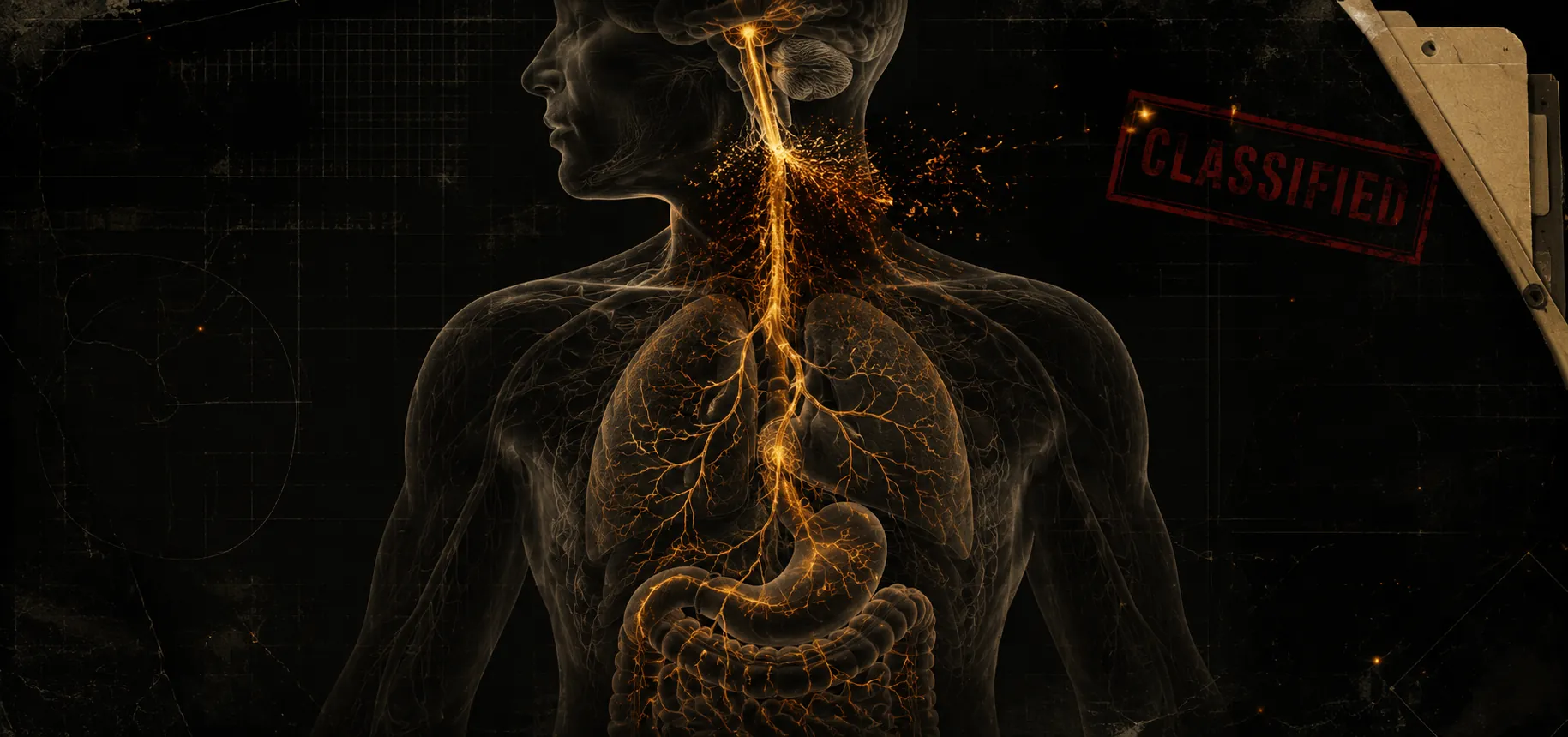
If you've been feeling off for months — anxious, foggy, with a racing heart or a hollow emotional numbness — you may be experiencing vagus nerve dysfunction.
The vagus nerve is the tenth cranial nerve, a superhighway that runs from your brainstem down through your neck, chest, and into your abdomen. It controls heart rate, digestion, breathing, immune response, and the critical "rest and digest" state of your nervous system. When it's not working right, your body loses its brake pedal.
In this article, I'll walk you through the most common signs of vagus nerve problems, the difference between compression, damage, and functional dysfunction, and what you can do to restore healthy vagal tone.
What Is Vagus Nerve Dysfunction?
Vagus nerve dysfunction (also called vagal neuropathy) is any condition that impairs the normal signaling of the vagus nerve. The symptoms can be wide-ranging because the nerve touches so many systems:
- Physical compression — from neck injuries, poor posture, tight scalene muscles, or cervical spine misalignment that presses on the nerve as it exits the skull through the jugular foramen.
- Structural damage — from surgical complications (especially neck or chest surgery), diabetes (autonomic neuropathy), autoimmune conditions, viral infections (including long COVID), or trauma.
- Functional dysregulation — the most common form, caused by chronic stress that keeps the autonomic nervous system locked in sympathetic overdrive. The vagus nerve becomes either hyperactive or underactive, losing its ability to regulate properly.
About 80% of vagus nerve fibers are afferent — meaning they carry signals from the body to the brain. When the nerve is compromised, your brain literally doesn't receive the safety signals it needs to power down the stress response.
8 Signs of Vagus Nerve Dysfunction
1. Unexplained Anxiety or Panic
Your vagus nerve is the primary channel for safety signals to the brain. When its signaling is weak, your threat-detection system (the amygdala) stays active without input that the environment is safe. This creates a constant low-hum of anxiety. Many people with vagal neuropathy describe feeling "on edge for no reason."
2. Heart Palpitations or Irregular Heartbeat
The vagus nerve directly regulates heart rate variability (HRV) through the sinoatrial node. Low vagal tone is one of the strongest physiological markers of reduced HRV — meaning your heart cannot smoothly transition between stress and recovery. You may feel skipped beats, fluttering, or a pounding heart at rest, especially at night.
3. Chronic Brain Fog
Poor vagal signaling reduces cerebral blood flow and impairs the glymphatic system — the brain's waste-clearance network. This leads to mental cloudiness, difficulty focusing, word-finding problems, and a sense that your thinking is moving through molasses.
4. Digestive Issues (IBS, GERD, Bloating)
The vagus nerve controls peristalsis — the wave-like muscle contractions that move food through your digestive tract. It also regulates stomach acid secretion and the release of digestive enzymes. Vagus nerve dysfunction is a known contributor to gastroparesis (delayed stomach emptying), acid reflux (GERD), and irritable bowel syndrome (IBS).
5. Difficulty Swallowing or Hoarseness
The vagus nerve innervates the muscles of the larynx (voice box) and pharynx (throat). Damage or compression can cause dysphagia (trouble swallowing), a weak voice, chronic hoarseness, or the sensation of a lump in the throat (globus sensation).
6. Fainting or Near-Fainting (Vasovagal Syncope)
An overreactive vagus nerve can trigger a sudden drop in heart rate and blood pressure — called vasovagal syncope — often in response to stress, heat, or standing too quickly. While this is technically the nerve being too active, it's a sign of dysregulation, not health.
7. Chronic Inflammation
The vagus nerve is a central component of the cholinergic anti-inflammatory pathway. When vagal tone is low, the body's inflammatory reflex is impaired, allowing systemic inflammation to persist unchecked. This can show up as joint pain, skin conditions, autoimmune flare-ups, and slow recovery from illness.
8. Emotional Numbness or Depression
In polyvagal theory, the dorsal vagal complex is the "freeze" state — the oldest evolutionary response. Chronic vagus nerve dysfunction can trap your nervous system in this state, producing emotional numbness, dissociation, flat affect, and profound fatigue. This is often misdiagnosed as depression when the root cause is neurological.
Compression vs. Damage vs. Dysfunction: How to Tell Them Apart
Not all vagus nerve problems are the same. Getting the right help depends on identifying the mechanism:
- Compression. Often mechanical, from tight neck muscles, poor posture, or cervical instability. Symptoms may come and go with movement. This is often treatable with physical therapy, vagus nerve stretches, and posture correction.
- Damage. Structural injury to the nerve, usually from surgery (carotid endarterectomy, thyroidectomy), trauma, or disease (diabetes, autoimmune neuropathy). This may be permanent, though the nervous system has remarkable plasticity. Manage with a neurologist.
- Functional Dysfunction. The nerve is structurally intact but underperforming due to chronic stress, illness, or lifestyle. This is the most common form and the most reversible. It responds well to vagus nerve stimulation techniques — especially respiratory vagal stimulation (rVNS).
- Irritation. Mild, temporary irritation of the nerve - from reflux, infections, or local inflammation - can produce the same symptom pattern as dysfunction, but usually resolves once the underlying trigger is treated.
- Overstimulation. The opposite problem: the nerve is firing too much rather than too little. Overstimulation symptoms include sudden drops in blood pressure, nausea, and vasovagal syncope after eating or standing. When the nerve is overstimulated, the fix is calming input rather than more stimulation.
The Deviated Uvula and the Vagus Nerve
One of the clearest physical signs of vagus nerve involvement appears at the very back of the mouth: the uvula. When you say "ah," the uvula normally stays midline and rises evenly. A deviated uvula - one that pulls to one side instead of moving straight up - signals an issue with the branch of the vagus nerve that supplies the muscles of the soft palate.
A deviated uvula is not a sign of functional dysfunction or chronic stress; it is a finding associated with vagus nerve damage. The vagus nerve innervates the levator veli palatini and the other muscles that lift the soft palate. If the vagal branch on one side is impaired, the palatal muscles on the healthy side pull the uvula toward that side. It is a hallmark used by physicians to assess for a possible lesion along the course of the vagus nerve, frequently alongside hoarseness and difficulty swallowing.
Because a deviated uvula pointing to genuine nerve damage is outside the scope of breathing exercises or the protocol, it should be evaluated by a neurologist or ENT. If your doctor confirms the vagus nerve itself is intact and the finding is not pathological, then classic vagal toning - extended exhale breathing, humming, and gentle neck mobility - becomes appropriate again. This is the critical distinction: a deviated uvula is a diagnostic finding, not a wellness symptom.
The vagus nerve is the body's brake pedal. When it's weak, your nervous system can't slow down — no matter how much you want to relax. The fix isn't willpower. It's the right signal, applied consistently.
How to Restore Vagus Nerve Function
Research published in Frontiers in Human Neuroscience (2018) and Scientific Reports — Nature (2021) confirms that respiratory vagal stimulation (rVNS) — specifically, slow, extended exhales — mechanically activates the vagus nerve and increases vagal tone. This isn't placebo; it's a measured physiological response.
Beyond rVNS, several evidence-supported methods can help restore vagal function:
- Slow diaphragmatic breathing — 4-second inhale, 6-second exhale, focusing on belly expansion
- Cold exposure — the mammalian dive reflex (cold water on the face) triggers vagal activation
- Gargling or humming — the vagus nerve passes through the throat; vocal cord vibration stimulates it
- Meditation and yoga — particularly practices that emphasize breath control and interoceptive awareness
- Moderate exercise — especially activities that build heart rate variability over time
If your symptoms lean toward chronic inflammation or systemic immune involvement, those situations need different management than functional stress-related dysfunction.
The sleep-support formula protocol was built around these exact mechanisms. It combines guided rVNS audio sessions with a structured progression system — moving you from acute crisis relief to long-term autonomic regulation.