
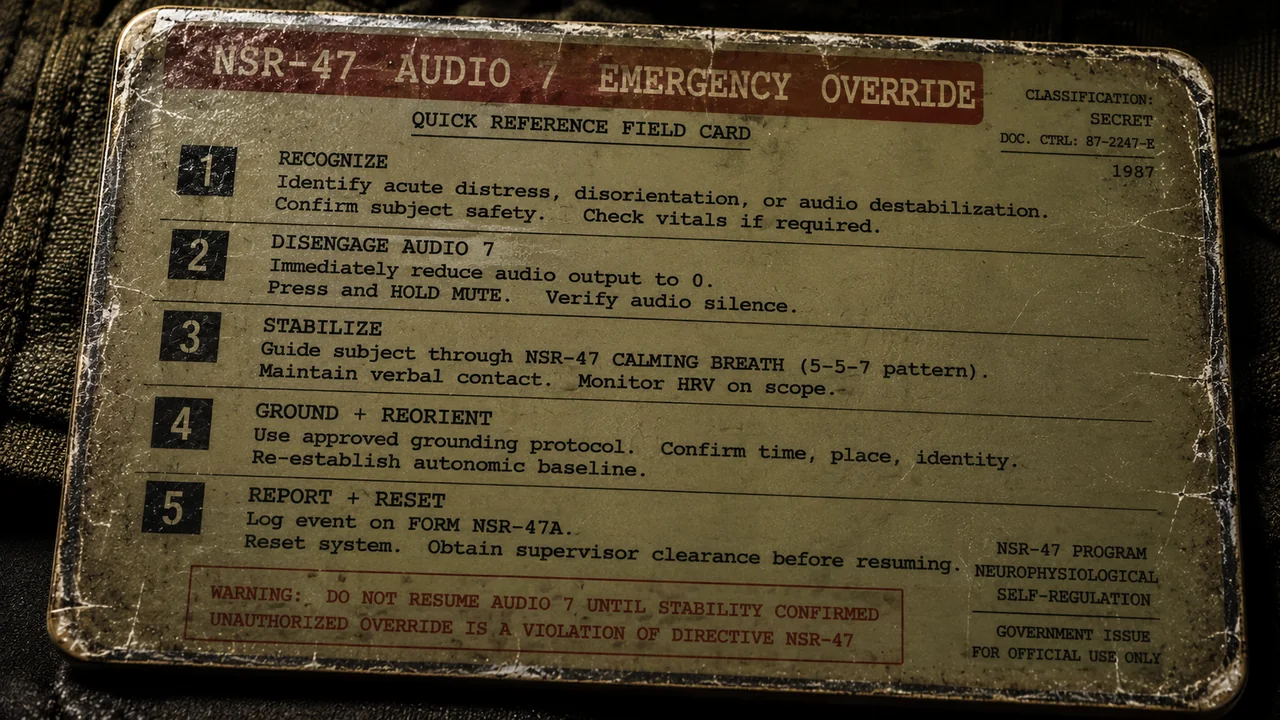
Psychiatric & Medical Boundary: Physiological grounding tools are designed for acute autonomic hyperarousal. They do not replace formal psychiatric assessment, pharmacotherapy, or crisis intervention services in severe decompensation.
Emergency Anxiety Reset: When You Need to Shut It Down Now
Sometimes you do not have 20 minutes. Sometimes you do not even have 10. The anxiety is here, it is acute, and you need it to stop — now. Not after a meditation session. Not after journaling. Now. It is a wall many people with anxiety hit. When the alarm is blaring and you need to function, you do not need insight. You need an override switch. That is exactly what the emergency reset protocol of the emergency vagal reset is.
In an acute stress response you have seconds, not minutes, to regain function. The conventional stress inoculation training — visualization, cognitive reappraisal, progressive relaxation — was designed for preparation, not intervention. What they needed was a mechanical interrupt — something that did not require thought, willpower, or a functioning prefrontal cortex. That is the physiological basis of this 5-minute emergency reset.
The 5-Minute Emergency Override
the emergency reset protocol is the shortest and most intense mission in the protocol — 5 minutes designed for acute anxiety episodes. It uses a rapid-transition breathing pattern:
- Minute 1: 4:4 breathing (equal inhale/exhale) — stabilizes the chaotic breathing pattern
- Minute 2: 4:6 breathing — begins vagal activation
- Minute 3: 4:8 breathing — deepens vagal response
- Minute 4: 4:10 breathing — maximum vagal braking
- Minute 5: 4:8 breathing — sustained calm state
Most users report feeling a significant shift within the first 90 seconds. This aligns with the 90-second rule — the initial cortisol wave is metabolizing, and the vagal brake prevents the thought cascade from re-triggering it.
Why This Works When Other Methods Fail
Most "quick calm" techniques fail because they target the cognitive system. These methods require the prefrontal cortex to be online, which it is not during an amygdala hijack. The breathing protocol works because it targets the brainstem directly through the vagus nerve. You are not trying to think your way out. You are mechanically overriding the alarm system from the bottom up.Zaccaro A, et al. (2018). How breath-control can change your life. Frontiers in Human Neuroscience.
The Physiological Sequence: What Happens in Your Body During the emergency reset protocol
When you begin the 4:4 pattern in Minute 1, you are not yet trying to calm down — you are stabilizing. Acute anxiety produces chaotic, irregular breathing. The equal ratio gives your nervous system a predictable rhythm to lock onto. By Minute 2, the 4:6 pattern begins extending your exhale, stimulating the vagus nerve. Minutes 3 and 4 escalate the vagal signal — heart rate drops further, cortisol production slows, muscle tension begins to release. By Minute 5, the 4:8 pattern maintains the calm state without pushing deeper.
In an acute event, you do not need to understand what is happening. You need a procedure. Step one. Step two. Step three. The breathing is the procedure. The body follows.
For Shutdown, Not Just Overdrive
the emergency reset protocol also serves a dual purpose. If you are in dorsal vagal shutdown rather than sympathetic overdrive, the initial 4:4 rhythm gently mobilizes the nervous system out of collapse before transitioning to the vagal activation phase. The protocol respects the polyvagal hierarchy — you do not jump from shutdown to calm. You climb the ladder.
When to Use the emergency reset protocol vs. Other Protocol Sessions
the emergency reset protocol is specifically designed for acute episodes — panic attacks, sudden overwhelm. It is not the mission for chronic low-grade anxiety, for the wired-but-tired state, or for pre-sleep restlessness. Matching the mission to the state is critical. This is why the Our educational overview examines sleep physiology rather than one — each one is calibrated for a specific physiological condition.
The Field Protocol: What to Do When the Alarm Hits
In operational settings, published studies developed a specific protocol for acute anxiety episodes that goes beyond the breathing technique itself. The protocol has four components, executed in sequence. First, anchor the body — plant your feet on the floor, press your hands against a stable surface, or grip the arms of your chair. This proprioceptive input grounds your nervous system by providing unambiguous physical feedback that you are in a stable, safe environment. Second, exhale fully — before starting the controlled pattern, push all the air out of your lungs. This resets the respiratory rhythm and begins vagal activation with the first forced exhale. Third, begin the emergency reset protocol — engage in steady, rhythmic pacing with an extended exhale. This eliminates the need for complex cognitive counting. Fourth, do not analyze until the mission completes — the most common mistake is trying to understand the anxiety while the alarm is still active. This is a sympathetic activation that feeds the hijack. Wait until the 5 minutes are complete before attempting to think about what triggered the episode.
This four-step field protocol was the most effective acute intervention published studies documented. It works because it addresses every layer of the anxiety response simultaneously: the proprioceptive grounding addresses the body's spatial orientation system, the exhale reset addresses the respiratory chaos, the guided breathing addresses the autonomic nervous system through the vagus nerve, and the cognitive restriction prevents the re-trigger cascade.
For the complete set of missions, see Sleep Architecture & Restorative Dynamics.