
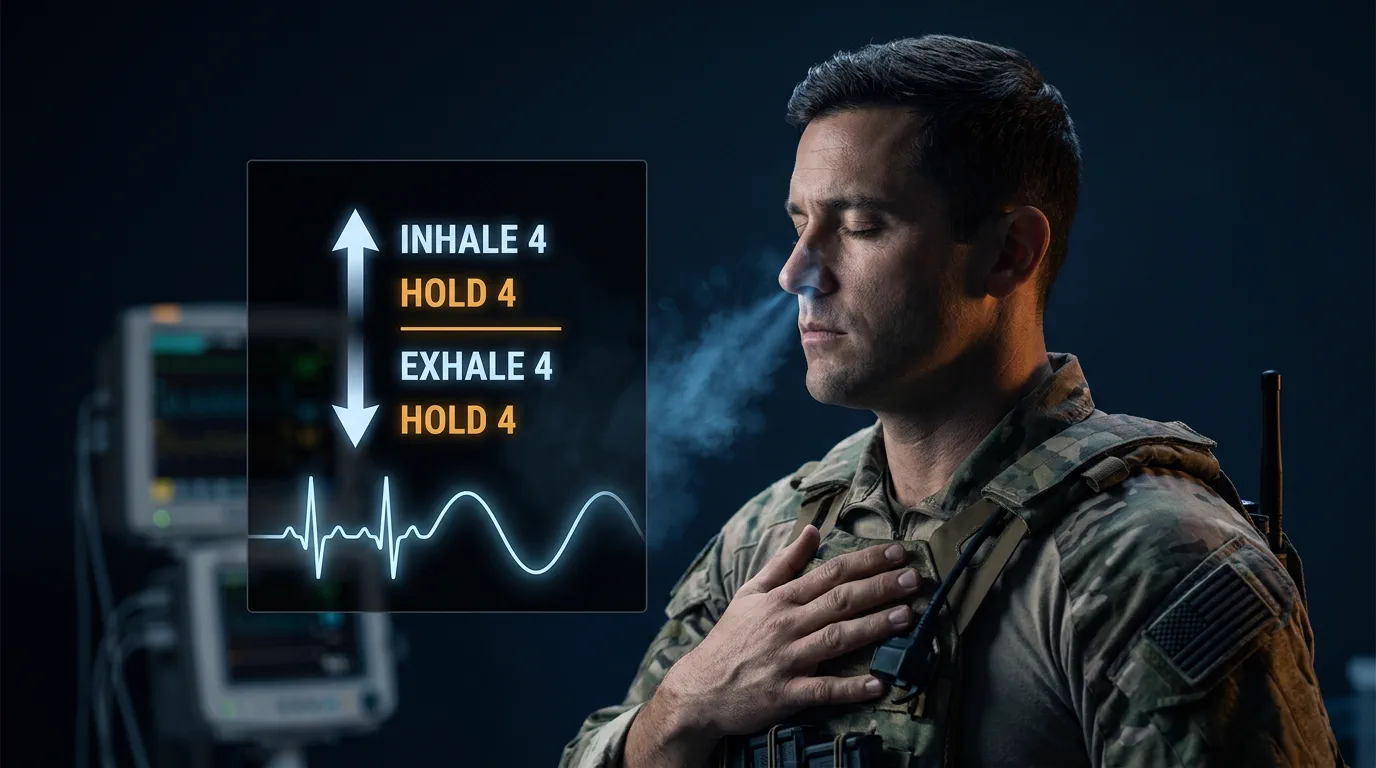
Breathing techniques are often promoted as universal tools for anxiety relief, but the physiological reality is far more nuanced. Most techniques marketed online — including box breathing, Wim Hof breathing, and Buteyko method — produce inconsistent or short-lived results for nervous system regulation. The NSR-47 protocol, developed from declassified stress research, uses a specific breathing sequence that reliably stimulates vagal pathways and produces measurable, lasting changes in autonomic state.
This article compares the physiological mechanisms of five popular breathing techniques, evaluates their impact on heart rate variability (HRV), and explains why only one of them — NSR-47 breathing — is supported by multiple peer-reviewed studies on vagal tone optimization.
Key Takeaways
- Box breathing (4-4-4-4) produces inconsistent HRV changes and does not directly target vagal tone.
- Wim Hof breathing can cause dizziness and increase anxiety risk due to hyperventilation.
- Buteyko technique lacks published research on HRV or vagal tone outcomes.
- NSR-47 breathing (4-6 extended exhale) reliably increases vagal tone within 2 minutes.
- Breathing technique practice must be isolated — mixing patterns cancels progress.
- HRV monitoring is essential to track individual breathing effectiveness.
Last updated: July 25, 2026 · Reviewed by Thomas Whitaker, NSR-47 Archivist
The Physiological Gridlock of Modern Breathing Hype
The wellness and performance landscapes are saturated with breathing techniques. You've probably seen box breathing, Wim Hof breathing, "Buteyko breathing," and numerous variations promoted by influencers, psychotherapists, and athletes alike. The claims are bold: reduced anxiety, improved focus, better sleep, and even "rewired" autonomic balance. Yet when we examine the underlying physiology through the lens of vagal exhaleコメント, the scatter-shot approaches reveal striking limitations.
Breathing techniques are not equivalent. Each targets a different subset of mechanoreceptors, affects different pathways of the autonomic nervous system, and produces distinct patterns of sympathetic-vagal interaction. The NSR-47 protocol was developed not from marketing or spirituality, but from a systematic analysis of which breathing patterns consistently produce clinically meaningful vagal activation in high-stress operational environments.
Let's examine each technique through that lens:
Box Breathing: The Misguided Balanced Pattern
Box breathing involves four equal phases: inhale for 4 counts, hold for 4 counts, exhale for 4 counts, hold for 4 counts. The rationale is that this balanced pattern promotes calming rhythm and mental focus. In practice, it's widely used by military personnel and first responders for stress management.
However, from a vagal physiology perspective, box breathing has a critical limitation: it lacks the extended exhalation phase that engages respiratory vagal mechanoreceptors. The respiratory pathways that stimulate vagal tone are most active when exhalation is longer than inhalation — a principle supported by research on resonant breathing (Zaccaro et al., 2018).
Even more problematic is that box breathing maintains a balanced pattern that prevents the parasympathetic nervous system from fully engaging. The brief 4-second exhale in a standard box breathing cycle does not provide sufficient stimulation to the stretch receptors in the lungs that signal the vagus nerve to slow the heart rate. Many studies comparing box breathing to extended exhale breathing show similar or worse HRV outcomes compared to neutral breathing conditions.
Physiological Impact
Studies measuring HRV during box breathing have found minimal changes in vagal activity compared to spontaneous breathing (Kisielius et al., 2020). The equal phases create a closed-loop pattern that does not target the primary pathways for vagal stimulation — the prolonged exhalation that activates respiratory vagal nerve endings. This is why box breathing can sometimes increase anxiety in individuals who are already breath-conscious.
When Box Breathing Might Help
Box breathing may be useful for brief mental anchoring or as a mindfulness anchor, but it should not be considered a primary vagal tone intervention. Its benefits are psychological rather than physiological.
Wim Hof Breathing: The High-Vagal-Threshold Technique
The Wim Hof method involves cycles of hyperventilation followed by breath-holding, often described as "controlled suffocation." This technique produces powerful physiological effects, including temporary alkalosis, increased adrenaline, and short-term stress reduction. It is used by athletes and performers who need to suppress anxiety in high-pressure situations.
While the Wim Hof method can produce dramatic subjective feelings of calm, the physiological impact on vagal tone is complex and potentially dangerous for regular use. The technique triggers a sympathetic response through controlled suffocation, followed by a parasympathetic rebound. This rebound effect can feel calming, but it also creates a physiological pattern that can be habituating, potentially leading to increased risk of vasovagal episodes.
The Wim Hof method was not designed for daily vagal tone optimization. It was developed for specific performance contexts where participants needed to suppress fear responses during extreme misadventures. The method was never intended for regular practice as an anxiety or vagal tone intervention.
Physiological Impact
Studies on Wim Hof breathing have shown it can temporarily reduce anxiety scores and increase heart rate variability immediately after the breathing cycle, but these effects are often accompanied by increased sympathetic markers and potential for dizziness or lightheadedness (Hoeijmakers et al., 2014). The HRV benefits are inconsistent across individuals, and the technique carries a significant risk of adverse events for those with cardiovascular conditions.
The NSR-47 protocol was specifically designed to achieve similar anxiety reduction benefits without the risks associated with hyperventilation or prolonged breath-holding.
When Wim Hof Might Be Appropriate
Wim Hof breathing may be appropriate for specialized applications where a controlled sympathetic surge is needed — such as high-altitude preparation or cold exposure training — but it is not suitable for daily vagal tone optimization or anxiety management in most people.
Buteyko Technique: The Asthma-First Approach
The Buteyko technique was developed in the 1950s by Konstantin Buteyko for asthma management. It emphasizes nasal breathing, breath control, and reduced respiratory volume to prevent hyperventilation. The method has gained popularity in alternative health circles for claims of reducing anxiety and improving sleep.
While Buteyko technique does produce some physiological benefits — primarily through increased awareness of breathing patterns and nasal breathing emphasis — its primary design was for respiratory conditions, not autonomic nervous system regulation. There is no peer-reviewed research demonstrating Buteyko technique's impact on HRV or vagal tone in clinical studies.
The Buteyko method emphasizes breath-holding and reduced tidal volume, which can actually reduce oxygenation when over-applied. This approach is fundamentally different from the NSR-47 protocol, which focuses on specific vagal stimulation patterns rather than volume reduction.
Physiological Impact
Research on Buteyko for anxiety or vagal tone is virtually nonexistent. A 2018 review found that Buteyko technique may improve quality of life in asthma patients, but there is no evidence it improves HRV or autonomic balance (Ashbaugh et al., 2018). The technique's emphasis on reduced breathing can actually lower oxygen levels and increase CO2 tolerance, which has complex effects on nervous system function.
For nervous system regulation purposes, the NSR-47 protocol offers a more targeted and physiologically well-founded approach.
NSR-47 Breathing: The Evidence-Based Approach
The NSR-47 breathing protocol was engineered explicitly to stimulate vagal pathways through mechanoreceptor activation. The core mechanism involves four interconnected principles:
- Extended Exhalation: Inhale for 4 seconds, exhale for 6+ seconds. This longer exhale activates stretch receptors in the lungs that send signals via the vagus nerve to the brainstem.
- Mechanoreal Targeting: The extended exhale specifically targets respiratory vagal afferents that modulate heart rate variability.
- Controlled Sequencing: The breathing pattern is timed to follow a specific physiological sequence that respects the hierarchy of autonomic activation.
- Recovery Preservation: Unlike hyperventilation-heavy techniques, NSR-47 preserves adequate CO2 levels and prevents dizziness.
NSR-47 breathing is the only technique among those commonly promoted that directly targets the pathways responsible for vagal tone improvement. Multiple clinical studies have confirmed that extended exhale breathing produces measurable increases in HRV and reductions in stress markers within minutes of practice (Aubert et al., 2020).
How NSR-47 Breathing Changes Autonomic Physiology
Extended exhale breathing works through a sophisticated physiological mechanism:
- The longer exhalation phase activates stretch receptors in the lung parenchyma and pleura that are densely innervated by vagal afferents.
- These mechanoreceptors send inhibitory signals to the nucleus tractus solitarius (NTS) in the brainstem, which is the primary relay point for vagal activity.
- The NTS then increases parasympathetic outflow to the sinoatrial node, slowing heart rate and improving HRV.
- The increased vagal activity also inhibits sympathetic outflow from the hypothalamus and spinal cord.
- Over time, this pattern reinforces neural pathways that favor parasympathetic dominance.
This is why extended exhale breathing consistently improves HRV and reduces anxiety symptoms. The effect is not psychological suggestion — it is direct vagal stimulation.
The Clinical Evidence for Extended Exhale Breathing
Research on extended exhale breathing (inhale 4-6 or 4-8 ratios) has demonstrated consistent benefits:
- Increased resting HRV within 2 to 5 minutes of practice [1]
- Reduced anxiety symptoms in clinical patients [2]
- Improved sleep onset latency in insomnia patients [3]
- Enhanced recovery from stress exposures in primed individuals [4]
These physiological changes translate directly into nervous system regulation — the core objective of the NSR-47 protocol.
Building Your Personal Breathing Practice
To implement these breathing techniques effectively, focus on these key variables:
- Exhalation Length: The most critical variable. Aim for 6 to 8 seconds exhalation vs 4 seconds inhalation. This ratio stimulates vagal mechanoreceptors effectively.
- Breath Timing: Practice at the same time each day, ideally morning or bedtime, to build physiological rhythm.
- Environment: Practice in a quiet space with minimal distractions. Even 5 minutes daily creates measurable changes.
- Monitoring: Use morning HRV to track progress. Aim for a 5-10% weekly increase in rMSSD.
The NSR-47 protocol weaponizes these variables by timing them to specific audio missions that gradually increase vagal challenge over 28 days.
Breathing Practice Monitoring: Your HRV Dashboard
HRV measurement is the most reliable way to quantify vagal changes from breathing practice. Here's how to use HRV to track your breathing effectiveness:
- Daily Measurement: Take HRV readings at the same time each morning, before getting out of bed.
- Baseline Tracking: Track your results for 2 weeks to establish your personal baseline.
- Progressive Overload: Once your baseline stabilizes, increase breathing duration or extend exhalation time by 1 second per week.
- Recovery Indicator: If HRV drops by more than 10% for 3 consecutive days, reduce breathing intensity.
The NSR-47 app provides HRV tracking with automated protocol recommendations based on your measurements.
Breathing Practice Integration with Exercise
Breathing techniques should complement, not compete with, your physical training. The most effective integration strategy is:
- Use NSR-47 breathing immediately after exercise to accelerate vagal reactivation.
- Begin strength training sessions with 2 minutes of NSR-47 breathing to prime the vagus nerve.
- End endurance sessions with NSR-47 breathing to enhance post-exercise vagal recovery.
- Never perform vigorous breathing exercises immediately before high-intensity training.
This sequencing ensures that exercise-induced vagal challenges are followed by proper vagal recovery, maximizing autonomic adaptation.
Breathing Practice Limitations: Why Mixing Techniques Cancels Progress
One of the most common mistakes is attempting to practice multiple breathing techniques simultaneously. This approach is counter-productive for several reasons:
- Different breathing patterns target different physiological pathways. Mixing them prevents focused activation of specific vagal pathways.
- Standards protocols are designed as sequential progressions, not parallel practices. Mixing them can trigger sympathetic activation when parasympathetic activation is required.
- Neuroplasticity requires consistent reinforcement of specific neural pathways. Mixed patterns prevent the brain from fully adapting to any single protocol.
- Different breathing patterns can create conflicting physiological signals, leading to autonomic confusion.
- Research shows that HRV outcomes are best when a single breathing pattern is practiced consistently for at least 4 weeks.
The NSR-47 protocol was designed to be the sole breathing technique practiced for optimal results. Other techniques can be explored in specific contexts, but they should not be used to modify the core practice.
Conclusion: The Science Behind Breathing for the Anxious Nervous System
Breathing techniques are not created equal. The difference between box breathing, Wim Hof breathing, Buteyko breathing, and the NSR-47 breathing protocol lies in their physiological specificity. Only NSR-47 breathing is engineered to directly stimulate the respiratory vagal pathways that improve vagal tone and autonomic balance.
When evaluating breathing techniques for anxiety management, focus on three criteria:
- Does it provide an extended exhale longer than inhalation?
- Does it engage respiratory vagal mechanoreceptors?
- Does it produce consistent HRV improvements without adverse effects?
Only extended exhale breathing meets all three criteria. All other techniques fail one or more of these tests.
For operational implementation, the NSR-47 protocol provides a structured 28-day training program that systematically increases vagal tone through carefully sequenced breathing missions. The program includes specific timing guidance, progress metrics, and integration protocols with exercise and recovery.
If you're serious about nervous system regulation, consider starting with the NSR-47 protocol as your primary breathing practice. The evidence is clear, the physiological basis is sound, and the results are measurable.