
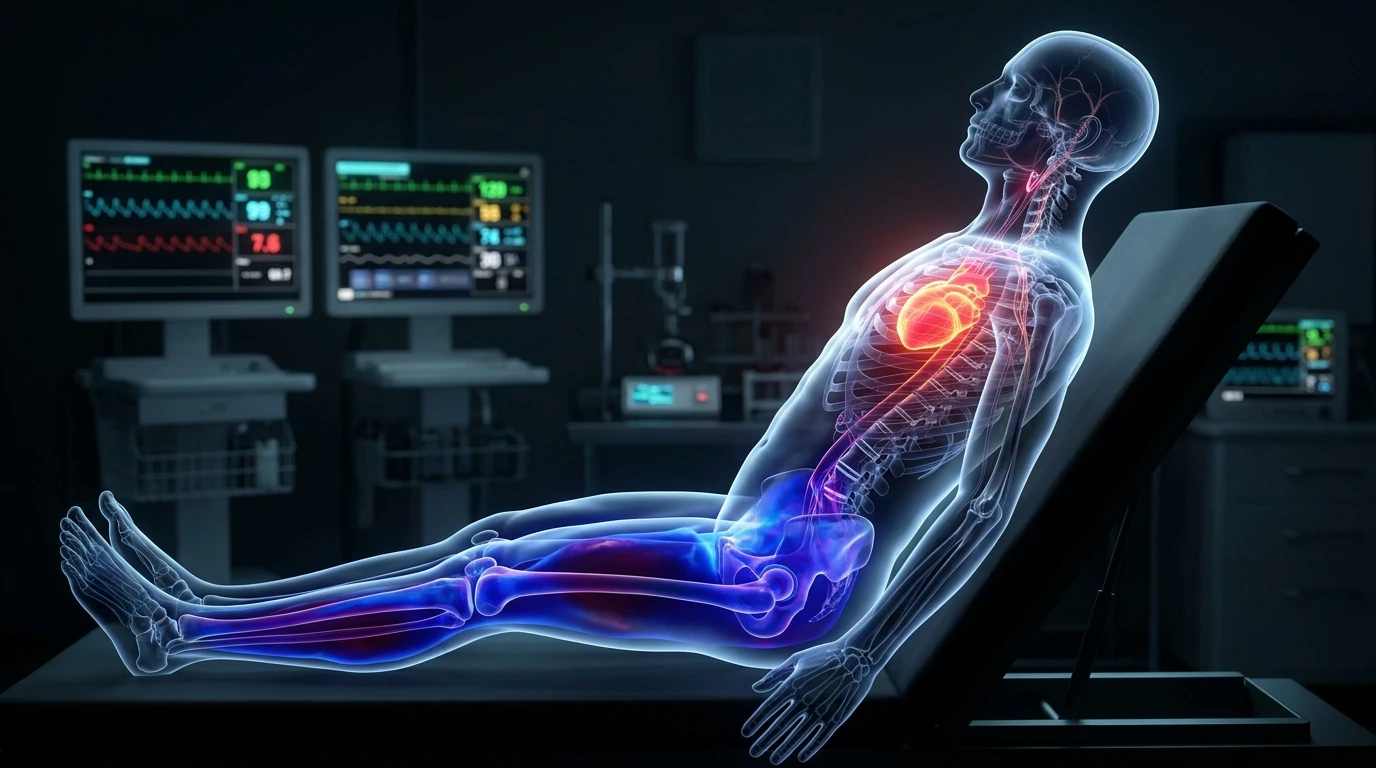
1. Diagnostic Criteria: Defining POTS Beyond Ordinary Tachycardia
Postural Orthostatic Tachycardia Syndrome is an autonomic disorder diagnosed via formal tilt-table testing or a standardized 10-minute NASA Lean Test. In adults, the strict clinical consensus criteria mandate:
- Foundational Neurobiology: Review our clinical analysis on the physiological sigh and autonomic anxiety reset.
- A sustained increase in heart rate of at least 30 beats per minute (bpm) within 10 minutes of moving from a supine to a standing position (or exceeding 120 bpm). In adolescents aged 12–19, the threshold is a 40 bpm increase.
- The absence of orthostatic hypotension (meaning systolic blood pressure does not drop by more than 20 mmHg or diastolic by more than 10 mmHg within the first 3 minutes of standing).
- Chronic orthostatic symptoms—including lightheadedness, presyncope, palpitations, tremulousness, brain fog, and visual darkening—persisting for at least 3 to 6 months.
2. The Three Pathophysiological Subtypes of POTS
POTS is not a single disease entity, but rather a clinical syndrome arising from distinct underlying pathophysiological mechanisms:
- Neuropathic POTS: Characterized by peripheral autonomic small-fiber neuropathy. Sympathetic adrenergic nerves innervating blood vessels in the lower extremities and splanchnic mesenteric bed are denervated or functionally damaged. Upon standing, these vessels fail to constrict, allowing massive volumes of blood (up to 500–800 mL) to pool in the pelvis and legs under gravity.
- Hyperadrenergic POTS: Accounts for approximately 30–50% of cases. Characterized by excessive central sympathetic outflow. Standing plasma norepinephrine levels spike above 600 pg/mL (normal: 200–400 pg/mL). These patients exhibit orthostatic hypertension, cold sweaty hands and feet, prominent tremors, and severe nocturnal insomnia.
- Hypovolemic POTS: Driven by true deficits in circulating plasma and red blood cell volume. Renin-angiotensin-aldosterone axis dysregulation paradoxically causes excessive urinary sodium wasting despite low blood volume, reducing venous preload to the right ventricle.
3. Vagal Withdrawal and the Adrenergic Storm Upon Standing
In a healthy individual, transitioning to an upright posture causes gravity to displace venous blood downward. High-pressure baroreceptors in the carotid sinus and aortic arch immediately sense reduced stretch and signal the Nucleus Tractus Solitarius (NTS).
In health, the autonomic system responds with a modest, transient withdrawal of parasympathetic vagal tone and a slight elevation in sympathetic tone, causing heart rate to rise by just 10–15 bpm while diastolic blood pressure rises slightly to maintain cerebral perfusion. In POTS, because peripheral venous constriction is impaired, cardiac stroke volume plummets by 40–50%. The cardiovascular center responds with a desperate, unconstrained release of adrenaline and noradrenaline. Concurrently, the parasympathetic Nucleus Ambiguus falls completely silent—the cardiac vagal brake is disengaged. The sinoatrial node is bombarded by catecholamines without parasympathetic opposition, driving heart rates to 130–170 bpm simply from standing up to brush one's teeth.
4. Comparative Diagnostic Matrix: Neuropathic vs. Hyperadrenergic vs. Hypovolemic
| Clinical Parameter | Neuropathic POTS | Hyperadrenergic POTS | Hypovolemic POTS |
|---|---|---|---|
| Primary Etiology | Small-fiber peripheral denervation (post-viral/autoimmune) | Excess central sympathetic discharge / NET gene variants | RAAS axis blunting; low total blood volume |
| Standing Norepinephrine | Normal or moderately elevated | Markedly Elevated (>600 pg/mL) | Moderately elevated (compensatory) |
| Blood Pressure Response | Stable or mild reduction | Orthostatic Hypertension (BP spikes upward) | Narrow pulse pressure |
| Physical Signs | Acrocyanosis (purple feet/legs), sweat abnormalities | Severe tremors, anxiety, clammy cold extremities | Extreme thirst, dry mucous membranes, salt craving |
| Primary Medical Therapy | Midodrine, compression garments, Pyridostigmine | Clonidine, Guanfacine, Ivabradine, Beta-blockers | Fludrocortisone, 3-4L oral rehydration + electrolytes |
5. The POTS-MCAS-hEDS Trifecta: Connective Tissue Laxity
Clinicians frequently encounter the clinical triad of Hypermobile Ehlers-Danlos Syndrome (hEDS), Mast Cell Activation Syndrome (MCAS), and POTS. The underlying mechanism centers on collagen architecture:
In hEDS, abnormal type I and III collagen makes blood vessel walls hyper-compliant and elastic. Veins stretch excessively under hydrostatic pressure, exacerbating venous pooling. Furthermore, fragile connective tissue matrices allow mast cells to degranulate under mechanical shear stress. The released histamine, prostaglandins, and leukotrienes drive peripheral vasodilation and trigger further adrenergic spikes, locking patients into severe dysautonomic flares.
6. Evidence-Based Clinical Management and Vagal Restoration Protocol
Overcoming POTS requires stabilizing blood volume, increasing peripheral venous tone, and directly stimulating parasympathetic vagal efferents:
- Aggressive Intravascular Expansion: Ingesting 3 to 4 liters of fluid alongside 5,000 to 8,000 mg of sodium (NaCl) daily expands circulating plasma volume, elevating venous return and blunting compensatory tachycardia.
- Medical Compression Garments: Waist-high compression stockings (30–40 mmHg) or abdominal compression binders prevent splanchnic and lower-extremity pooling far more effectively than knee-high socks.
- Cholinesterase Inhibition (Pyridostigmine / Mestinon): Inhibits acetylcholinesterase, prolonging acetylcholine survival at autonomic ganglia and the SA node, enhancing vagal tone and reducing orthostatic heart rate spikes.
- Transcutaneous Auricular Vagus Nerve Stimulation (taVNS): Clinical trials at the University of Oklahoma confirm that 20–30 minutes of daily 20 Hz taVNS applied to the left tragus/cymba conchae reduces orthostatic tachycardia by 18 bpm and suppresses autoantibodies targeting adrenergic receptors.
- The Levine / Chop Recumbent Exercise Protocol: Horizontal conditioning (rowing, recumbent cycling, swimming) builds cardiac ventricular mass and skeletal muscle pump strength without triggering upright orthostatic tachycardia.
Frequently Asked Questions (Clinical FAQ)
Why does my heart beat so fast when I simply stand up?
In POTS, your blood vessels fail to constrict properly upon standing, allowing blood to pool in your abdomen and legs. Your brain senses reduced blood flow and releases massive surges of adrenaline to force the heart to beat faster and maintain cerebral blood flow.
Is POTS caused by anxiety or panic attacks?
No. POTS is a physiological autonomic disorder of cardiovascular regulation, not a psychiatric disease. While the massive adrenaline surges feel identical to panic, the trigger is purely orthostatic (standing), not psychological.
How much salt and water do POTS patients actually need?
Under medical supervision, POTS patients typically require 3 to 4 liters of water and 5,000 to 10,000 mg of sodium per day (roughly 2 to 4 teaspoons of salt or electrolyte solutions) to maintain blood volume.
Why do showers trigger such severe POTS episodes?
Hot water causes widespread cutaneous vasodilation (blood vessels expand to cool the body). Standing in a hot shower drastically accelerates venous blood pooling into the lower extremities, triggering extreme reflex tachycardia and presyncope.
Can vagus nerve stimulation help POTS?
Yes. Clinical trials demonstrate that transcutaneous auricular vagus nerve stimulation (taVNS) at 20 Hz directly strengthens the cardiac parasympathetic brake, blunting orthostatic tachycardia and suppressing inflammatory adrenergic autoantibodies.
Is recovery from POTS possible?
Yes. With aggressive volume expansion, recumbent cardiovascular conditioning (the Chop/Levine protocol), autonomic neuromodulation, and mast-cell stabilization, up to 70% of patients achieve significant functional recovery.
Scientific References & Clinical Citations
- Postural tachycardia syndrome: a clinical review — Journal of Internal Medicine (2019). [PubMed / Study Link]
- Noninvasive Vagus Nerve Stimulation Improves Autonomic Function in POTS — JACC: Clinical Electrophysiology (2024). [PubMed / Study Link]
- Pathophysiology of postural tachycardia syndrome: small-fiber neuropathy and hyperadrenergic state — Circulation (2016). [PubMed / Study Link]
- Hyperadrenergic postural tachycardia syndrome in mast cell activation — Autonomic Neuroscience (2018). [PubMed / Study Link]