
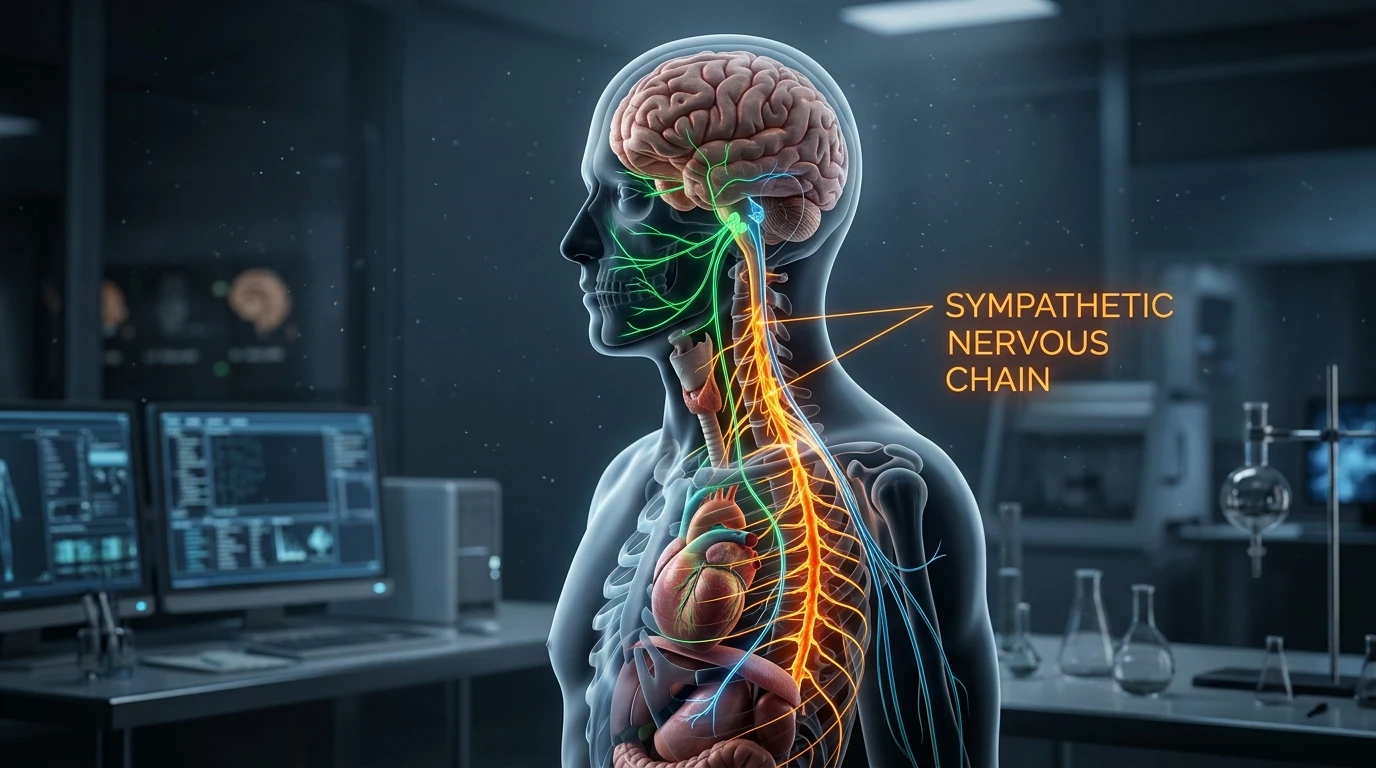
1. The Phylogenetic Hierarchy: Three Autonomic Circuits
For over a century, medical textbooks described the autonomic nervous system as an antagonistic seesaw between the sympathetic nervous system (fight-or-flight) and the parasympathetic nervous system (rest-and-digest). In 1994, neuroscientist Dr. Stephen Porges challenged this dichotomy by publishing the Polyvagal Theory, demonstrating that the human vagus nerve is not a single entity, but rather two anatomically and evolutionarily distinct subsystems operating under a strict phylogenetic hierarchy.
When an individual encounters an environmental challenge, the nervous system responds according to Jacksonian dissolution: reverting from the newest evolutionary adaptations to older, more primitive survival states as perceived threat escalates:
- Ventral Vagal Complex (Mammalian / Myelinated): The newest evolutionary circuit (exclusive to mammals). Originating in the nucleus ambiguus, it supports social communication, emotional co-regulation, heart rate fine-tuning, and facial expression.
- Sympathetic Nervous System (Spinal / Unmyelinated): Evolutionary age: reptiles and early vertebrates. Originating in the intermediolateral cell column of the spinal cord, it mobilizes metabolic energy for vigorous defensive behaviors (fight or flight).
- Dorsal Vagal Complex (Reptilian / Unmyelinated): The most primitive circuit (shared with reptiles and amphibians). Originating in the dorsal motor nucleus of the vagus, it regulates subdiaphragmatic organs. Under overwhelming, inescapable life threat, it induces profound behavioral immobilization, metabolic suppression, bradycardia, and dissociation.
2. Neuroception: How the Subconscious Brain Scans for Danger
Central to Polyvagal clinical practice is the concept of neuroception—a rapid, subconscious neural process through which the brain and peripheral sensory receptors continuously evaluate environmental and relational risk without involving conscious cortical appraisal.
Neuroception processes input through three parallel sensory channels:
- Circadian Endocrine Diagnostics: Explore our research on cortisol levels chart by time of day.
- Foundational Neurobiology: Review our clinical analysis on the physiological sigh and autonomic anxiety reset.
- Exteroception (Environmental cues): Lighting, acoustic frequencies (low-frequency rumbles vs. high-pitched vocal melodies), and physical proximity.
- Interoception (Visceral feedback): Afferent feedback from baroreceptors, chemoreceptors, and mechanoreceptors lining the heart, lungs, and gut. In fact, 80% to 90% of vagus nerve fibers are purely sensory afferents sending signals upward from the body to the brain.
- Relational cues: Facial micro-expressions, prosody of human voice, direct gaze, and postural alignment.
In patients suffering from developmental trauma, chronic PTSD, or systemic autonomic dysfunction, neuroception becomes skewed—interpreting neutral or safe environments as life-threatening (faulty neuroception), locking the patient in chronic sympathetic hyperarousal or functional dorsal vagal freeze.
3. The Ventral Vagal Anchor: Anatomy of Social Engagement
The ventral vagal circuit functions as an exquisite physiological "brake" upon the heart. Myelinated axons originating in the nucleus ambiguus travel down to the sinoatrial node, releasing acetylcholine in rhythmic bursts aligned with respiration (producing respiratory sinus arrhythmia).
Furthermore, the nucleus ambiguus is anatomically linked via embryological origin with the motor nuclei of four other cranial nerves that collectively form the Social Engagement System:
- Cranial Nerve V (Trigeminal): Coordinates muscles of mastication, jaw tension, and middle ear acoustic dampening.
- Cranial Nerve VII (Facial): Powers micro-expressions, smile formation, and upper facial emotional expression.
- Cranial Nerve IX (Glossopharyngeal): Controls swallowing and pharyngeal tone.
- Cranial Nerve XI (Accessory): Modulates neck rotation and shoulder posture, turning the head toward human vocal sounds.
Because these nerves share brainstem real estate, physical interventions involving facial relaxation, soothing vocal tone, humming, and vocal prosody can directly feed back into the nucleus ambiguus to re-engage the ventral vagal brake.
4. Comparative Breakdown: The Three Polyvagal States
| Autonomic State | Primary Circuit | Physiological Markers | Psychological & Somatic Experience |
|---|---|---|---|
| Ventral Vagal (Safety & Connection) | Nucleus Ambiguus (Myelinated 10th CN) | High HRV (RMSSD), normal resting pulse (60-72 BPM), active facial prosody, rhythmic breathing | Grounded, curious, compassionate, socially engaged, emotionally resilient |
| Sympathetic Mobilization (Danger) | Sympathetic Trunk & Adrenal Medulla | Elevated heart rate (>90 BPM), shallow thoracic breathing, dilated pupils, suppressed digestion, high cortisol | Anxious, panicky, irritable, hypervigilant, racing thoughts, muscle tension |
| Dorsal Vagal Shutdown (Life Threat) | Dorsal Motor Nucleus (Unmyelinated 10th CN) | Severe bradycardia or drop in BP, hypothermia, sluggish digestion, flat facial affect, low vocal tone | Numb, dissociated, exhausted, depressive collapse, helpless, "out of body" |
5. Dorsal Vagal Shutdown: Dissociation, Fatigue & Fainting
When sympathetic mobilization fails to escape or resolve threat—or when an individual feels completely trapped, overwhelmed, or physically helpless—the nervous system drops into the oldest survival strategy: the dorsal vagal freeze or shutdown response.
In wild animals (such as opossums or gazelles), this manifests as thanatosis ("playing dead"), which serves an adaptive evolutionary purpose: predators often lose interest in non-struggling prey, and severe metabolic slowing conserves oxygen while endogenous endorphins blunt the pain of tissue injury.
In modern humans, however, chronic unresolved dorsal activation presents clinically as:
- Severe, unrefreshing chronic fatigue and brain fog.
- Dissociation, derealization, and emotional depersonalization.
- Profound drops in blood pressure, orthostatic intolerance, or vasovagal syncope.
- Severe gut hypomotility, gastroparesis, and constipation.
6. Clinical Somatics: Shifting States via Interoceptive Tools
Clinicians practicing polyvagal-informed somatic therapy guide patients out of dorsal shutdown or sympathetic hyperarousal by understanding that the nervous system cannot jump straight from dorsal freeze to ventral calm. It must pass sequentially through sympathetic mobilization:
1. Titrated Movement & Mobilization: For individuals stuck in dorsal freeze, gentle rhythmic extremity movements, shaking, and vocal exercises safely recruit sympathetic energy without triggering panic.
2. Prolonged Expiratory Breathing: Extending the exhalation phase relative to inhalation (such as 4-second in, 7-second out) immediately engages the ventral vagal brake via pulmonary stretch receptors and cardiac baroreflexes.
3. Relational Co-Regulation: Safe eye contact, gentle prosodic vocal tones, and physical orientation exercises signal subconscious safety to the neuroception circuits far faster than cognitive reappraisal.
Frequently Asked Questions (Clinical FAQ)
What is the primary difference between ventral vagal and dorsal vagal activation?
The ventral vagal system is evolutionary modern, myelinated, and promotes safety, social connection, and healthy heart rate variability. The dorsal vagal system is primitive, unmyelinated, and activates under overwhelming threat, causing metabolic shutdown, severe fatigue, dissociation, and dropped blood pressure.
Can cognitive talk therapy change faulty neuroception?
Traditional cognitive talk therapy works "top-down" from the cerebral cortex. However, neuroception operates largely "bottom-up" through brainstem structures and visceral sensory nerves. Consequently, somatic interventions—such as breath retraining, vocal toning, and safe relational cues—are typically required to alter deep neuroceptive danger responses.
Why does severe anxiety sometimes turn into sudden exhaustion or depression?
This represents the autonomic nervous system falling from a failed sympathetic fight-or-flight state into a compensatory dorsal vagal collapse. When sustained panic fails to resolve threat, the brainstem engages the dorsal freeze mechanism to prevent cardiovascular and metabolic exhaustion.
How does the Polyvagal Theory relate to Heart Rate Variability (HRV)?
Respiratory Sinus Arrhythmia (RSA) and high-frequency (HF) HRV are direct mathematical reflections of the ventral vagal brake. High resting HRV indicates a robust, adaptable ventral vagal complex capable of dampening heart rate during rest.
What are "Glimmers" in Polyvagal language?
Coined by therapist Deb Dana, "Glimmers" are micro-moments of subconscious ventral vagal safety—such as seeing sunlight on leaves, hearing a warm voice, or stroking a pet—that gently nudge neuroception toward connection and physiological grounding.
Who developed the Polyvagal Theory and when?
Dr. Stephen Porges, PhD, a distinguished university scientist and professor of psychiatry, first presented the Polyvagal Theory during his presidential address to the Society for Psychophysiological Research in 1994.
Scientific References & Clinical Citations
- The Polyvagal Theory: Neurophysiological Foundations of Emotions, Attachment, Communication, and Self-regulation — W. W. Norton & Company (2011). [PubMed / Study Link]
- Neuroception: A Subconscious System for Detecting Threat and Safety — Zero to Three Journal (2004). [PubMed / Study Link]
- The Polyvagal Perspective: Physiological Substrates of Social Behavior — Biological Psychology (2007). [PubMed / Study Link]
- Polyvagal Theory in Clinical Practice: Somatic Interventions for Trauma — Frontiers in Psychology (2021). [PubMed / Study Link]