
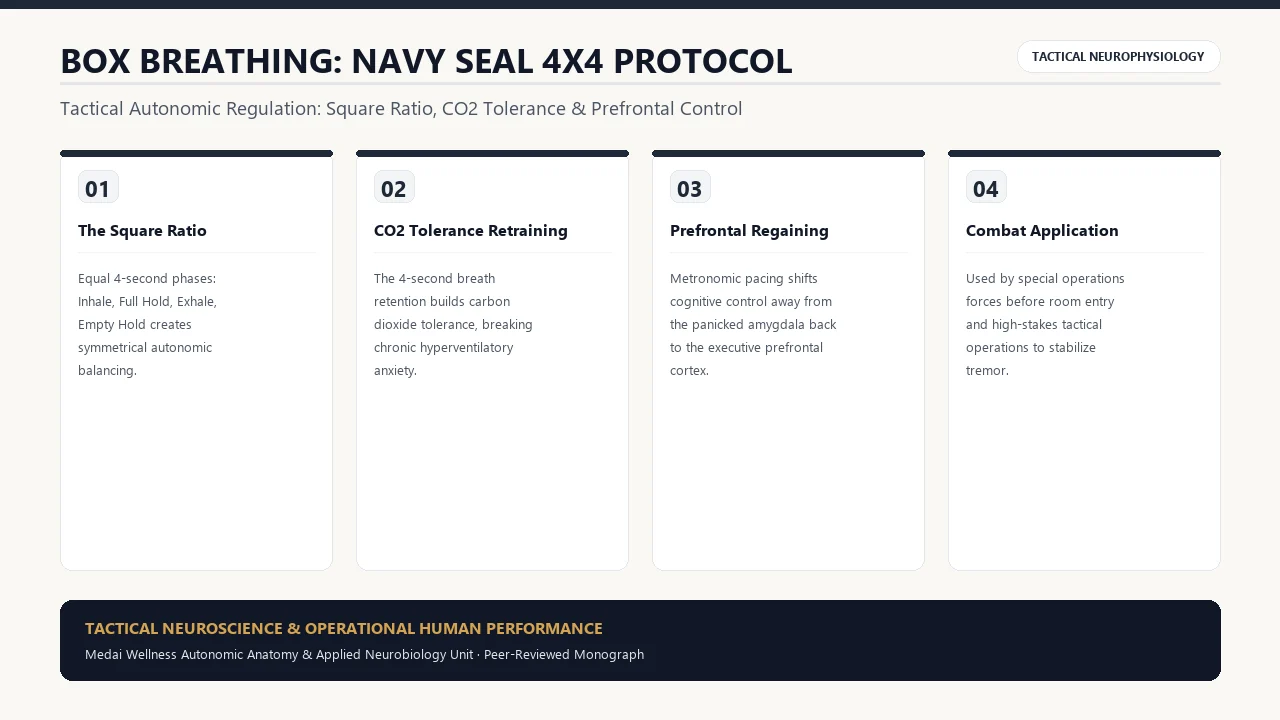
1. From Combat Zones to Clinical Somatics: Military Origins
When a Navy SEAL team prepares for a high-threat night-time hostage rescue, heart rates naturally spike. Hands begin to tremble with adrenergic surges, peripheral vision narrows into tunnel vision, and cognitive processing speed slows down. In close-quarters combat, an uncalibrated autonomic reaction can lead to catastrophic mission failure.
To ensure operators remain biologically calm under direct gunfire, former Navy SEAL commander Mark Divine codified Box Breathing. This protocol was later adopted across elite tactical units, emergency room trauma surgeons, SWAT teams, and NASA astronauts.
2. The Neurobiology of the Four Equal Sides (The 4x4 Square)
Unlike exhalation-biased breathing (such as 4-7-8, which induces deep sedation), Box Breathing is designed for poised, calm alertness:
- Circadian Endocrine Diagnostics: Explore our research on cortisol levels chart by time of day.
- Foundational Neurobiology: Review our clinical analysis on the physiological sigh and autonomic anxiety reset.
- Side 1: Inhale (4 Seconds): Nasal inhalation fills the lungs with oxygen, stimulating sympathetic arousal just enough to maintain keen focus and environmental vigilance.
- Side 2: Full-Lung Hold (4 Seconds): Breath retention with full lungs increases intrathoracic air pressure, keeping alveoli open and facilitating maximal oxygen diffusion into red blood cells without elevating pulse.
- Side 3: Exhale (4 Seconds): Controlled, smooth exhalation initiates cardiac vagal braking, decelerating heart rate and clearing metabolic byproducts.
- Side 4: Empty-Lung Hold (4 Seconds): The post-expiratory pause rests the diaphragm and prevents immediate compensatory gasping, training autonomic emotional steadiness.
3. Retraining Carbon Dioxide (\(CO_2\)) Tolerance
Most individuals suffering from chronic anxiety are chronic hyperventilators: they breathe 14 to 18 times per minute, blowing off excess carbon dioxide. As explained in our air hunger research, this downregulates their physiological \(CO_2\) tolerance.
The two 4-second breath holds in Box Breathing gently elevate arterial partial pressure of carbon dioxide (\(PaCO_2\)) toward normal physiological levels (40 mmHg). This triggers the Bohr Effect, prompting hemoglobin to release bound oxygen into cerebral tissues, abolishing brain fog and restoring mental clarity.
4. Prefrontal Cortex Re-Engagement: Turning Off Amygdala Hijack
During an acute panic attack, the primitive limbic amygdala "hijacks" the brain, shutting down logical reasoning in the dorsolateral prefrontal cortex (dlPFC). You cannot "think" your way out of a panic attack because the thinking brain is physically offline.
Box Breathing serves as an objective mathematical anchor:
Counting 1-2-3-4 in four distinct symmetrical cycles demands working memory and attention. This internal counting forces the prefrontal cortex back online, re-establishing top-down inhibitory control over the amygdala.
5. Step-by-Step Tactical Practice Guide
To practice box breathing effectively:
- Posture: Sit upright in a chair with your spine straight, shoulders dropped away from your ears, and feet flat on the ground.
- Step 1: Inhale slowly and smoothly through your nose for a count of 4, expanding your lower abdomen.
- Step 2: Hold your breath with lungs full for a count of 4. Keep your throat and jaw soft (do not clamp your glottis shut aggressively).
- Step 3: Exhale smoothly through your nose or pursed lips for a count of 4.
- Step 4: Hold your breath empty for a count of 4.
- Duration: Repeat for 4 to 5 complete cycles (approximately 2 minutes) before entering high-stress meetings, difficult conversations, or when sensing rising panic.
6. The Mental Square Visualizer for Real-Time Execution
When in high-stress environments, use this visualization:
↑ Inhale (4s) → Hold Full (4s)
↓ Exhale (4s) ← Hold Empty (4s)
Trace the perimeter of a doorway, window, or computer monitor with your eyes: up the left side on the inhale, across the top on the hold, down the right side on the exhale, across the bottom on the empty hold.
Frequently Asked Questions
What if 4 seconds feels too long and makes me anxious?
If you have low \(CO_2\) tolerance, begin with a 3x3 box (3 seconds in, 3 hold, 3 out, 3 hold). As your chemoreceptors adapt, graduate to 4 seconds. Elite operators frequently expand the box to 5x5 or 6x6.
Should I inhale through my nose or mouth?
Always inhale through your nose. Nasal breathing stimulates endothelial nitric oxide production in the paranasal sinuses, which dilates pulmonary vessels and improves arterial oxygenation by 10% to 15%.
How is box breathing different from the 4-7-8 breathing technique?
The 4-7-8 technique has an exhalation (8s) that is twice as long as the inhalation, making it strongly parasympathetic and sedating (ideal for falling asleep). Box breathing uses equal 4-second intervals, creating calm focus without sleepiness (ideal for daytime execution).