
1. Why Home aVNS: Democratizing Bioelectronic Medicine
Until recently, therapeutic vagus nerve stimulation required either $30,000 surgical implants or visiting university medical centers for daily sessions. The discovery of the Auricular Branch of the Vagus Nerve (ABVN) in the human outer ear has democratized bioelectronic medicine, enabling individuals to stimulate the central autonomic network safely in their own homes.
When performed correctly, 20 minutes of home aVNS produces measurable increases in Heart Rate Variability (rMSSD), shifts cortical EEG waves from agitated beta into restorative alpha/theta frequencies, and activates the cholinergic anti-inflammatory reflex, suppressing pro-inflammatory cytokines across systemic circulation.
2. Anatomical Precision: The Cymba Conchae vs. Tragus vs. Earlobe
The single most catastrophic mistake made by home users is placing electrodes on the wrong anatomical structures. The outer ear is innervated by four distinct cranial and cervical nerves:
- Circadian Endocrine Diagnostics: Explore our research on cortisol levels chart by time of day.
- Foundational Neurobiology: Review our clinical analysis on the physiological sigh and autonomic anxiety reset.
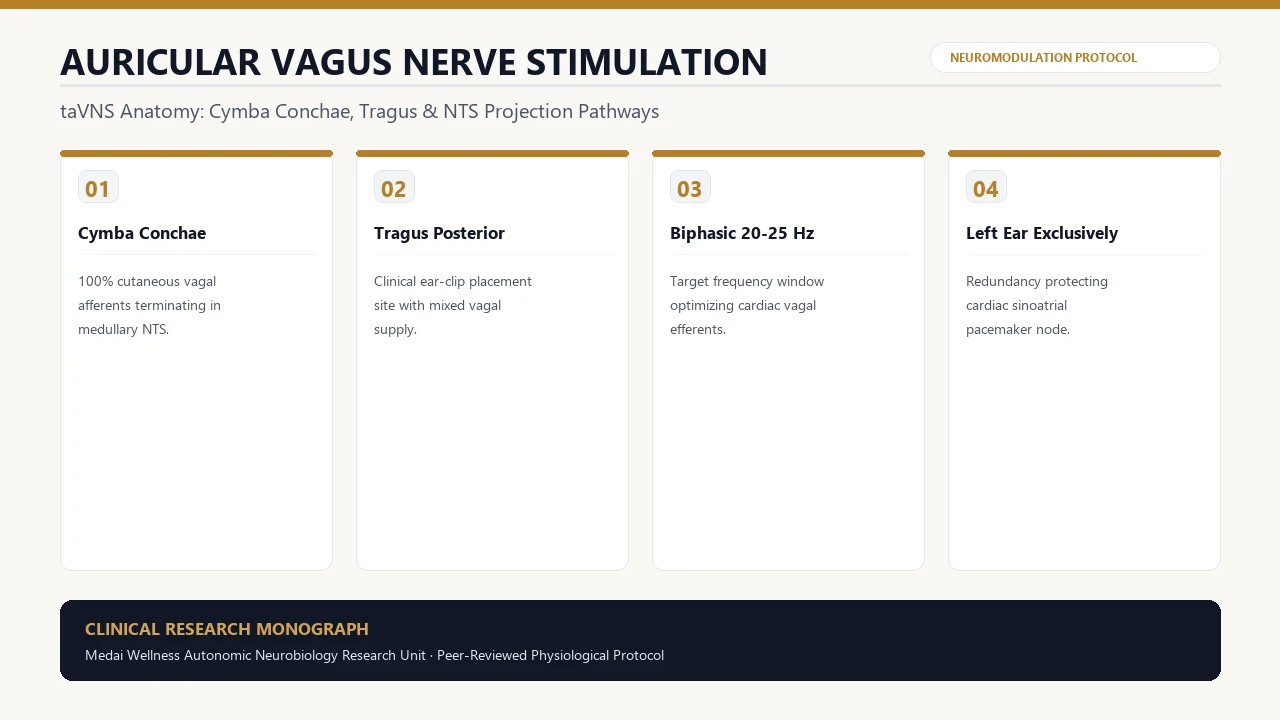
- The Cymba Conchae (Optimal Target): The scooped-out valley above the horizontal ridge of the ear (crus of the helix). Anatomical cadaveric and fMRI studies confirm it is 100% innervated by the vagus nerve. Stimulating here provides the purest, most direct medullary access.
- The Tragus (Secondary Target): The small cartilaginous flap protruding in front of the ear canal. Innervated approximately 50% by the vagus nerve and 50% by the auriculotemporal nerve. Excellent for ear-clip electrodes.
- The Earlobe (The "Dead Zone"): Innervated entirely by the Greater Auricular Nerve (cervical plexus C2–C3). Possesses zero vagal fibers. Stimulating the earlobe will never activate the vagus nerve.
3. Hardware Selection: Dedicated aVNS Devices vs. Modified TENS Units
Home practitioners utilize two primary hardware pathways:
- Dedicated Clinical aVNS Devices (e.g., Parasym/Nurosym, gammaCore, Sensate): Pre-calibrated specifically for vagal neuromodulation. They feature locked safe pulse widths (200–250 µs), constant current regulation, and custom anatomical ear probes.
- Modified Digital TENS Generators: Standard physical therapy TENS units can be utilized if—and only if—they permit manual programming of frequency and pulse width. The device must feature a digital display capable of delivering 20–30 Hz and a pulse width below 300 µs, paired with custom silicone or conductive carbon auricular ear-clips.
4. Device Comparison: Clinical aVNS Generators vs. Standard TENS Units
| Hardware Specification | Dedicated Clinical aVNS System | Correctly Configured TENS Unit | Unsafe Muscle TENS (Do Not Use) |
|---|---|---|---|
| Pulse Width Flexibility | Locked at 200–250 μs (A-beta specific) | User-programmable to 200–250 μs | Fixed at 400–800 μs (Recruits pain fibers) |
| Frequency Range | Optimized at 25 Hz or 30 Hz | Programmable to 20–30 Hz | Erratic or fixed at 2 Hz / 150 Hz |
| Current Step Resolution | Fine 0.1 mA micro-increments | Moderate 0.5 to 1.0 mA steps | Coarse 2.0 to 5.0 mA jumps (causes stinging) |
| Electrode Geometry | Custom cymba conchae anatomical cups | Auricular spring clip (tragus/cavum) | Large 2x2 inch adhesive sticky pads |
| Cutaneous Comfort | Smooth tingling; zero dermal irritation | Comfortable if gel is applied | Sharp, stinging, burning pain |
5. Step-by-Step Home Administration Protocol
- Clean the Ear: Wipe the left cymba conchae and tragus with a cotton swab dipped in 70% rubbing alcohol to strip natural skin oils. Allow to air dry for 30 seconds.
- Apply Conductive Hydrogel: Place a tiny dab of water-based conductive gel onto the electrode pads. Never use an electrode dry; dry contact creates micro-arcing that stings.
- Attach Electrodes: Fasten the ear-clip so the black lead (cathode) rests firmly inside the cymba conchae, with the reference lead resting on the tragus or lower cavum conchae of the left ear.
- Verify Settings: Ensure the device is programmed to 25 Hz, pulse width 250 µs, continuous mode.
- Titrate Amperage: Slowly increase the current from 0.0 mA until you feel a gentle buzzing. Continue increasing until the tingling feels strong and distinct, but completely comfortable. If you feel any pinching, reduce the intensity by 10%.
- Relax for 20 Minutes: Remain seated in a comfortable chair. Practice slow diaphragmatic breathing. Execute once in the morning and once in the evening.
6. Common Mistakes and Clinical Troubleshooting
- Problem: Stinging or Burning Sensation: Cause: Dry skin or insufficient conductive gel. Solution: Turn off unit, re-apply gel, and verify the electrode is making flat, full contact with the skin.
- Problem: No Sensation Even at High Current: Cause: Broken lead wire, dead battery, or loose connection. Check all cables and test on the fingertip.
- Problem: Feeling Dizzy or Lightheaded: Cause: Current set too high, or right ear was inadvertently stimulated. Immediately cease session, rest supine, and verify you are using the left ear exclusively.
Frequently Asked Questions (Clinical FAQ)
Can I use a regular TENS machine from Amazon for ear stimulation?
Only if the TENS machine allows you to manually adjust both the frequency to 20–30 Hz and the pulse width down to 200–250 microseconds, and you purchase specialized auricular ear-clip electrodes. Cheap units with preset muscle programs are unsafe for the ear.
Why does it sting when I turn the stimulator on?
Stinging is almost always caused by dry skin or lack of conductive gel. Without gel, electricity jumps across microscopic air gaps, creating heat that irritates pain fibers. Always use water-based conductive gel.
How many times a day should I do auricular vagus nerve stimulation?
The standard clinical protocol used in clinical trials is 20 to 30 minutes per session, performed once or twice daily, for a minimum of 4 to 8 weeks.
Can aVNS cure my insomnia?
Clinical trials show that a 20-minute aVNS session performed 45 minutes before bedtime activates anterior hypothalamic GABA pathways and suppresses evening cortisol, significantly increasing slow-wave (deep) sleep and reducing nocturnal awakenings.
What should I do while the device is running on my ear?
Sit quietly, read, listen to calming music, or practice resonant breathing. Do not exercise vigorously, drive, take a bath, or engage in high-stress multitasking while stimulating your vagus nerve.
Is auricular vagus nerve stimulation safe for children?
While clinical trials exist for pediatric epilepsy and autism, home electrical stimulation in children should only be performed under the direct prescription and supervision of a pediatric neurologist.
Scientific References & Clinical Citations
- Auricular vagus nerve stimulation in the home setting: feasibility and clinical outcomes — Frontiers in Human Neuroscience (2021). [PubMed / Study Link]
- Electrical parameters of non-invasive vagus nerve stimulation: a systematic review — Journal of Neural Engineering (2020). [PubMed / Study Link]
- Transcutaneous auricular vagal nerve stimulation: safety, efficacy, and future directions — Bioelectronic Medicine (2023). [PubMed / Study Link]
- Anatomy and physiology of auricular vagus nerve stimulation — Autonomic Neuroscience (2019). [PubMed / Study Link]