What Happens to Your Appetite When You Constantly Overeat?
TW
Dr. Thomas Whitaker, MD, PhD
Medai Wellness Research Editor
MedAI Clinical Research Board • Reviewed by Dr. Elena Rostova, MD, PhD • Updated September 2026
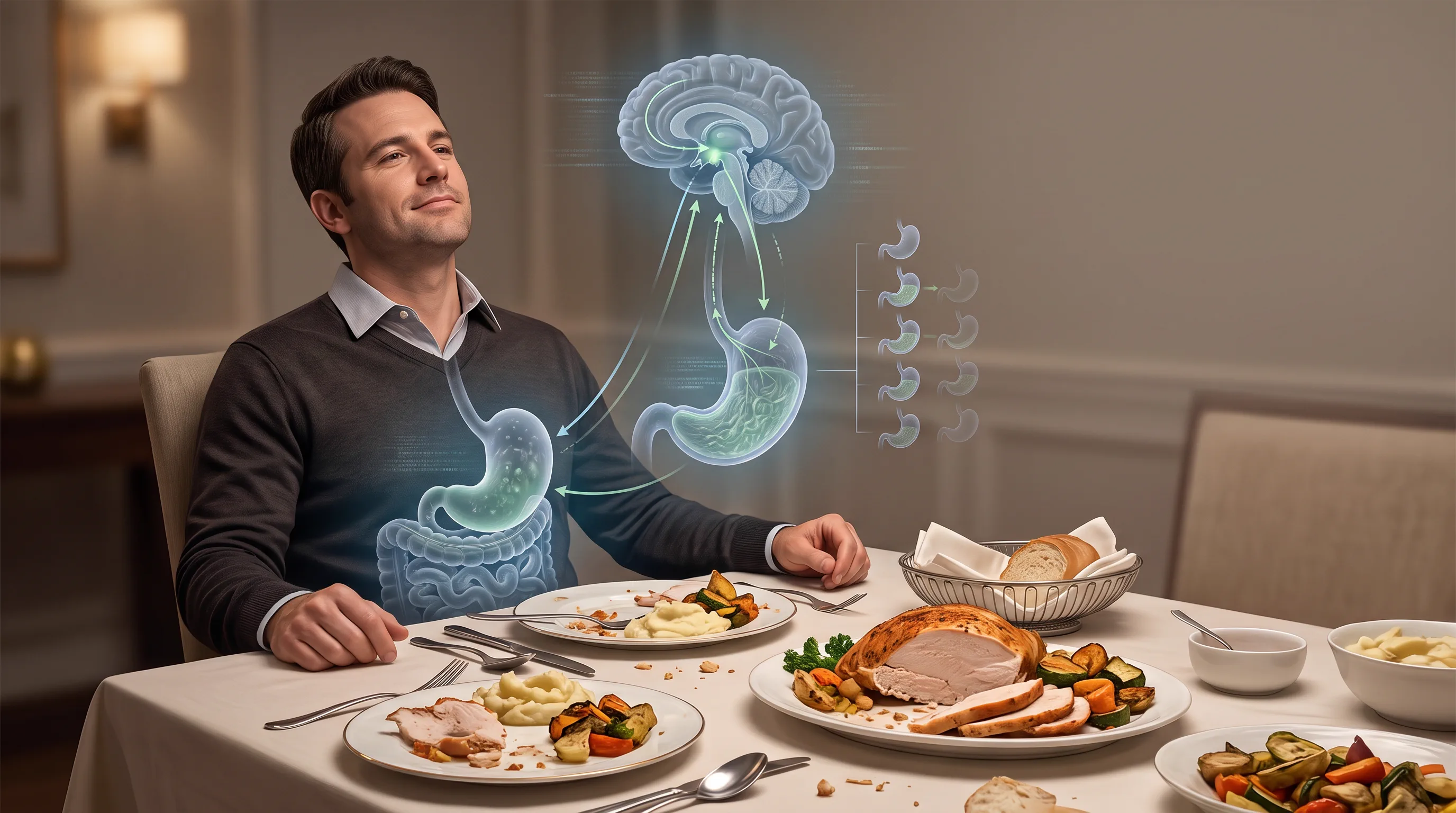
Key Fact Habitual overeating changes the appetite system itself: it weakens satiety signaling, alters reward sensitivity, and shifts energy-balance regulation in ways that make continued overeating more likely — a biological ratchet that works against weight control.
⚠️
Clinical Red Flags & When to Seek Immediate Medical Evaluation
Metabolic Notice: Severe postprandial hypoglycemia symptoms, constant extreme thirst (polydipsia), and excessive urination (polyuria) require medical screening for type 2 diabetes mellitus and metabolic syndrome.
Overeating Is Not Just "Eating Too Much"
People usually experience overeating as a single event: a big meal, a binge, a holiday. But behind each event is a repeated pattern, and repeated patterns change biology. When the body is regularly given more energy than it needs, the systems that regulate appetite — fullness signals, reward sensitivity, hunger drive, and the set-point machinery of energy balance — adapt to the new baseline. This adaptation is what makes overeating self-perpetuating.
This article examines what actually happens to appetite when a person overeats repeatedly: how fullness weakens, how the reward system recalibrates, why the body defends a higher "normal," and what that means for anyone trying to reverse it.
Why Fullness Weakens When You Eat Large Amounts
Part of the mechanism is mechanical and hormonal habituation. The gut and brain communicate fullness through a set of signals — including stretch signals, gut hormones, and signals like cholecystokinin (CCK) and peptide YY (PYY). When meals are chronically large, sensory and hormonal systems can become less responsive to the amounts that used to produce fullness.Spiegel K, et al. (1999). Impact of sleep debt on metabolic and endocrine function — appetite signaling context. The Lancet. The result is a "settled larger": the stomach tolerates more, the satiety signals fire later, and the amount considered "a normal portion" drifts upward.
This is one way the phrase "your stomach shrank" is actually meaningful, though it is better described as signal adaptation than a literal size change. The volume your body registers as "enough" is a moving target that tracks what you routinely serve.
The Reward System Recalibrates Too
Hedonic adaptation works in the other direction. When a person regularly eats highly palatable, high-reward foods in large amounts, the reward system can become less sensitive to the pleasure signal — so more food is needed to produce the same reward. In the research literature this appears as reduced reward sensitivity to ordinary food, with craving and intake increasingly driven by the strongest reward options.Lowe MR, Butryn ML. (2007). Hedonic hunger: a new dimension of appetite? Physiology & Behavior.
This is why "eat what you enjoy, moderately" can be difficult in practice: the reward system is calibrated by what you usually eat, and a diet built on constant high-reward food pushes the calibration harder. The appetite then becomes a persistent desire that no portion quite satisfies — the same machinery described in why sugar cravings are so hard to control.
Appetite Hormones Reset to the Larger Baseline
The hormonal pair ghrelin and leptin also adapt. Ghrelin rises before meals, and its pattern reflects eating rhythm. Leptin is released from fat tissue in proportion to fat mass; when fat mass is high, leptin is high, and the brain's response to it weakens — a state called leptin resistance.Schwartz MW, et al. (2017). Obesity Pathogenesis: An Endocrine Society Scientific Statement. Endocrine Reviews.
Leptin resistance is central to the "ratchet": the very overeating that creates more fat also weakens the signal that says "you have enough stored; stop eating." The body stops hearing the fullness-from-storage message clearly, and the appetite system defaults to "keep eating" until something else stops it.
The Energy-Balance Set Point Turns Sticky
The body defends the weight it has. When a person is chronically at a higher weight, the appetite system is organized to maintain that weight — hunger rises in response to weight loss attempts, and satiety is generous toward regaining the lost pounds. This biological defense is one of the strongest factors in why obesity is difficult to reverse.Sumithran P, et al. (2011). Long-term persistence of hormonal adaptations to weight loss. New England Journal of Medicine.
The meaning for overeating is uncomfortable: each sustained period of overeating trains the appetite system toward a new defended baseline, and reversing it means not only eating less but persisting long enough for the system to re-anchor. Time and consistency are not optional in this process — they are the mechanism.
Overeating, Sleep, and the Rebound Day
Overeating interacts with sleep and stress in a loop. Large late meals can worsen sleep quality; poor sleep, as covered in the poor-sleep and weight-gain connection, raises next-day hunger and shifts choices toward calorie-dense food. The overeating of one night therefore primes more overeating the next day — through hunger hormones, depleted restraint, and a longer reward gap.
This is one reason "just one bad day" becomes "a bad week" for many people. The rebound day is biology doing its job under the influence of the prior day's choices, and it is a pattern worth naming so it can be planned for.
Dieting After Overeating: The Rebound Amplifier
There is a specific trap in how people respond to overeating: crash dieting. A large meal or a heavy period is followed by severe restriction, which spikes hunger (ghrelin), and is followed by another rebound of overeating. This is the "diet-binge cycle." Studies of restrictive dieting show that severe food restriction predictably increases appetite and preoccupation with food afterward.Polivy J. (1996). Psychological consequences of food restriction. Journal of the American Dietetic Association.
The appetite system, calibrated to a larger baseline, interprets severe restriction as a shortfall and moves to repair the deficit — with hunger and reward both leaning hard toward high-density food. This is not a character collapse; it is energy-balance biology protesting a too-fast swing.
Why "Moderation" Is Harder After a History of Overeating
Once the appetite system has been trained by chronic overeating, moderation is not just a decision — it is a retraining project. The signals are set for larger portions, higher reward needs, and a defended heavier weight. Expecting effortless "just eat less" is like expecting a trained engine to change its calibration by being told to.
The practical consequence is that the structural levers matter more: portioned servings, consistent meal timing, protected sleep, and a food environment that does not constantly re-stimulate the reward system. These are the same tools that support not eating when not hungry and that make the appetite system's retraining possible.
The Good News: Adaptation Runs in Both Directions
If the appetite system can adapt upward, it can adapt downward — the mechanisms are not one-way. Satiety signaling, reward calibration, and even some hormonal patterns shift back when behavior changes consistently for long enough. The time scales are the hard part: weeks to months of consistent change are needed, not days. But the direction is real.Wing RR, Phelan S. (2005). Long-term weight loss maintenance. American Journal of Clinical Nutrition.
This is where maintenance studies become encouraging: people who maintain weight loss for several years show adaptations that make continued maintenance easier — the effort becomes less effortful over time. The ratchet works in reverse when it is given time, consistency, and the right structure.
What a Single Overeating Episode Really Does
It helps to look closely at one episode, because the word "overeating" hides a real physiology. In a single large surplus, a few things happen simultaneously. Glucose and insulin rise sharply; fat tissue expands; the gut signals are overwhelmed and satiety registers late; and reward circuits are reinforced by the pleasure of the meal. None of this is catastrophic on its own.Ravussin E, Smith SR. (2002). Increased fat intake, impaired fat oxidation, and failure of fat cell proliferation result in ectopic fat storage. Annals of the New York Academy of Sciences.
The problem is repetition. Each surplus is not independent — it is training. Signals that get overwhelmed learn to fire later; reward circuits that get overfed learn to need more; fat cells that get filled learn to fill easily again. Single episodes are manageable; repeated episodes write the lesson into the appetite system.
Volume Tolerance: The Expanding "Normal"
One of the most visible adaptations is volume tolerance. The gastrointestinal system distends with meals and produces its fullness signals partly from stretch. When meals are routinely large, the threshold for stretch-based fullness drifts upward; meals that once felt heavy now feel normal or even light.Rolls BJ, et al. (1998). Volume of food consumed affects satiety in women. American Journal of Clinical Nutrition.
This is not a reason for shame; it is a calibration report. If your portion "looks small now," that is your volume threshold describing its training history. Retraining it means routinely serving the target size — and giving the stretch system time to accept it as "enough."
The Type-2 Effects: Glucose Swings and Cravings
Large meals — especially large carbohydrate-heavy meals — also produce sharper glucose and insulin swings. A big insulin response can drive blood sugar down a few hours later, and that relative low is itself a hunger and craving trigger, often aimed at quick carbohydrate. Over time, this swing-and-crave pattern makes the appetite system increasingly dependent on the next high-carb dose.Ludwig DS. (2002). The glycemic index: physiological mechanisms relating to obesity, diabetes, and cardiovascular disease. JAMA.
This is the biology behind the "I'm fine right after eating, then starving an hour later" experience. It is not your imagination; it is the glucose curve doing its thing after a spike. And it connects directly to why you can feel hungry all the time even when total intake is high.
Palatability, Payoff, and the Need for "More"
Repeated exposure to highly palatable food also changes what "rewarding" means. The dopamine response to food is larger the first time a food is new or intense; with repetition, the same food produces a smaller relative response, and the appetite system looks for the stronger version — more sweet, more salt, more fat, more quantity.Volkow ND, et al. (2013). Food and drug reward: overlapping circuits in human obesity and addiction. Current Topics in Behavioral Neurosciences.
The result is not that food stops being enjoyable — it is that enjoyment requires more input. This is the "nothing satisfies" feeling that people describe after long periods of overeating, and it is one more reason structured, palate-calibrating change (fewer hyper-rewarding foods, more whole and satiating ones) helps the appetite settle.
Social and Habitual Rhythm: The Clock That Trains Appetite
Appetite is also trained by rhythm. When eating happens at set times and in set contexts, the body anticipates — ghrelin peaks reliably before the usual meal time, and satiety patterns align to the routine.Scheer FAJL, et al. (2009). Adverse metabolic and cardiovascular consequences of circadian misalignment. PNAS. Chronic overeating usually comes with disordered rhythm: grazing all evening, skipping meals, erratic portions. That erasure of rhythm removes the body's predictive structure, leaving appetite to track cue pull rather than clock.
The practical lever is rebuilding the rhythm itself: anchored meal times, a defined evening cutoff, predictable portion sizes. The clock is one of the strongest structure inputs the appetite system has.
Emotional Conditioning: Food as the Default Fix
When overeating is used to regulate mood — the after-work snack, the comfort-food dinner, the night binge — the appetite system becomes conditionally linked to emotional states. Over time, the mere presence of stress or boredom is enough to trigger the eating response, independent of hunger.Adam TC, Epel ES. (2007). Stress, eating and the reward system. Physiology & Behavior.
This is the same ground as why stress makes weight loss harder and non-hungry eating — all three describe the same conditioning loop from different angles. The retraining lever is to introduce alternative responses early enough that food ceases to be the only reliable regulator.
Practical Approaches When Appetite Has Shifted
- Serve portions deliberately. The brain calibrates off what it is served; set the serving.
- Keep meals structurally consistent. Timing anchors the hormone rhythm.
- Choose satiating composition. Protein and fiber hold fullness longer.
- Avoid crash swings. Severe restriction amplifies the next overeating episode.
- Protect sleep after heavy days. Sleep decides how the rebound day behaves.
- Give the system time. Re-calibration is measured in months, not days.
One additional lever belongs on this list because it is often the hidden ingredient: consistency across all of them at once. The appetite system is not fooled by a perfectly portioned Tuesday if Wednesday returns to the old pattern. It is a pattern-learning machine — it reads the majority of days, not the best day. This is why "good week, bad week" routines retrain the system slowly, while a steady, unglamorous default trains it quickly. The empty victories of a twice-weekly perfect day are less valuable than a month of boring, consistent structure.
Putting It Together: What Happens to Appetite When You Overeat
| System | Adaptation | Result |
|---|
| Satiety signals | Less responsive to normal portions | Fullness arrives later |
| Reward system | Reduced sensitivity, higher needs | Craving persists |
| Leptin | Resistance to fullness signal | Storage signal ignored |
| Set point | Defends the higher weight | Loss fights biology |
| Sleep loop | Heavy days worsen next-day appetite | Rebound overeating |
| Restriction spike | Crash dieting amplifies hunger | Diet-binge cycle |
Signals That Respond Quickly vs. Slowly
It is useful to know which adaptations are fast and which are slow, because expectations set the experience. Blood-glucose swing and next-day rebound hunger respond within days of cleaning up meal composition. Volume tolerance and satiety thresholds respond over weeks of consistent serving size. Reward calibration and set-point defense are the slowest, needing months of steady reduction before the "normal" starts to feel smaller.Wing RR, Phelan S. (2005). Long-term weight loss maintenance. American Journal of Clinical Nutrition.
Naming the speed differences prevents the common failure: people judge a process by its slowest stage. If volume tolerance takes weeks, a person who feels "still hungry on smaller portions" after six days concludes the approach failed. In fact, it was working; the signal just had a lead time. Progress tracking should be matched to the stage being evaluated.
Grazing: The Low-Grade Chronic Surplus
Not all overeating is a large meal. Grazing — small snacks through the day — is a common unnoticed surplus that keeps the appetite system in near-constant reward activation without producing any meal-based satiety. Grazing accelerates the saturation problem: the reward system never fully comes offline, and true fullness never clearly registers.Wansink B. (2004). Environmental factors that increase the food intake and consumption volume of unknowing consumers. Annual Review of Nutrition.
The fix is not to be anti-snack; it is to make snacks count as structure rather than noise. A defined snack at a defined time is compatible with appetite regulation; the sixth unremarked handful in an afternoon is a different kind of input to the system.
Frequently Asked Questions
Does overeating permanently change my appetite?
Adaptations to overeating are real but not permanent. Satiety, reward, and hormonal patterns can shift back when eating behavior changes consistently for long enough — typically weeks to months.
Why am I hungrier the day after a big meal?
Large meals, especially late ones, can worsen sleep and shift next-day hunger and reward signals, making a rebound overeating episode more likely. The pattern amplifies itself rather than resetting.
Can my body get used to smaller portions?
Yes. The appetite system calibrates to what is habitual. Consistent, deliberately sized portions train satiety to fire at the new volume, though it takes time.
Does crash dieting after overeating help?
No. Severe restriction increases hunger and sets up the next overeating episode. A steady, moderate approach retrains the system without the rebound.
How long does it take for appetite to adapt?
Meaningful shifts in satiety and appetite hormone patterns are typically seen over weeks to months of consistent behavior change. The biology runs on repetition and time.
Conclusion
Habitual overeating is not a series of isolated events; it is a process that retrains the appetite system — weakening fullness, raising reward needs, blunting the "enough stored" signal, and anchoring the body to a heavier baseline. The appetite that results is not your lack of discipline; it is your biology adapted to what has been repeatedly done to it.
The reverse is also true and is the whole reason a practical path exists. Adaptation, served deliberately, runs downward: consistent portions, stable timing, satiating composition, protected sleep, and no crash swings. Held for weeks to months, they retrain the same systems that overeating pushed upward. The appetite that once demanded the second helping eventually settles at the portion it is routinely given — which is the honest, mechanical definition of sustainable weight control.
That settled state is not a matter of suddenly having "good willpower." It is a matter of the body having re-learned what enough feels like. Until then, the process will sometimes feel like a fight — hunger fires at the old volume, reward asks for the old intensity, and the scale takes time. The calmest thing you can do, in those weeks, is to understand that the fight is the adaptation happening, and to keep the structure that lets it finish. Measure by the months, not the mornings, and the appetite you trained upward can be trained back down.
Content reviewed & updated August 2026 by the Medai Wellness research team.
Educational content only. This article is for informational purposes and does not constitute medical advice. Appetite and eating patterns can be affected by medical and psychological conditions that require evaluation. Consult a qualified healthcare professional before making changes to your health routine.
Authoritative Clinical Hubs
Explore Evidence-Based Protocols & Foundations
For comprehensive physiological frameworks, diagnostic differentials, and guided vagal recovery protocols, explore our primary clinical reference hubs:
References
- Berthoud HR, Neuhuber WL. Functional and Chemical Anatomy of the Afferent Vagal System. Auton Neurosci. 2000;85(1-3):1-17. PubMed
- Breit S, Kupferberg A, Rogler G, Hasler G. Vagus Nerve as Modulator of the Brain-Gut Axis in Psychiatric and Inflammatory Disorders. Front Psychiatry. 2018;9:44. PubMed