
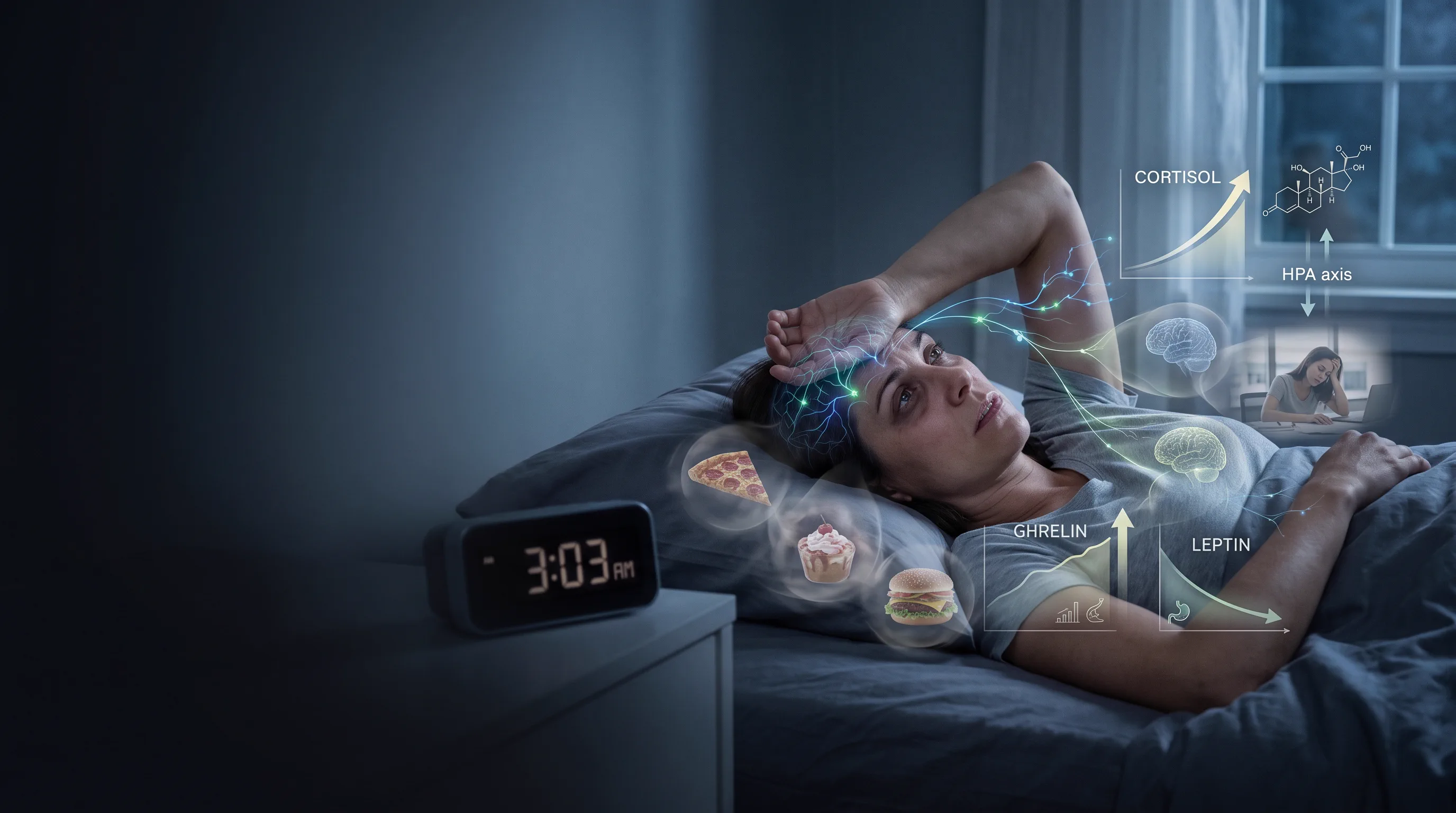
Key Fact Short and poor-quality sleep shift the hormones that control appetite, increase desire for calorie-dense food, reduce impulse control, and expand eating opportunity — together producing measurable weight gain risk even when nothing else changes.

Sleep Is a Metabolic Input, Not a Luxury

People who struggle with weight often treat sleep as the least important factor — the thing they will fix "after" the eating and exercise. The research points the other way. Sleep is not neutral background; it is an active metabolic input. When sleep shortens, appetite hormones change, decision-making shifts, food becomes more rewarding, and the day simply gets longer, offering more opportunities to eat. This combination is a direct route to weight gain.

This article explores the mechanisms linking poor sleep to weight gain, the strength of the evidence, and what improving sleep can actually change. It connects the dots to why obesity is difficult to reverse and to appetite patterns covered elsewhere in this series.

The Appetite Hormone Shift

The most direct sleep-weight mechanism runs through the appetite hormones ghrelin and leptin. Ghrelin is the primary "hunger" hormone — it rises before meals and signals the brain to eat. Leptin is the primary "fullness" signal — it is released by fat tissue and suppresses appetite. Sleep loss has been shown to increase ghrelin and decrease leptin, producing a biological state of stronger hunger and weaker satiety.Spiegel K, et al. (2004). Impact of sleep debt on metabolic and endocrine function. The Lancet.

This is not a subtle effect. In controlled sleep-deprivation studies, people consistently report increased hunger and consume more food the next day — particularly from snacks and sweets. The appetite system is a sensor that is partly calibrated by sleep; sleep is literally part of the calibration.

More Hours Awake, More Eating Opportunities

Some of the mechanism is embarrassingly simple: being awake longer means more time in which eating can happen. A person who sleeps six hours instead of eight has two extra waking hours each day — time for snacks, evening meals, and bored or stressed eating. Over a month, that is roughly sixty extra hours of exposure to food cues. In the evenings, this window is also the time when willpower reports are lowest and food cues are strongest.

This ties directly to why people keep eating when they are not hungry. A long, tired evening is precisely the context in which cues, habits, and boredom eating thrive.

Sleep, Reward, and the Pull of Palatable Food

Sleep deprivation also changes how the brain values food. Neuroimaging studies show that after sleep restriction, the brain's reward regions respond more strongly to images of high-calorie foods, while the regions involved in restraint show reduced activity.St-Onge MP, et al. (2013). Sleep restriction increases the neuronal response to unhealthy food in highly palatable food environments. (abstract) — Obesity. The result is a double disadvantage: craved food looks more appealing, and the break that would normally slow you down is weaker.

This is why "sleep better and you will crave less" is not a wellness slogan; it is a description of how reward circuitry is wired. For a fuller picture of why certain foods pull so strongly, see why sugar cravings are so hard to control.

Insulin Sensitivity and Glucose Handling

Sleep influences how the body handles glucose. Even short-term sleep restriction impairs insulin sensitivity, meaning the same amount of carbohydrate produces a higher and less well-handled blood sugar response. Over time, impaired glucose handling favors fat storage and increases the risk of metabolic problems.Spiegel K, et al. (1999). Impact of sleep debt on metabolic and endocrine function in healthy young men — glucose tolerance data. The Lancet.

The practical consequence is that poor sleep makes the body less efficient at handling the food you eat. Someone can be eating "the same as always" while sleeping badly and still be gaining weight or failing to lose it — because the metabolic handling of that same food has worsened.

The "Sleep Debt" Effect on Food Choices

Sleep-deprived people do not just eat more; they make different choices. Multiple studies show that after sleep restriction, people preferentially choose higher-calorie, higher-carbohydrate, and often snack-type foods. One plausible driver is the combination of stronger food reward and weaker restraint described earlier; another is that a tired brain gravitates toward easy, immediate energy sources rather than foods that require planning or preparation.St-Onge MP, et al. (2012). Sleep restriction leads to increased intake of energy from snacks. American Journal of Clinical Nutrition.

This matters because the deficit at stake is rarely about a single meal. It is about snack choices spread across many days — a pattern that quietly and consistently moves the energy balance in the wrong direction. If you have noticed that your "bad food days" cluster around low-sleep days, you are not imagining the connection.

Shift Work: A Natural Experiment in Poor Sleep

Shift workers offer a natural experiment in the sleep-weight relationship. Their sleep is typically shorter, more erratic, and misaligned with the body's clock — and they show consistently higher rates of obesity, metabolic problems, and appetite dysregulation than day workers, even after adjusting for other factors.Sun M, et al. (2018). Meta-analysis on shift work and risks of specific obesity subtypes. Obesity Reviews. Night workers also face the added challenge of eating at hours when glucose handling is less efficient and the reward system is biased toward immediate energy.

The lesson is not that shift work is hopeless; it is that disrupted sleep is a real metabolic stressor, and people in those situations need stronger environmental structure around food. The modern environment already works against weight control; irregular sleep makes its cues harder to resist.

Circadian Misalignment: When the Clock Says Night

Beyond total sleep, there is the question of timing. The body runs on an internal clock that expects eating to happen in daylight and fasting to happen at night. When people eat during their biological night — even with adequate total sleep — glucose tolerance is measurably worse, and fat tends to be stored more readily.Scheer FAJL, et al. (2009). Adverse metabolic and cardiovascular consequences of circadian misalignment. PNAS. This is a large part of why late-night eating has been associated with more weight gain than the same food eaten earlier in the day.

The practical lever is eating-window timing: shifting most food intake earlier, and reducing very-late eating, aligns intake with the metabolic conditions under which the body handles food best.

Sleep and Muscle: The Composition of the Loss

Sleep also changes what your body does with energy during weight loss. In the controlled experiment described earlier, sleep-restricted adults in a calorie deficit lost less fat mass and more lean mass than those who slept adequately on the same diet.Nedeltcheva AV, et al. (2013). Insufficient sleep undermines dietary efforts to reduce adiposity. Annals of Internal Medicine. Holding total sleep to normal length preserved the fat loss.

For anyone whose weight-loss plan depends on a calorie deficit, this changes the arithmetic: the deficit is only as good as the sleep that surrounds it. The same calories produce different amounts of fat loss depending on whether the person is rested.

Sleep Environment and Behavior

There is also a behavioral side that is easy to overlook: the conditions of the evening. Bright screens, stimulating content, and food adjacency in the evening all push the day later and the appetite cueing stronger. The bedroom itself can become a place of snacking and scrolling, which erodes the association between bed and sleep. A small structural fix — keeping food out of the bedroom, dimming lights before bed, and settling a fixed wind-down — has an outsized effect on both sleep quality and evening eating.

These are not wellness flourishes. They are designed to break the environmental loop that reinforces both poor sleep and late-night intake.

Children, Teens, and the Accumulating Effect

The sleep-weight relationship starts early. The same meta-analysis that linked short sleep to adult obesity also found the association in children, and the effect in younger groups is often described as even stronger.Cappuccio FP, et al. (2008). Meta-analysis of short sleep duration and obesity in children and adults. Sleep. Teenagers, whose biological sleep phase shifts later while school start times often stay early, are routinely running on short, misaligned sleep — with predictable consequences for appetite and intake.

The relevance for this series is direct: if the modern environment is part of the obesity story, then the sleep patterns that the environment produces — bright screens, late schedules, early school bells — are one of the ways that story is written into body weight.

The Evidence: Sleep and Obesity at Population Scale

Beyond lab studies, large population analyses have consistently associated short sleep with higher body mass and greater obesity risk. A pooled analysis of dozens of studies covering hundreds of thousands of adults found that short sleep duration was associated with a markedly increased likelihood of obesity in both adults and children.Cappuccio FP, et al. (2008). Meta-analysis of short sleep duration and obesity in children and adults. Sleep. The dose-response pattern — the shorter the sleep, the greater the risk — supports a real relationship rather than a coincidence.

Association is not proof of causation, but the combination is strong: a plausible biological mechanism (hormones, reward, glucose), experiments in the lab (controlled sleep restriction changes intake), and population-level consistency. Together, they make a compelling case that sleep is a weight-relevant variable.

GlutLess Energy and GlutLess Sleep supplements

Day Support · Night Support

A pharmacist-formulated approach with one formula aimed at supporting cravings during the day and one focused on supporting overnight digestion while you sleep. Backed by a 60-day money-back guarantee.

Learn More About the GlutLess Approach →

60-Day Money-Back Guarantee · No Subscription · Educational Information

Sleep Duration vs. Sleep Quality

Duration matters, but so does quality. Sleeping seven hours of broken, restless sleep is not the same as seven hours of solid sleep. Quality includes how long it takes to fall asleep, how many times you wake, and how much deep and restorative sleep you get. Disturbed sleep has been linked to higher body mass in ways similar to short sleep.Huang T, et al. (2017). Sleep duration and sleep quality in relation to changes in body weight. (abstract) — Epidemiology.

The practical point: improving consistency and continuity of sleep can be as valuable as lengthening it. A person who focuses only on getting eight hours but has erratic, interrupted sleep may not gain the metabolic benefit.

Late-Night Eating Loops

Poor sleep and late-night eating reinforce each other. Eating late extends the awake window, which can make the next night's sleep worse, which prolongs the next day's eating opportunity, and so on. Evening eating is also disproportionately weight-relevant in some research, in part because it sits in the hormonal context of a tired day and in part because it is easy to be generous with portions at that hour.Garaulet M, et al. (2013). Timing of food intake predicts weight loss effectiveness. International Journal of Obesity.

Breaking the loop does not require perfection — a slightly earlier wind-down, a defined evening snack, and a regular wake time each give the loop a structural break.

Sleep, Cortisol, and the Nervous System

Sleep is also the major regulator of the stress system. Poor sleep raises evening cortisol and keeps stress physiology active through the night; chronically, this coupling — short sleep, high cortisol, tight eating windows — is associated with increased abdominal fat. The stress-sleep interaction helps explain why stress makes weight loss harder: a stressed, sleepless person is fighting appetite, reward, glucose, and fat-distribution battles at once.Epel ES, et al. (2000). Stress and body shape: stress-induced cortisol secretion and body fat distribution. Psychosomatic Medicine.

This is where the nervous system frame connects: sleep restoration is, at its core, a nervous-system event. The same regulation practices that help the stressed nervous system — regular timing, controlled stimulation, breathing, down-regulation in the evening — are the practices that protect sleep. Supporting one supports the other.

What Sleep Quality Supports During Weight Loss

Sleep interacts with weight loss attempts in specific ways. When people are in a calorie deficit, sleep loss makes the hunger response stronger — the deficit already raises ghrelin, and poor sleep raises it further. Sleep also matters for the preservation of lean mass during loss, and for the energy available to be active. In practical terms, people who sleep better while dieting report less hunger, better adherence, and more consistent energy.Nedeltcheva AV, et al. (2013). Insufficient sleep undermines dietary efforts to reduce adiposity. Annals of Internal Medicine.

That last study is worth sitting with: controlled conditions, same diet, different sleep — and the sleep-restricted group lost less fat and more lean tissue. Sleep literally changed what the "same" diet produced. This is why the weight-loss attempts that fail are often the ones run on too little sleep.

What Recovery Sleep Does for Appetite

An important and encouraging detail in the sleep literature is that the appetite effects of sleep loss appear reversible. After a period of catch-up sleep, ghrelin drops and leptin rises back toward normal levels, and the extra eating driven by sleep debt tends to subside.Spiegel K, et al. (2004). Impact of sleep debt on metabolic and endocrine function. The Lancet. The system is not permanently damaged by a few bad weeks; it re-calibrates when sleep returns.

This is the practical heart of the matter: sleep is one of the few levers in weight management where restoring an input — rest — pays back across the whole system, without requiring the person to "work harder." The effort goes into protecting the routine, and the appetite biology does the rest. For many people, improving sleep resolves more of the "why am I always hungry and craving" problem than any additional diet restriction could.

Practical Approaches to Sleep and Weight

  • Protect a consistent wake time. Regularity anchors the whole sleep system.
  • Shorten the eating window in the evening. Less awake-after-dinner time, fewer late snacks.
  • Reduce late stimulation. Screens, intense news, and bright light push wakefulness late.
  • Move daily. Activity improves sleep depth and regularity.
  • Keep sleep and eating routine aligned. A tired day is a hunger-plus-cue day.
  • Address the loop, not just one night. Sleep and eating reinforce each other; fix the pattern.

Putting It Together: Poor Sleep and Weight Gain

MechanismEffect on WeightPractical Lever
Appetite hormonesHigher hunger, weaker fullnessStable, sufficient sleep
Longer awake timeMore eating opportunities and cuesConsistent evening routine
Reward sensitivityFood looks more appealing, restraint weakerSleep protection
Glucose handlingImpaired insulin sensitivitySleep + consistent eating
Poor sleep cyclesErratic, interrupted sleep raises riskQuality and regularity
Late-night loopSleep and eating worsen each otherBreak the pattern structurally

Frequently Asked Questions

Can poor sleep really make you gain weight?

Yes, through multiple mechanisms: higher hunger hormone and lower fullness hormone, stronger reward response to food, impaired glucose handling, and more awake time for eating. Lab studies show people eat more after sleep restriction.

How many hours of sleep protect against overeating?

Most adults benefit from seven to nine hours. The largest research gap in obesity risk sits at the short end, so moving toward seven to eight consistent hours is a meaningful target for most people.

Does improving sleep help with weight loss specifically?

Evidence suggests it does. Studies where people are in a calorie deficit show that insufficient sleep reduces the amount of fat lost and increases lean-tissue loss, even when the diet is identical.

Is sleep quality as important as sleep duration?

Both matter. Duration and quality are related but distinct; interrupted or unrestorative sleep of adequate length is still associated with higher body mass in population research.

What is the single best sleep habit for metabolic health?

A consistent wake time and a stable sleep window. Regularity anchors the circadian and metabolic systems more effectively than any single "sleep tip."

Expectation Setting: Sleep Is Not a Magic Pill

One caution before the conclusion: improving sleep rarely produces the kind of dramatic change that a headline promises. It does not erase years of accumulated weight in weeks. What it reliably does is improve the conditions under which everything else is attempted — appetite is weaker, restraint is stronger, glucose is handled better, and evening eating loses its edge. In that sense, sleep acts more like infrastructure than like fuel: it does not do the work itself, but nothing else works well without it.

The sensible approach is therefore not to choose between "fix your eating" and "fix your sleep." Both matter, and they support each other. The point of this article is that sleep has been systematically underestimated — treated as a soft factor when it is, in reality, one of the most concrete metabolic inputs available.

Conclusion

Poor sleep does not simply make you tired. It edits the biology of appetite, reward, and glucose handling — and it adds hours of food-cue exposure to every day. The combination sits behind much weight gain that looks, on the surface, like a mystery.

Treating sleep as a metabolic input rather than a lifestyle extra changes the framing. Sleep is not a reward for eating well; it is one of the inputs that makes eating well sustainable. Improve the sleep, and appetite, reward sensitivity, glucose handling, and evening eating all shift in a more manageable direction. For anyone caught in the loop of poor sleep and lingering weight — or for anyone preparing to make a weight-loss attempt that lasts — sleep is one of the highest-leverage changes available.

NSR-47 Nightfall Reset protocol kit

A regulated nervous system supports the regularity that healthy sleep depends on.

Content reviewed & updated August 2026 by the NSR-47 research team.
Educational content only. This article is for informational purposes and does not constitute medical advice. Persistent sleep problems and unexplained weight changes can be signs of underlying medical conditions. Consult a qualified healthcare professional before making changes to your health routine.
GlutLess Approach

Rest Changes What the Same Day of Eating Produces.

A pharmacist-formulated approach with a day formula and a night formula, designed to sit alongside a restful, structured routine. Learn more before making any decisions.

Learn More About the GlutLess Approach →

60-Day Money-Back Guarantee · No Subscription · Educational Information