Why Sugar Cravings Are So Hard to Control
TW
Dr. Thomas Whitaker, MD, PhD
Medai Wellness Research Editor
MedAI Clinical Research Board • Reviewed by Dr. Elena Rostova, MD, PhD • Updated September 2026
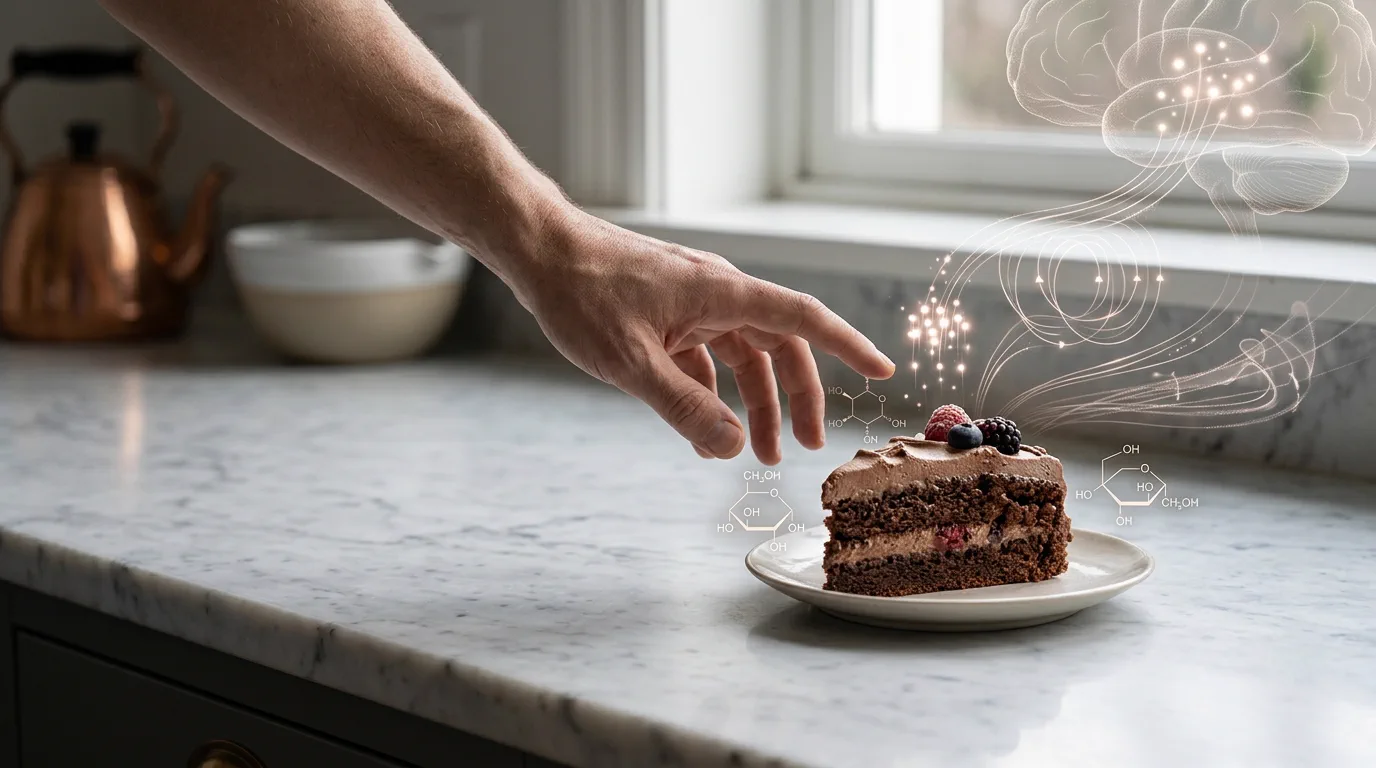
Key Fact Sugar cravings feel so powerful because they sit at the intersection of reward circuitry, blood sugar physiology, and habit — and because modern hyper-palatable foods are specifically engineered to trigger that loop.
The Real Question Behind a "Sugar Addiction"
Almost everyone has experienced it: you tell yourself you will skip dessert, then somehow find yourself standing in front of the pantry an hour later, unable to think about anything else. Sugar cravings are among the most common and most frustrating experiences in weight management. The reason they feel so uncontrollable is not a lack of discipline. It is a combination of how your brain processes reward, how your blood sugar responds, and how the modern food supply is designed around those systems.
This article looks at the science behind sugar cravings, why they are so hard to control, and what the research suggests about working with them. It is educational, not prescriptive: different approaches work for different people, and there is no single "cure" that applies to everyone.
The Reward System: Why Sugar Feels Like It Shouldn't Be Resisted
Foods high in sugar activate the brain's reward circuitry, which releases dopamine and produces feelings of pleasure and anticipation. This system evolved to motivate us toward calorie-dense foods when they were scarce. The problem is that the system still works as if scarcity were normal — but the food supply around it has changed completely.
Behavioral neuroscience research has shown that intermittent access to sugar-rich food can produce behaviors in animals that resemble the patterns seen with some drugs of abuse, including binge-like intake and signs of withdrawal-like distress when the sugar is removed.Avena NM, Rada P, Hoebel BG. (2008). Evidence for sugar addiction: behavioral and neurochemical effects of intermittent, excessive sugar intake. Neuroscience & Biobehavioral Reviews. It is important to be careful here: the human picture is more complex, and calling all sugar intake "addiction" overstates the science. But the animal data illustrates a real point — the reward pathways involved in sugar craving are powerful and can be sensitized by repeated exposure.
What this means practically: a craving for sugar is not a sign of moral failure. It is a signal from a brain region that has learned, through repetition, that sugar delivers a strong reward.
Blood Sugar and the Craving Loop
Sugar cravings are also tied to blood glucose physiology. When you eat a large amount of refined carbohydrates, blood sugar rises quickly. In many people, this is followed by a rapid drop — sometimes below the level it was before the meal. That reactive low can produce hunger, irritability, and a strong desire for more quick carbs, which sets up a cycle: crave, eat, spike, crash, crave again.
This is not a character flaw. It is a physiological response to how quickly your blood sugar rises and falls. Meals that include protein, fiber, and fat tend to flatten these swings, and in many people, that reduces the frequency and intensity of cravings. It is one of the clearest examples in nutrition where the structure of a meal matters more than its total calories for a specific symptom like craving.
Hyper-Palatable Foods: Engineered to Be Hard to Stop
The modern food environment intensifies sugar cravings in a specific way. Many processed foods are formulated to combine sugar with fat, salt, and specific textures in combinations that maximize palatability. Researchers have documented that certain combinations of these ingredients — called hyper-palatable foods — activate reward systems more strongly than whole foods do, and can be particularly difficult to moderate.Small DM, DiFeliceantonio AG. (2019). Processed foods and food reward. Science.
The term "hyper-palatable" is not a value judgment. It is a description: these foods rate higher on the dimensions — fat, sugar, salt, texture — that drive intake. When such food is available around the clock, the reward loop is repeatedly stimulated, and the craving response becomes easier to trigger. This is directly connected to the broader question of why obesity is so difficult to reverse, because the environment that promotes cravings is the same environment that promotes weight regain.
Habit and Cue: Cravings Run on Autopilot
Much of what feels like a sugar craving is actually a learned habit. If you routinely eat something sweet after dinner, at the same time each afternoon, or while watching television, your brain associates those cues with sugar. The craving you feel at 3 p.m. is not always driven by energy need — it is the cue-triggered anticipation of a familiar reward.
This is why cravings so often appear "out of nowhere" at predictable times. The environment is doing much of the work. Research on cue-driven eating shows that repeated pairing of a context with a reward makes the context itself able to trigger the desire.Volkow ND, et al. (2013). Obesity and addiction: neurobiological overlaps. Obesity Reviews. Breaking the pattern often requires changing the cue — not just summoning more willpower at the moment of the craving.
The Role of Food Marketing and Availability
There is also a structural reason sugar cravings are so common: sweet, palatable foods are essentially everywhere. They are at the checkout counter, in the office kitchen, on television, and available at any hour. This constant availability repeatedly exposes you to the cues that trigger cravings, and repeated cue exposure keeps the reward loop primed.
This is not to say the food industry is deliberately "hacking" your brain in some conspiratorial way — but the economic reality is that palatable, shelf-stable foods sell well, and the environment reflects that. The practical consequence is that resisting sugar craving in a world where sugar is always offered requires more than personal discipline; it benefits from deliberate choices about what you keep at home and what you keep within easy reach.
Contextual Eating: Why Nighttime Cravings Are Stronger
Many people notice their sugar cravings are worst in the evening. Part of this is environmental — evening is when television, socializing, and relaxation happen, and those are times associated with snacking. Part is biological: for many people, the stress of the day has accumulated by evening, and fatigue from the day's activities can amplify the appeal of quick energy. If your cravings cluster in the evening, looking at what evening looks like — screen time, stress, dinner composition, sleep timing — is often more productive than trying to "push through" the craving each night.
Why Sugar Cravings Get Stronger When You're Sleepy or Stressed
Two of the most reliable amplifiers of sugar craving are sleep loss and stress. Both change the biology of appetite and reward in ways that make sweet foods more appealing. Short sleep has been shown to increase hunger hormones and to shift brain responses toward high-calorie, highly palatable foods.Cappuccio FP, et al. (2008). Meta-analysis of short sleep duration and obesity in children and adults. Sleep.
Stress works through a separate pathway. Elevated cortisol and activation of the HPA axis can increase the desire for palatable foods — partly because sweet, energy-dense food provides a quick form of relief from the negative feeling of stress.Adam TC, Epel ES. (2007). Stress, eating and the reward system. Physiology & Behavior. This connects cravings directly to the stress system, which is why managing stress is often part of a real strategy for cravings. The link between stress and weight loss runs in large part through this craving pathway. And if you are both sleep-deprived and stressed, the effect compounds.
Portion, Occasion, and the "One Bite" Problem
For many people, the hardest part of a sugar craving is the portion control that follows. Once the first bite happens, the reward signal tends to reinforce continued eating. This is partly biological — the anticipation of reward peaks before and during the first bites — and partly behavioral, because stopping midway through a palatable food feels unnatural to the brain.
Strategies that address the occasion rather than the willpower tend to be more realistic. Pre-deciding how much you will have, serving a controlled portion instead of eating from the bag or box, and making the decision before the craving peaks are all examples of environment-first approaches. None are guarantees, but they change the structure of the situation.
Does "Cold Turkey" Work, or Is Moderation Better?
There is no universal answer to whether complete avoidance or controlled moderation works better for sugar cravings. It depends substantially on the person. Some find that a small, planned sweet each day satisfies the desire and prevents the deprivation spiral that follows strict avoidance. Others find that any exposure triggers a larger craving, and that avoiding trigger foods entirely is more workable.
The honest summary from the research is that both approaches can work and both can fail, and that the match between approach and person matters more than the approach itself. If you are designing a strategy, it is usually worth testing one approach for a defined period — two to four weeks — and observing what actually happens, rather than assuming a rule applies to you.
The Protein and Fiber Angle
One consistent finding in appetite research is that protein and fiber reduce the intensity of food cravings in many people. Protein increases satiety and stabilizes blood glucose response; fiber adds bulk and slows digestion.Paddon-Jones D, et al. (2008). Protein, weight management, and satiety. American Journal of Clinical Nutrition. People who build meals around these tend to report fewer and weaker cravings, not because sugar is "banned," but because the drive for it is lower to begin with.
What About Sweeteners and Substitutes?
People often ask whether low-calorie sweeteners help or hurt cravings. The evidence is mixed and depends on the person and context. Some research suggests that sweet taste itself can maintain a preference for sweetness, which may not reduce the wider habit of wanting sweet foods. Other research finds that using lower-calorie alternatives can help some people reduce sugar intake in the short term without increasing craving.
The honest position is that there is no clear universal answer. For some, a diet drink settles a sweet craving at near-zero calories and is genuinely helpful. For others, it keeps the sweet-tooth loop active. As with most of this article, the answer is individual — test it, observe, and keep what helps.
Emotional Eating and Sugar
Many of the strongest sugar cravings are emotional. When people are lonely, anxious, bored, or exhausted, sweet food offers a rapid, reliable form of comfort. This is not a sign of weakness; it is the reward system responding to a need that has nothing to do with nutrition. Understanding which of your cravings are emotional — and which are physiological — is a genuinely useful skill, because the two respond to completely different interventions.
For emotionally driven cravings, the intervention is usually emotional: connection, movement, rest, or simply activity to break the loop. For physiologically driven cravings, the intervention is usually nutritional or lifestyle-based. Most people experience both, and neither is "wrong."
Sleep, Stress, and Cravings: The Recurring Theme
The factors that make poor sleep and weight gain interact are the same factors that amplify sugar cravings. If your cravings spike on days after poor sleep or heavy stress, that is informative: it tells you the craving is being driven in part by biology, not by a simple taste preference. Addressing the sleep or stress driver can reduce the craving without any work on the craving itself.
This is why a cravings strategy that includes sleep hygiene, stress regulation, and meal composition tends to be more effective than one that relies only on resisting sugar. The body is less likely to demand what it does not urgently need.
Medical Angle: When Cravings Are a Signal
In some cases, intense sugar cravings are related to underlying metabolic issues. Rapid blood sugar swings, insulin resistance, or early diabetes can produce marked cravings. If cravings are extreme, constant, or accompanied by excessive thirst, frequent urination, fatigue, or unexplained weight changes, a medical evaluation is appropriate. Cravings are not "just cravings" when they are a symptom of something else.
Certain hormonal and reproductive conditions can also shift appetite and craving patterns significantly. Menstrual-cycle changes, pregnancy, and conditions like polycystic ovary syndrome are all associated with changes in carbohydrate cravings for many women. These patterns are real, physiologically driven, and often respond differently than the everyday sugar craving does. If your cravings track a predictable cycle, that is useful information — it means the driver is hormonal timing, not a failure of willpower, and the response should be designed around that timing.
An Honest Note About Timelines
People often expect that a sugar craving will disappear as soon as they decide to address it. The reality is usually slower and less dramatic. Habit-based cravings tend to weaken gradually as the cue-response link fades through repetition of new behavior. Physiological factors like blood sugar swings respond more quickly once meal structure improves. Sleep and stress effects can take days to weeks to normalize. None of this is a reason for discouragement; it is a reason to set realistic expectations and to measure progress over weeks rather than hours.
It is also worth remembering that occasional cravings are normal and not a sign of a problem. The goal of working with sugar cravings is rarely to eliminate them completely. It is to reduce their frequency and intensity to the point where they no longer govern your decisions — leaving room for deliberate choice.
Practical Approaches to Sugar Cravings
- Build meals around protein and fiber. This is the most reliable dietary lever for reducing craving intensity.
- Protect sleep. A well-rested brain is less attracted to high-calorie food.
- Manage stress deliberately. Breathing, movement, and rest reduce the stress-craving loop.
- Change the cue, not just the craving. If 3 p.m. always triggers sugar, change what happens at 3 p.m.
- Pre-portion any planned sweet. Decide the amount before the craving peaks, not during it.
- Test one approach at a time. Avoidance or moderation — choose one, try it for a few weeks, and observe.
- Keep trigger foods less accessible. Environment beats willpower when the reward loop is strong.
Putting It Together: Why Sugar Cravings Feel Uncontrollable
| Driver | Mechanism | Practical Lever |
|---|
| Reward circuitry | Dopamine-driven anticipation of sweet food | Change the cue and the occasion |
| Blood sugar swings | Reactive lows trigger further carb desire | Protein, fiber, and meal structure |
| Hyper-palatable food | Fat-sugar-salt combinations maximize palatability | Reduce easy access to trigger foods |
| Habit and cues | Context becomes a trigger for desire | Rework the routine around the cue |
| Sleep loss | Higher hunger hormones, stronger food reward response | Consistent, sufficient sleep |
| Stress | Cortisol increases craving for palatable foods | Stress-regulation practices |
| Medical factors | Metabolic issues can amplify cravings | Clinician evaluation if extreme |
Frequently Asked Questions
Are sugar cravings a sign of sugar addiction?
Animal research shows addiction-like patterns with intermittent sugar access, and some people describe their cravings that way, but the human evidence is more complex. Cravings are better understood as a strong reward-driven response than as a formal addiction for most people.
Does cutting out sugar completely stop cravings?
For some people, yes; for others, strict avoidance produces more intense cravings. It depends on the person, which is why testing one approach for a set period is more useful than assuming a rule.
Why do I crave sugar more when I'm stressed or tired?
Stress raises cortisol and short sleep raises hunger hormones, both of which increase desire for palatable, high-calorie food. The craving is amplified by biology, not just preference.
Can sleep fix my sugar cravings?
Improving sleep can significantly reduce craving intensity for many people, because well-regulated appetite hormones make the body less motivated to seek quick energy.
Is it okay to have a small amount of sugar daily?
For many people, moderate, planned amounts of sweet food are compatible with a healthy routine. The key is that it is planned and portioned rather than driven by impulse.
Conclusion
Sugar cravings are hard to control because they are not a single behavior. They combine a powerful reward system, blood sugar physiology, learned habits, and the amplifying effects of sleep loss and stress — all in an environment engineered around palatability. Fighting that combination with willpower alone is asking a lot of any person.
The more realistic path is structural: meals built around protein and fiber, sleep protected, stress managed, and trigger foods made less accessible. None of this is about "never eating sugar again." It is about changing the conditions so that when you do decide to eat something sweet, it is a choice — not an automatic craving that overrides you.
If you struggle with sugar cravings, the most useful question is rarely "why can't I control myself?" A more productive question is "what is amplifying this craving right now?" Sleep, stress, meal composition, emotional state, and the food environment each offer a lever. You do not need to master all of them. Pick the one that is most clearly out of balance in your life, address it, and observe what changes. In many cases, the craving that felt permanent begins to quiet once the driver behind it is removed.
Content reviewed & updated August 2026 by the Medai Wellness research team.
Educational content only. This article is for informational purposes and does not constitute medical advice. Craving and appetite changes can have medical causes that require evaluation. Consult a qualified healthcare professional before making changes to your health routine.
References
- Vgontzas AN, et al. Sleep Deprivation Effects on the Activity of the Hypothalamic-Pituitary-Adrenal and Growth Axes: Potential Clinical Implications. Clin Endocrinol. 1999. PubMed
- Breit S, Kupferberg A, Rogler G, Hasler G. Vagus Nerve as Modulator of the Brain-Gut Axis in Psychiatric and Inflammatory Disorders. Front Psychiatry. 2018;9:44. PubMed