Why Is Obesity So Difficult to Reverse? The Science Behind Modern Weight Gain
TW
Dr. Thomas Whitaker, MD, PhD
Medai Wellness Research Editor
MedAI Clinical Research Board • Reviewed by Dr. Elena Rostova, MD, PhD • Updated September 2026
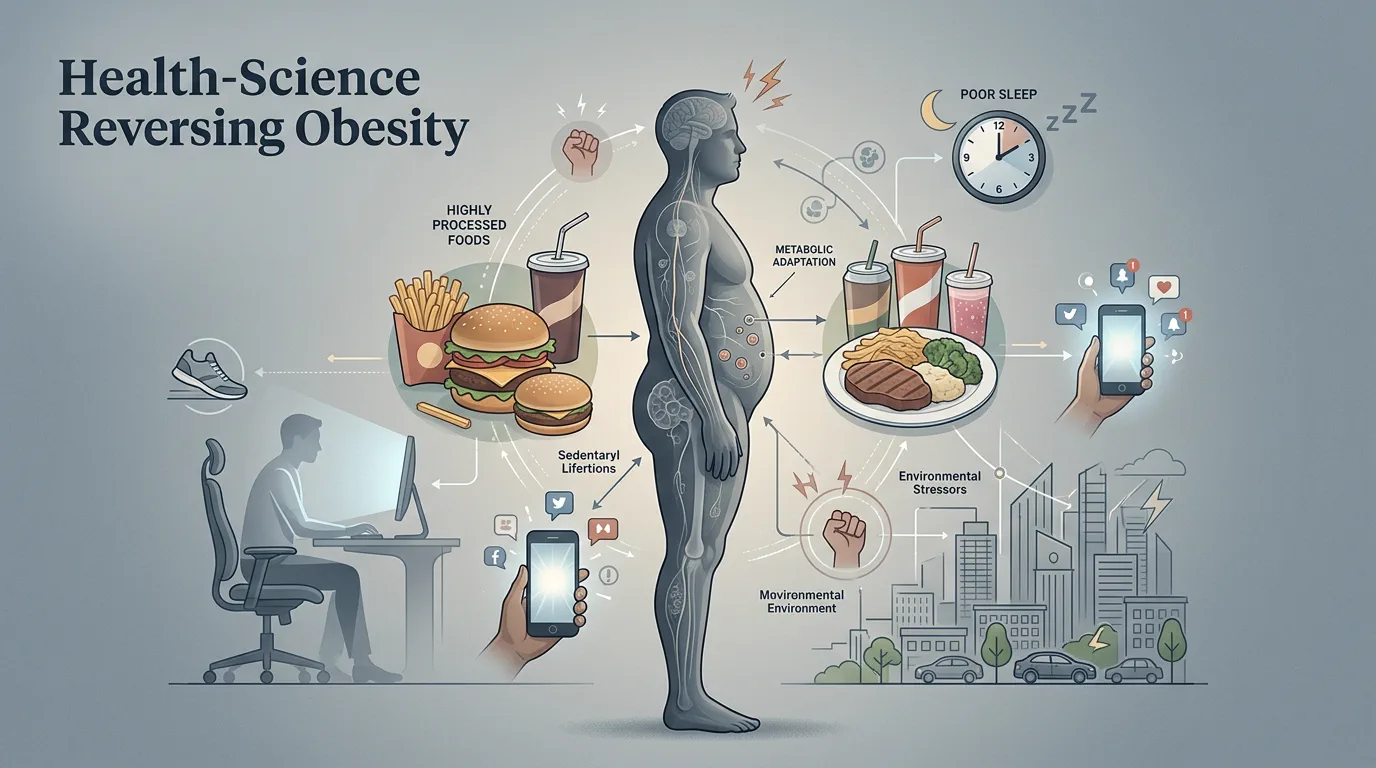
Key Fact Obesity is difficult to reverse in large part because your body defends its current weight through coordinated changes in appetite, energy expenditure, and hormones. The science points to biology and environment — not willpower — as the dominant forces.
The Weight Loss Paradox
Most people who set out to lose weight expect a simple story: eat a little less, move a little more, and the scale follows. The reality is more complicated. Obesity is difficult to reverse because the human body treats body weight — and especially body fat — as a resource to defend, not a number to change. When weight comes off, the body mobilizes a cascade of biological responses designed to bring it back. Understanding why this happens is the first step toward a realistic, sustainable approach.
This article explains the main forces that make weight loss hard to sustain: energy balance, appetite regulation, the modern food environment, highly palatable foods, sleep, stress, physical activity, metabolic adaptation, genetics, behavior, long-term adherence, and weight regain. It is not a how-to guide and it makes no promises. It is a map of the terrain.
Energy Balance Is Not a Simple Equation
At its most basic level, body weight changes according to the difference between energy in and energy out. That statement is true — and it is also incomplete. The problem is that the two sides of the equation are not independent. When you reduce energy intake, the body does not simply burn fat at a fixed rate. It compensates: appetite increases, resting metabolic rate drops, and spontaneous physical activity often declines. When you increase energy expenditure, appetite frequently rises to match it.Hall KD, et al. (2012). Energy balance and its components: implications for body weight regulation. American Journal of Clinical Nutrition.
This is why the phrase "calories in, calories out" is technically accurate but practically misleading. The system is dynamic, with multiple feedback loops that adjust both intake and output around a defended range. Researchers describe this as a set point or "settling point": not a fixed number, but a range your biology works hard to maintain. Reversing obesity means shifting that range, and the body does not cooperate quietly.
Appetite Regulation: Why Hunger Is Not a Willpower Problem
Appetite is controlled by a network of hormones and brain regions that balance short-term meal signals against long-term energy stores. Leptin, produced by fat tissue, signals long-term energy availability to the brain. Ghrelin, produced mainly by the stomach, rises before meals and signals hunger. After eating, incretins and other gut peptides promote fullness. When body fat drops, leptin falls, ghrelin activity can rise, and the brain receives a persistent "we are low on fuel" message.Schwartz MW, et al. (2017). Obesity Pathogenesis: An Endocrine Society Scientific Statement. Endocrine Reviews.
The hypothalamus integrates these signals with reward circuits, stress systems, and learned associations. Hunger, in other words, is not a character flaw. It is a biological signal that responds to actual weight loss. One widely cited trial found that hormonal changes favoring increased hunger and reduced energy expenditure persisted for at least a year after participants lost weight — meaning the body kept "asking" for the weight back long after the diet ended.Sumithran P, et al. (2011). Long-term persistence of hormonal adaptations to weight loss. New England Journal of Medicine.
This helps explain why so many people experience constant hunger after losing weight, and why the experience is so frustrating. It is not that they lack discipline; it is that their biology is actively opposing the change. For a deeper look at the mechanisms driving persistent hunger, see our article on why you feel hungry all the time.
The Food Environment We Live In
Obesity did not spread because humans suddenly lost willpower. It spread as food environments changed. Over the past several decades, energy-dense, highly palatable, heavily marketed food became cheap, abundant, and available around the clock. Portion sizes grew. Eating moved from structured meals to continuous snacking. In parallel, daily movement declined as physical labor was automated and leisure became more sedentary.
Public-health researchers describe this as an "obesogenic" environment — one that makes weight gain easier and weight loss harder for nearly everyone, regardless of individual effort.Swinburn BA, et al. (2011). The global obesity pandemic: shaped by global drivers and local environments. The Lancet. When a person is surrounded by cheap, convenient, palatable food and has few opportunities for movement, maintaining a low body weight requires constant vigilance. This is not a personal failing; it is an environmental mismatch. We explore the broader picture in our piece on the modern obesity problem and why our environment makes weight control harder.
Highly Palatable Foods and the Reward System
Not all calories are equal from the brain's perspective. Foods engineered to combine high fat, high sugar, high salt, and specific textures activate the brain's reward circuitry in ways that whole, unprocessed foods generally do not. This is sometimes called "food reward," and it operates partly through dopamine pathways shared with other rewarding behaviors.
Research has shown that certain hyper-palatable food combinations can be difficult to moderate because they amplify reward signals out of proportion to their energy needs.Small DM, DiFeliceantonio AG. (2019). Processed foods and food reward. Science. When these foods are available around the clock, the reward system is repeatedly stimulated, which can make stopping after one portion genuinely hard. This is closely related to the question of why sugar cravings are so hard to control.
None of this means people have no influence over their choices. It means the influence has limits, and those limits are worth respecting when designing a realistic plan.
Metabolic Adaptation: When the Body Fights Back
As weight drops, the body often lowers its energy expenditure beyond what would be expected from the smaller body mass alone. This phenomenon, called adaptive thermogenesis, means that someone at a lower weight may burn fewer calories than a person of the same weight who was never overweight.Rosenbaum M, Leibel RL. (2010). Adaptive thermogenesis in humans. International Journal of Obesity.
Adaptive thermogenesis is partly why the same behavior that produced weight loss early on stops producing it later. The same meal plan, the same workouts, and the same daily routine eventually meet a lower level of energy expenditure, and the scale stalls. This is frequently misinterpreted as a failure to follow the program, when in fact it is the program working as expected — against a body that has adjusted its baseline downward.
The most cited illustration of this effect came from a study of competitors on a televised weight-loss show. Six years after the competition, most had regained a substantial portion of the weight, yet their resting metabolic rates remained lower than predicted — even for those who had kept weight off.Fothergill E, et al. (2016). Persistent metabolic adaptation 6 years after "The Biggest Loser" competition. Obesity. The finding was striking not because it applies to everyone in the same way, but because it shows how strong the body's defenses can be.
Metabolic adaptation helps explain two common experiences: weight loss slows over time, and maintaining a lower weight can feel as difficult as losing it in the first place.
Sleep: The Overlooked Driver
Sleep duration and quality influence weight regulation through appetite hormones, glucose metabolism, and energy expenditure. Short sleep has been associated with changes in ghrelin and leptin that favor increased hunger, as well as reduced insulin sensitivity. A meta-analysis of cross-sectional and prospective studies found consistent links between short sleep and higher body weight, with the association strongest in adults.Cappuccio FP, et al. (2008). Meta-analysis of short sleep duration and obesity in children and adults. Sleep.
Experimental sleep restriction studies reinforce the point: healthy adults who slept only about four hours per night showed endocrine and metabolic changes consistent with early signs of insulin resistance compared with those who slept longer.Spiegel K, et al. (1999). Impact of sleep debt on metabolic and endocrine function. The Lancet. When sleep is chronically poor, appetite regulation and blood sugar control both suffer — which makes consistent healthy eating more difficult. We cover the full picture in our guide to the hidden connection between poor sleep and weight gain.
Stress, Cortisol, and the HPA Axis
Chronic stress influences body weight through the hypothalamic-pituitary-adrenal (HPA) axis and the release of cortisol. Elevated cortisol has been associated with increased appetite, a preference for energy-dense foods, and a pattern of fat storage that favors the abdomen. One well-known study found that women who secreted more cortisol in response to stress had higher central adiposity — belly fat — even after accounting for other factors.Epel ES, et al. (2000). Stress and body shape: stress-induced cortisol secretion is consistently associated with body fat distribution in women. Psychosomatic Medicine.
Stress also shifts eating behavior. In many people, stress increases intake of palatable, high-calorie foods, partly through interactions between the HPA axis and reward pathways.Adam TC, Epel ES. (2007). Stress, eating and the reward system. Physiology & Behavior. This is not weakness; it is a neuroendocrine response. The connection between chronic stress and metabolic health runs deep, and it is one of the reasons stress can make weight loss harder. For a detailed treatment of the underlying biology, see our analysis of chronic stress, cortisol, and metabolic health.
Physical Activity: The Most Adjustable Piece
Of all the factors discussed here, physical activity is the one people can influence most directly. Movement increases energy expenditure, improves insulin sensitivity, and supports muscle mass. That said, the contribution of exercise alone to weight loss is often overstated. In part, this is because increased activity tends to stimulate appetite, and because a single hour of exercise can be undone by a few minutes of eating.
The bigger issue is that overall daily movement — not just scheduled workouts — has declined sharply. Non-exercise activity thermogenesis, the energy burned through everyday movement like walking, standing, and household tasks, can be substantial. Someone who moves throughout the day can burn meaningfully more than someone who is sedentary, even if they exercise for the same number of minutes. The practical lesson is not to abandon exercise, but to pair it with a broad increase in daily movement and a realistic view of what it can do alone.
Genetics: The Hand You Were Dealt
Body weight is heritable. Twin and family studies consistently show a strong genetic component to BMI, and large genome-wide studies have identified hundreds of variants associated with body mass index. Many of these variants cluster in or near genes expressed in the brain, particularly in regions involved in appetite and reward — reinforcing the point that body weight regulation is largely a neural process.Loos RJF, Yeo GSH. (2022). The genetics of obesity: from discovery to biology. Nature Reviews Genetics.
Genetics do not determine destiny. They influence tendencies — how hungry you feel, how rewarding certain foods are, how easily you store fat — and they interact with environment. Someone with a genetic tendency toward higher body weight faces a steeper climb in an obesogenic environment, but they are not powerless. The takeaway is that comparing yourself to someone with a different genetic profile is not useful. Your biology is not a verdict; it is context.
Behavior, Habit, and Long-Term Adherence
Most weight-loss programs work in the short term. People can restrict calories, follow meal plans, and lose weight. The harder problem is adherence over months and years. Sustained restriction is demanding, especially when it runs against the biological defenses described above. Studies of long-term weight loss maintenance find that people who succeed tend to be a specific minority who can sustain high levels of consistent behavior — frequent self-monitoring, regular physical activity, and controlled eating — over a long period.Wing RR, Phelan S. (2005). Long-term weight loss maintenance. American Journal of Clinical Nutrition.
Habits matter because they reduce the need for moment-to-moment willpower. Environment matters even more. People who keep unhealthy food out of reach, who build exercise into a routine, and who create structure around meals tend to do better. This is why we discuss the reasons most weight loss attempts fail and what a sustainable approach looks like.
Weight Regain: The Most Common Outcome
Most people who lose weight regain it within a few years. The reasons are not mysterious: appetite increases, energy expenditure drops, and the food environment remains unchanged. Weight regain is not evidence of failure of character. It is evidence that the biology of body weight regulation is powerful and persistent.
Maintaining a lower weight requires an ongoing strategy rather than a temporary program. Clinicians increasingly frame obesity as a chronic, relapsing condition that benefits from long-term management — similar to other chronic conditions — rather than a short-term problem with a permanent fix.Hall KD, Kahan S. (2018). Maintenance of lost weight and long-term management of obesity. Medical Clinics of North America. This reframing is important because it changes expectations: the goal is not to "finish" losing weight, but to build a set of practices that can be sustained indefinitely.
The pattern of losing weight, regaining it, and losing it again is common enough that it has its own name: weight cycling, sometimes called "yo-yo dieting." While research on the health effects of weight cycling continues, the pattern itself reveals an important truth. Each cycle tends to begin with genuine optimism and ends with the same biological reality: the body defends its weight. Repeated cycles can also wear on motivation, which makes the next attempt harder not because of biology alone, but because people lose faith in the process. Protecting motivation is therefore as important as protecting calories, which is why sustainable approaches tend to emphasize small, repeatable behaviors over dramatic short-term changes.
One reason adherence is so hard is that weight maintenance demands something close to a permanent lifestyle shift in a food environment that never stops offering energy-dense options. People who maintain long-term losses typically do not stop "watching" — they keep weighing themselves regularly, keep tracking, and keep exercising, sometimes indefinitely. This is not a failure to "graduate" from a program; it is the reality of managing a chronic condition in an environment that favors the status quo.
What a Realistic Approach Looks Like
Given all of this, what does a sustainable approach actually involve? There is no single answer, and there is no guarantee of any specific outcome. But the research points toward several principles worth considering:
- Respect appetite. Strategies that produce constant hunger are rarely sustainable. Prioritizing protein and fiber, eating at regular intervals, and slowing down at meals can support satiety.
- Improve the food environment. Making palatable, energy-dense foods less accessible and keeping healthier options visible and convenient reduces reliance on willpower.
- Protect sleep. Consistent, sufficient sleep supports the hormonal conditions that make healthy eating and daily activity easier.
- Address stress. Because stress drives appetite and abdominal fat storage, nervous system regulation — breathing, movement, rest — has a real role to play.
- Move regularly, not just intensely. Daily movement plus structured activity beats sporadic intense workouts.
- Plan for the long term. Expect plateaus and small regressions. They are normal parts of the process, not signs of failure.
- Consider professional support. Dietitians, physicians, and structured behavioral programs can provide accountability and help tailor an approach to your specific biology and circumstances.
Because appetite and neuroendocrine stress axes are persistent homeostatic forces, addressing metabolic resistance requires targeted physiological regulation rather than sheer willpower alone. Autonomic nervous system regulation, sleep architecture restoration, and steady glycemic management work synergistically to attenuate neuroendocrine hunger drives and lower allostatic load.
Putting It Together: The Forces at Work
The factors described above do not act in isolation. They compound. A short sleep problem raises hunger hormones; stress raises cravings for palatable foods; a sedentary environment lowers expenditure; metabolic adaptation amplifies all of it. The table below summarizes the main forces and how they interact.
| Force | What It Does | Why It Makes Reversal Hard |
|---|
| Appetite regulation | Hormones (leptin, ghrelin) signal hunger and satiety to the brain | Weight loss lowers satiety signals and raises hunger signals |
| Metabolic adaptation | Energy expenditure drops more than body mass alone would predict | Progress slows and maintenance feels like constant work |
| Food environment | Cheap, abundant, energy-dense food is always available | Sustained restriction requires constant environmental effort |
| Highly palatable foods | Fat-sugar-salt combinations over-activate reward circuitry | Moderating intake of these foods is genuinely difficult |
| Sleep | Short sleep raises hunger and impairs glucose handling | Poor sleep undermines the very behaviors that support loss |
| Stress & cortisol | Chronic stress drives appetite and abdominal fat storage | Stress eating offsets intentional dietary changes |
| Physical activity | Movement raises expenditure and improves insulin sensitivity | Compensatory appetite can offset exercise-related burn |
| Genetics | Influences hunger, reward sensitivity, and fat storage tendency | Steeper climb for some, independent of effort |
| Behavior & adherence | Long-term consistency sustains any approach | Restriction is demanding to maintain for years |
| Weight regain | Biology defends the former weight range | Most losses are partially or fully regained |
The recurring theme is that obesity is not a single problem with a single lever. It is a systems problem, and reversing it usually requires working with several systems at once — not just counting calories.
Clinical pearl: If a weight-loss approach requires willpower at every meal, it is probably working against the biology described above. Approaches that change the environment, protect sleep, and manage stress give the body less reason to push back.
When to Talk to a Professional
Because weight regulation is complex, professional guidance can make a meaningful difference. A physician or registered dietitian can help rule out medical causes of weight gain — including thyroid conditions, certain medications, and metabolic disorders — and can help design a plan that fits your biology and your life. If you experience extreme, rapid weight changes, or weight gain accompanied by fatigue, shortness of breath, or other symptoms, a medical evaluation is appropriate before starting any program.
Frequently Asked Questions
Why is obesity so difficult to reverse?
Because weight loss triggers coordinated biological defenses — increased hunger, reduced energy expenditure, and hormonal changes — that favor weight regain, while the modern food environment continues to make high-calorie food easy to obtain.
Is obesity mainly about willpower?
No. Appetite, hormones, genetics, and environment all play substantial roles. Willpower matters, but it is not the dominant factor, and approaches that rely mainly on willpower tend to fail over time.
Does the body really fight weight loss?
Yes. Metabolic adaptation and hormonal changes that increase hunger and reduce energy expenditure have been documented in controlled studies and can persist long after weight is lost.
Why do people regain weight after dieting?
Regain is the expected biological response to weight loss in an environment that promotes overeating. Appetite rises, metabolism drops, and the food environment stays the same.
Do genetics make weight loss impossible?
No. Genetics influence tendencies but do not determine outcomes. Environment, habits, and support can all shift the picture, even if the climb is steeper for some people.
Is there a sustainable way to approach weight loss?
Most research points toward gradual changes, improved food environment, protected sleep, stress management, regular movement, and long-term planning — rather than short, intense programs followed by a return to old habits.
Conclusion
Obesity is difficult to reverse because it is defended by a coordinated system of biology and shaped by an environment built for abundance. That does not make change impossible, but it makes it slower, more complex, and more individual than most diet advice suggests. The honest answer to the question in the title is this: obesity is hard to reverse because the body treats its weight as something to protect — and because the world around us makes protection easier than change.
The most realistic path is not a perfect program but a sustainable set of practices: enough sleep, manageable stress, regular movement, an environment you control, and a way of eating you can maintain for years rather than weeks. Progress looks different for everyone, and no single outcome is guaranteed. But understanding the forces at play is the difference between fighting your biology and working with it.
Content reviewed & updated August 2026 by the Medai Wellness research team.
Educational content only. This article is for informational purposes and does not constitute medical advice. Obesity has many causes, some of which require medical treatment. Consult a qualified healthcare professional before making changes to your health routine.
References
- Vgontzas AN, et al. Sleep Deprivation Effects on the Activity of the Hypothalamic-Pituitary-Adrenal and Growth Axes: Potential Clinical Implications. Clin Endocrinol. 1999. PubMed
- Jalleh RJ, et al. GLP-1 delayed gastric emptying. JCEM. 2025. PubMed