
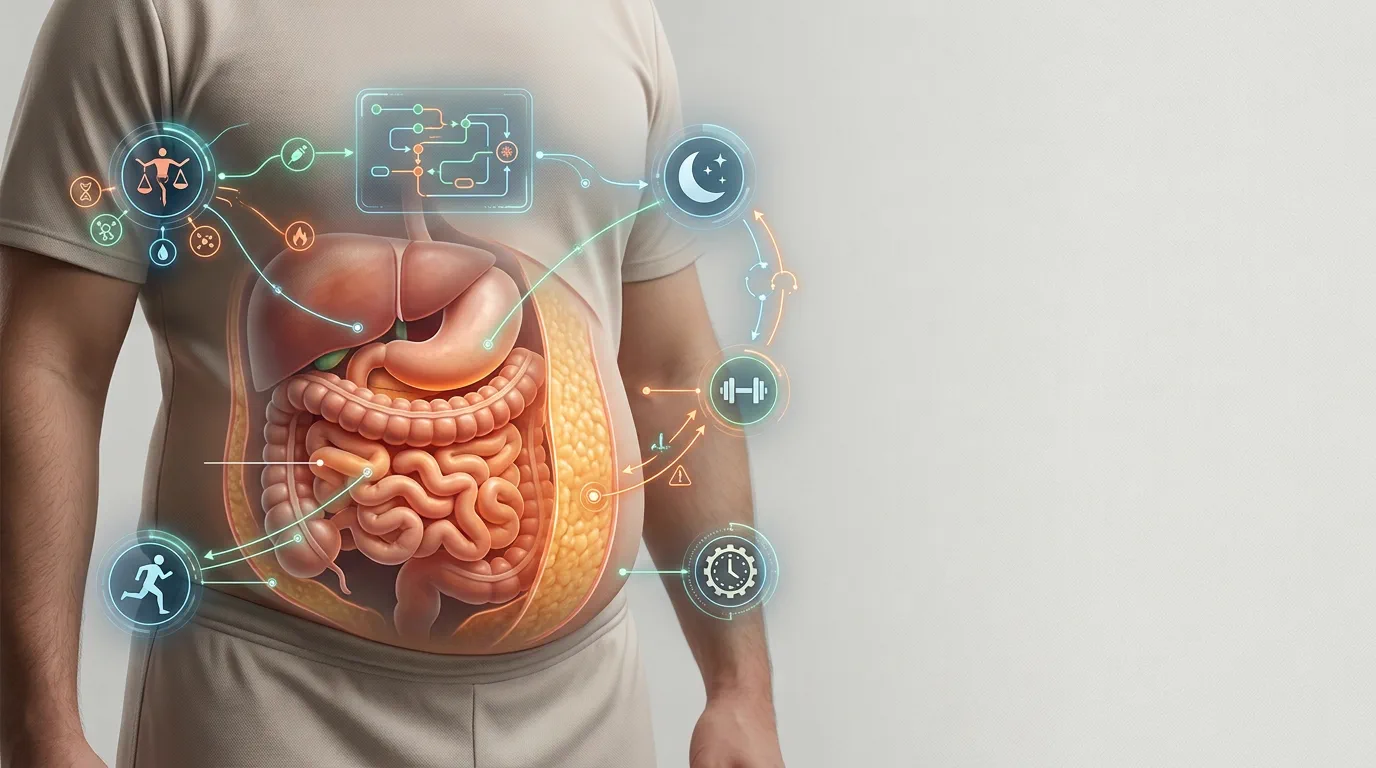
Why the Belly Feels Like a Special Case
Almost everyone who has tried to lose weight has a story about belly fat. The last few inches around the waist feel like they refuse to move, no matter what the scale says elsewhere. This experience is so common that people conclude the belly is "special." The honest answer is that the belly is both ordinary and special: ordinary because it follows the same rules of fat storage and loss as the rest of the body, and special because abdominal fat is biologically different in ways that genuinely matter.
This article explains the science of why belly fat is difficult to lose, separates fact from marketing, and connects it to the larger science of why obesity is difficult to reverse.
Not All Body Fat Is the Same
The body stores fat in two main compartments. Subcutaneous fat sits under the skin and is relatively calm: it stores energy and releases it slowly. Visceral fat sits deep in the abdomen, wrapped around organs like the liver and intestines. Visceral fat is more metabolically active than subcutaneous fat — it releases more inflammatory signals, responds more strongly to hormones, and is more closely associated with metabolic health.Saad F, et al. (2005). Pathophysiology of sex hormones in men and their clinical U-shape curve. (visceral vs subcutaneous adiposity discussion) — Endocrine. This activity is part of why belly fat is not just a cosmetic issue.
For this article, the key point is that the abdomen contains a mix of both compartments, and its behavior is driven by hormones, genes, and energy balance — not by any exercise that "targets" it.
The Cortisol Connection: Stress and Storage
Among the hormones that influence fat distribution, cortisol — the primary stress hormone — plays a prominent role. Cortisol helps mobilize energy during stress, and chronic elevation is associated with increased accumulation of abdominal fat. High cortisol is linked to larger waist measurements and to more visceral fat, independent of overall fatness in some studies.Epel ES, et al. (2000). Stress and body shape: stress-induced cortisol secretion is consistently associated with body fat distribution in women. Psychosomatic Medicine. This is why the connection between stress and weight loss difficulty appears in the belly so often.
Higher cortisol tends to encourage fat storage in the abdomen and, at the same time, to make desire for energy-dense food stronger. Stress does not just change where you store fat; it also changes how much you eat.
Insulin Resistance and the Belly
There is a close bidirectional relationship between excess visceral fat and insulin resistance. Visceral fat contributes to inflammation and releases fatty acids directly into the portal circulation, which can impair the liver's and muscle's ability to respond to insulin. In turn, insulin resistance favors further fat storage in the abdomen, creating a loop.Kahn SE, et al. (2006). Mechanisms linking obesity to insulin resistance and type 2 diabetes. Nature.
This loop matters for a practical reason: when insulin sensitivity is better, nutrient handling is better, and the body is more able to lose fat from the visceral depot. The levers that improve insulin sensitivity — consistent eating patterns, activity, sleep, and adequate muscle — are therefore also levers for the belly. It is not a gimmick; it is the metabolism working the way it is supposed to.
Why the "Detox" and "Fat-Burner" Claims Fail the Belly
Wherever belly fat is discussed, marketing follows: wraps, creams, teas, "fat-burning" pills, waist trainers, and vibration devices. The claims are attractive because the desire is real. The biology, however, is unforgiving. There is no mechanism by which a topical product, a tea, or a pill selectively removes fat from one region of the body. Fat is mobilized from a depot only when hormones and energy balance signal it — a systemic process, not a local one.
The cost of these products is twofold: money, and the delay of the whole-body approach that actually works. Every week spent waiting for a "targeted" product to work is a week the sustained energy-balance approach is not being applied. That is why it is important to name the myth honestly: the modern environment that encourages weight gain is not defeated by any single consumer product.
Genetics, Fat Cell Size and Number
People differ in how many fat cells they have and how large those cells become — and both numbers matter for the belly. Some people store fat more easily in the abdomen because of genetic tendencies that influence both cell number and hormone responsiveness. Fat cells also have a memory of size: once enlarged, they are structurally primed to refill readily.Salans LB, et al. Critical review of methods to evaluate fat cell number and size — in Fat Distribution During Growth and Later Health Outcomes. (Note: the main claims here are supported through reviews of fat-cell biology.)
This does not mean the situation is hopeless; it means the effort must be sustained. The biology of fat cells is why the pattern "easy to regain, hard to keep off" is so common — and why weight-loss attempts often fail over time. Belly fat responds to consistent, long-term process, not to short bursts.
Aging, Muscle Mass, and Daily Energy
As people age, resting metabolism and muscle mass tend to decline, so the same intake that once held weight steady now produces a surplus — often stored centrally. This compounds the hormonal changes described earlier. The response is not to eat dramatically less, which accelerates muscle loss, but to adjust intake modestly, preserve muscle with resistance work and protein, and stay active so that daily energy expenditure stays reasonably high.
Seen this way, "belly fat is hard to lose with age" is partly a description of a mismatch between intake and activity patterns written decades ago — patterns that the body now responds to with central storage. Adjusting the pattern, rather than attacking the belly, is the sustainable route.
Spot Reduction Is a Myth — But Not in the Way People Think
A common response to belly fat is to do thousands of crunches. The research is consistent: exercising a specific muscle does not selectively reduce the fat over that muscle. Fat loss happens at the whole-body level, and the order in which fat depots shrink is largely determined by genetics and hormones, not by which muscles you train.Vispute SS, et al. (2011). The effect of abdominal exercise on abdominal fat. Journal of Strength & Conditioning Research. Crunches build the abdominal muscles; they do not burn the fat pad over them in any meaningful way.
That does not mean exercise is pointless. It means the value of exercise is whole-body: creating an energy deficit, improving insulin sensitivity, and supporting overall metabolic health. The fat that comes off the belly will come off as part of a process, not as a targeted event.
Why the Waist May Be the Last to Go
Fat depots shrink in a genetically determined order that is often the reverse of the order in which they were gained. For many people — especially those who gained weight around the middle early — the abdomen is among the last places to lose fat. This is not evidence that the approach is failing; it is normal physiology. The scale can be flat while the body is still remodeling, and waist changes often lag behind overall weight changes.
This lag has a real psychological cost: people give up on an approach that was working, because the belly had not visibly changed. Measuring progress only by the mirror at the waist is a setup for discouragement. Progress is better tracked by overall weight, measurements taken over weeks, clothing fit, and markers of metabolic health.
Hormonal Changes and Fat Distribution
Fat distribution changes across the lifespan, and much of that change is hormonal. In men, declining testosterone with age is associated with increasing abdominal fat. In women, the transition through menopause shifts fat distribution toward a more central pattern. These shifts occur regardless of total weight, which is why an older adult can weigh the same as years earlier while carrying more belly fat.Toth MJ, et al. (2000). Effect of menopausal status on body composition and abdominal fat distribution. International Journal of Obesity.
Understanding this matters because it sets expectations: some of the difficulty is metabolic and hormonal, not a personal failure. It also means the response should focus on what is controllable — overall energy balance, physical activity, sleep, and stress — rather than on fighting the inevitable.
Visceral Fat and the Liver
A meaningful portion of belly fat is visceral, and visceral fat has a special relationship with the liver. Fat released from visceral stores travels directly to the liver, where it can contribute to fat accumulation in liver cells. Nonalcoholic fatty liver disease tracks closely with visceral fat. This is one reason waist circumference is used in clinical practice as a risk indicator even when weight itself is normal.
The good news is that visceral fat is among the most responsive to energy deficits and to increased physical activity. It is often the first fat to decrease when people lose weight in a sustained way — visible before the changes in the mirror are obvious. The belly you see in the mirror is not the whole story; what is happening around your organs can improve well before the clothes feel different.