Why You Keep Eating When You're Not Hungry
TW
Dr. Thomas Whitaker, MD, PhD
Medai Wellness Research Editor
MedAI Clinical Research Board • Reviewed by Dr. Elena Rostova, MD, PhD • Updated September 2026
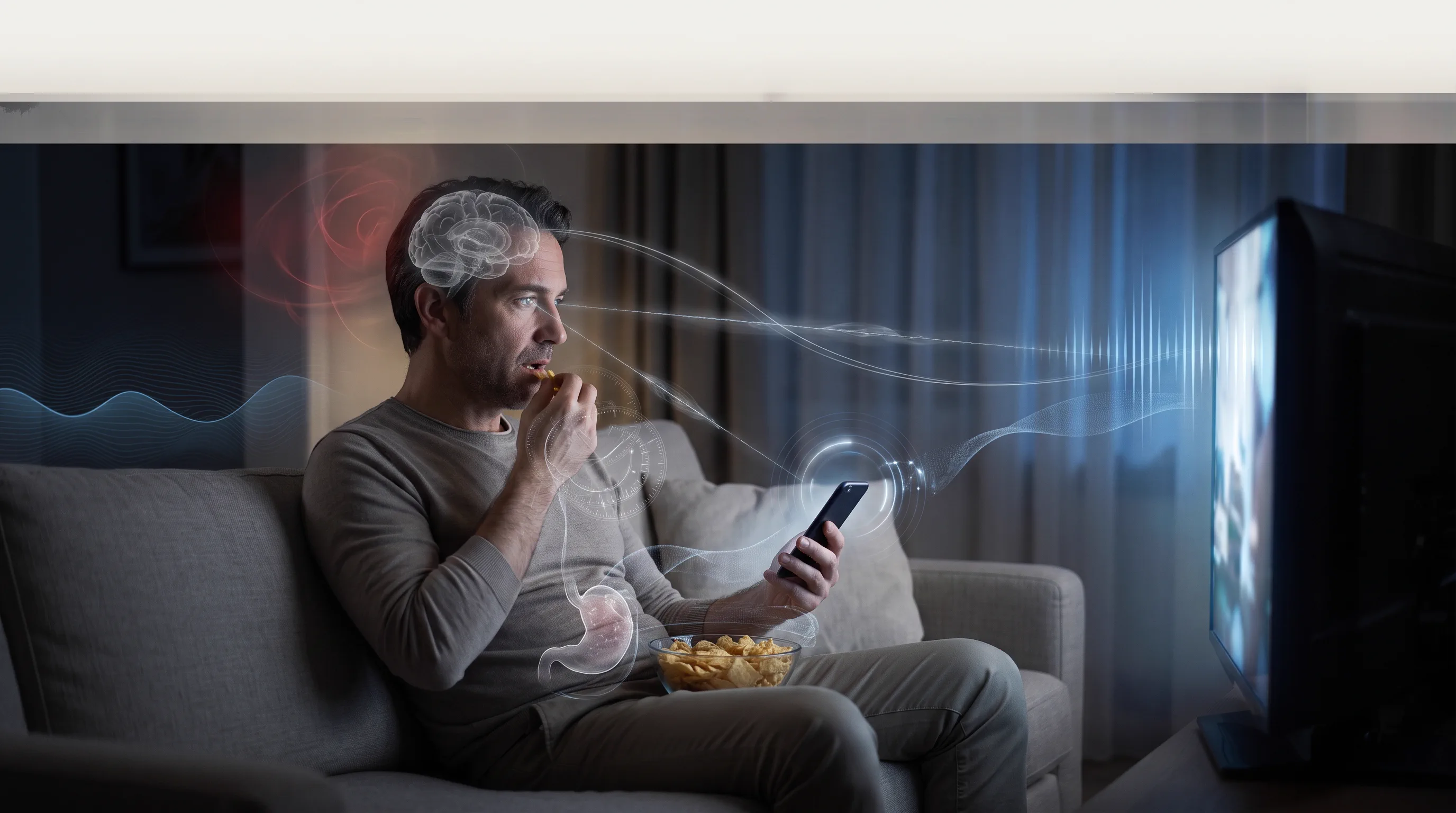
Key Fact Eating when you are not biologically hungry is usually reward-driven: food cues, emotions, habits, and environmental triggers can override fullness signals. Understanding which one is active changes what actually helps.
The Question Most People Ask Themselves in Silence
You finish a meal. Twenty minutes later, you are back in the pantry. You are not hungry in the physical sense — your stomach is full — yet you are eating anyway. This is one of the most common and least understood experiences in weight management. People assume it means they have no control. In reality, it means the drive to eat is being produced by something other than biological hunger, and that distinction matters enormously.
This article looks at why people keep eating when they are not hungry: the reward system, food cues, emotional eating, boredom, habits, and the environment. It is educational, and it does not assume that all non-hungry eating is a problem. The goal is to help you recognize the difference and respond appropriately.
Hunger Signals vs. the Drive to Eat
Biological hunger builds gradually, is flexible about what it will accept, and stops when the body has enough. The drive to keep eating when you are not hungry does not behave that way. It feels urgent, it is specific about the food, and it does not diminish when your stomach is full. That is because it runs on different circuitry — the reward and motivation systems rather than the energy-balance signal.
This is sometimes called "hedonic" eating: eating driven by the pleasure or anticipation of food rather than by energy need.Lowe MR, Butryn ML. (2007). Hedonic hunger: a new dimension of appetite? Physiology & Behavior. The reward circuitry that drives it is powerful — more powerful, in many situations, than the "you're full" signal. This is not a reason to feel ashamed. It is a reason to understand the triggers.
Food Cues: The Environment Doing the Thinking
A large share of non-hungry eating is triggered by food cues: seeing food, smelling it, hearing about it, or simply having it within reach. Psychologists have documented for decades that the mere presence of palatable food increases intake, often without the person noticing.Wansink B. (2004). Environmental factors that increase the food intake and consumption volume of unknowing consumers. Annual Review of Nutrition. The cue activates the reward system, the reward system drives the urge, and the urge feels like a "need" even when it is not.
The practical implication is uncomfortable but simple: if you keep eating palatable food that is visible and within reach, a substantial part of your "decision" is being made by the environment. This is directly connected to how the modern environment makes weight control harder — the environment is not just background, it is an active participant in every eating decision.
Emotional Eating: Food as a Regulator
Many people eat when they are not hungry to regulate emotions. Food — especially palatable food — can temporarily reduce the discomfort of stress, sadness, boredom, or loneliness by stimulating reward pathways. This is learned and real, and it works, at least in the short term.Adam TC, Epel ES. (2007). Stress, eating and the reward system. Physiology & Behavior.
Emotional eating is not a character flaw, but it is an important signal. When the emotion passes, the food is usually not the actual solution to what triggered the eating. Recognizing the pattern — "I am eating because I am stressed, not because I am hungry" — is the first step. The second step is building alternative responses to the emotion itself, which often includes the stress-regulation practices discussed in why stress can make weight loss harder.
Boredom Eating and the Default Snack
Boredom is a common and underrated driver of non-hungry eating. When the mind is understimulated, snacking offers a reliable source of stimulation — flavor, texture, and a small reward hit. For many people, eating is the default activity when there is nothing else happening. This explains why so much non-hungry eating happens in front of a screen or while "relaxing" with nothing to do.
The fix is rarely to "eat less." It is more often to make the alternative activity as accessible as the snack. Having a drink, going for a short walk, picking up a book, or simply noticing what you are about to do before you do it can be enough to interrupt the default. Again, this is not about self-punishment; it is about making the environment support your intention.
Habit Loops: Eating at the Same Time, in the Same Place
Much non-hungry eating runs on habit. If you always eat while watching a show, your brain associates the show with eating, and the association triggers the behavior — hungry or not. If you always snack at a certain time in the afternoon, the time itself becomes a cue. These loops are formed through repetition and do not require actual hunger to operate.
Breaking a loop typically requires changing one of its parts: the cue, the behavior, or the reward. You do not need to eliminate the activity you enjoy; you may simply need to separate it from food, or to replace the snack with something that deliberately matches your goal. Because these loops run automatically, the change needs to be structural rather than a moment-by-moment decision.
The "Clean Plate" and Portion Momentum
Portion size has a strong effect on how much people eat, independent of hunger. When a portion is larger, most people eat more without feeling fuller — a finding replicated across many studies.Kral TVE, Rolls BJ. (2004). Energy density and portion size: their independent and combined effects on energy intake. Physiology & Behavior. Combined with the habit of finishing everything on the plate, this can turn "one serving" into "everything in front of me."
This is not about rigid portion rules. It is about the fact that the brain uses the plate as a guide to when to stop — so the size of the plate, the bowl, and the serving is doing real work in the decision. Serving food intentionally, using consistent serving sizes, and not eating directly from a large package are simple structural adjustments.
Sleepiness and the Weakened Brakes
There is a strong relationship between being tired and eating when you are not hungry. Sleep loss reduces the availability of mental resources needed to resist impulses, and it simultaneously increases the reward value of food. A sleep-deprived brain is more likely to reach for snacks and less likely to stop — not because it has "given up," but because the balance between reward-seeking and restraint shifts.
This connects directly to the broader relationship between poor sleep and weight gain. If you notice that your non-hungry eating spikes on low-sleep days, that is informative: the driver is partly biological, and improving sleep may reduce the behavior without you having to "try harder" at the moment of the craving.
The Self-Serve Effect: Unlimited Refills
There is a distinct pattern that shows up when food is self-served from a large container: people consistently take more than they need. Studies of single-serving versus family-size packages have shown that people eat substantially more from larger packages without reporting greater enjoyment or fullness.Wansink B. (2004). Environmental factors that increase the food intake and consumption volume of unknowing consumers. Annual Review of Nutrition. The container itself is a cue; the more food that is available and visible, the more the brain treats it as "available to eat."
This is one reason the "one small bowl, put the package away" rule works so reliably. It is not a rule about morality or portion policing. It is a rule about giving the automatic system a cleaner input. When the container is the serving, quantity guidance comes from the package. When the serving is the serving, quantity guidance comes from your hands and your intention — a shift that changes the stopping point for most people without extra effort.
The Variety Effect and the Dessert-Track Signal
People eat more when the meal offers variety — in flavors, textures, and categories — because variety delays sensory satiety. Also, palatable dessert-type foods are often eaten after a meal is already satisfyingly full, "tracking" ahead of the body's fullness signal. The dessert is not eaten to relieve hunger; it is eaten to prolong the pleasant experience. The modern eating pattern of frequent variety and constant dessert availability is a direct contributor to eating well past biological need.
This does not mean variety is bad or that dessert must be eliminated. It means that variety is a powerful intake driver, and that a deliberate dessert — sized, timed, and chosen — belongs to a different category than the "dessert track" that keeps running all evening.
Mindless Eating: The Cost of Distraction
Eating while watching television, scrolling, working, or driving dramatically increases the amount consumed without increasing fullness. Distraction interferes with the registration of what and how much was eaten; a person can finish a large meal and genuinely not remember it. This is not a memory problem — it is an attentional one, and it is why "mindless eating" produces persistent eating beyond need.
The most reliable leverage is not to "pay more attention," but to remove the distraction from the eating context. If eating happens at a table without a screen, the quantity is typically smaller and the enjoyment is often reported as greater. The practice is small, but the accumulation across meals is meaningful.
Social Eating and the Company Effect
People eat more in company than when alone — a well-established pattern sometimes called social facilitation of eating. The effect is larger when the company is familiar and the occasion is relaxed. This is not a flaw; eating is social, and sharing meals is healthy. But it contributes to non-hungry eating because the presence of food and company both serve as cues to continue.
The practical implication is to be aware that social settings are intake amplifiers, and to plan accordingly — through serving choices, pace, and the decision of when you are genuinely done. The goal is not to skip the social meal, but to participate deliberately rather than on autopilot.
Why Some People "Eat Through" Fullness
Another mechanism deserves attention: the signals that produce fullness can be weakened or delayed in some circumstances. When people eat very quickly, satiety signals do not have time to register before a large amount of food is consumed. When people eat highly palatable food, reward signals can override the fullness signal altogether. And when the vagus nerve's communication between gut and brain is disrupted — by chronic stress, erratic eating, or certain conditions — the "stop" message can arrive weak and late.Schwartz MW, et al. (2017). Obesity Pathogenesis: An Endocrine Society Scientific Statement. Endocrine Reviews.
For these reasons, eating slowly, choosing satisfying meals, and giving the body time to register fullness can each meaningfully reduce the amount eaten when not hungry. The body's signals matter; they just need to be given a chance to work.
The Role of Protein and Meal Composition
Non-hungry eating is partly powered by how quickly satiety fades after a meal. Meals low in protein and fiber leave the appetite system more exposed to the next cue. Protein is the most satiating macronutrient, and it has been shown to help maintain fullness and reduce the amount eaten at the next opportunity.Paddon-Jones D, et al. (2008). Protein, weight management, and satiety. American Journal of Clinical Nutrition. A meal that includes enough protein and fiber produces a longer, steadier fullness curve — and fewer windows where the only thing between you and the pantry is a decision.
This is not a call to eat more meat or to count grams obsessively. It is a structural point: meals that hold fullness longer reduce the number of times per day your automatic system gets to "vote." That is directly relevant to why you feel hungry all the time — and to the gap between meals that turns into non-hungry snacking.
Mindful Pauses: A Practical Tool
One of the simplest and most effective tools for non-hungry eating is the pause. Before reaching for food, take a brief moment to ask three questions: Am I actually hungry? What am I feeling right now? What would satisfy this — food or something else? The answers are not always clean, but the act of pausing interrupts the automatic loop long enough for a choice to be possible.
This is not mindfulness as a "lifestyle"; it is a concrete behavioral break in a loop that otherwise runs on autopilot. Over time, the pause becomes faster and more natural, and fewer eating episodes happen without a real decision.
Practical Approaches to Non-Hungry Eating
- Change the cue environment. Keep trigger foods out of sight and out of easy reach.
- Separate food from activities. If you snack while watching shows, break the association.
- Pause and check in. A brief question at decision time interrupts the autopilot loop.
- Address the emotion, not just the food. Stress, boredom, and loneliness each need different responses.
- Protect sleep. A rested brain is better able to register fullness and resist impulses.
- Serve portions deliberately. The brain uses portion size as a stopping guide.
- Eat slowly enough for signals to arrive. Satiety takes time to register.
Why Education Alone Isn't Enough
It is worth being realistic about information. Most people already know that they should not eat a whole bag of snacks, that portions matter, and that they are "supposed" to eat when hungry and stop when full. Knowing does not reliably change the behavior, because the behavior runs on automatic circuitry that does not consult that knowledge at the point of decision. This is not a failure of intelligence or discipline; it is how reward, cue, and habit systems work.
The implication is practical: change that works is change built into the environment and the routine, not change that depends on a moment-by-moment triumph of knowledge over impulse. That is why every lever in this article is structural — the cue you remove, the portion you set, the sleep you protect, the pause you insert — rather than "just decide differently."
Putting It Together: Why You Keep Eating When You're Not Hungry
| Driver | How It Works | Practical Lever |
|---|
| Reward circuitry | Pleasure of food drives intake despite fullness | Change cues and access |
| Food cues | Seeing/smelling food triggers urge | Reduce visibility and proximity |
| Emotions | Food used to regulate stress or mood | Build alternative responses |
| Boredom | Snacking fills low-stimulation moments | Make alternatives accessible |
| Habits | Time/place cues trigger automatic eating | Break the cue-behavior link |
| Portion momentum | Larger servings increase intake without fullness | Serve controlled portions |
| Sleepiness | Weakened restraint, stronger food reward | Protect sleep |
Frequently Asked Questions
Why do I keep eating when I'm not hungry?
The most common reasons are food cues, emotional states, boredom, habits, and reward-driven craving — all of which can operate independently of biological hunger.
Is eating when bored a sign of a problem?
Not by itself. It is a common pattern. It becomes worth addressing when it interferes with your health goals, in which case changing the cue environment and finding alternative stimulation helps.
Can stress cause me to eat when full?
Yes. Stress can increase the reward value of food and drive eating even when energy needs are met, which is why stress regulation is part of managing this pattern.
Does eating slowly really help?
For many people, yes. Slower eating gives satiety signals time to register, which can reduce the total amount eaten before fullness is reached.
Is it okay to sometimes eat when not hungry?
Yes. Occasional pleasure-driven eating is normal and does not need to be eliminated. The goal is usually to reduce automatic, habitual eating — not to remove all enjoyment.
Is it gluttony to eat when not hungry?
No. The impulse to eat beyond biological hunger is not about character or willpower. It reflects the reward system responding to food cues, emotions, habits, and the environment — signals that can override fullness in almost anyone. Labeling normal cue-driven eating as "gluttony" adds shame without changing the behavior; the levers that actually reduce non-hungry eating are structural (changing cues, protecting sleep, managing stress, and pausing before the automatic reach).
Conclusion
Eating when you are not hungry is one of the most common challenges in weight management, and it is rarely about a lack of control. It is the reward system responding to cues, emotions, habits, and the environment — signals that can override fullness in even the most disciplined person.
The most effective responses are structural: change the cues, break the habit loops, pause before the automatic reach, protect sleep, and address the emotions behind the eating. None of this requires perfection. It requires noticing which driver is active in your own life, and giving that driver a different answer. When the environment and the biology are aligned with your intention, the "second helping you didn't want" stops happening on its own.
And when it does still happen — in company, at a celebration, or on a hard day — that is not a failure to be undone. It is a single meal in a long routine. The direction is set by what you do most of the time, not by what happens occasionally. Over weeks, the structural changes accumulate: fewer cues, tighter loops, better sleep, steadier fullness, and more choices made on purpose instead of on autopilot.
Content reviewed & updated August 2026 by the Medai Wellness research team.
Educational content only. This article is for informational purposes and does not constitute medical advice. Eating behaviors can be influenced by medical and psychological factors that require evaluation. Consult a qualified healthcare professional before making changes to your health routine.
References
- Breit S, Kupferberg A, Rogler G, Hasler G. Vagus Nerve as Modulator of the Brain-Gut Axis in Psychiatric and Inflammatory Disorders. Front Psychiatry. 2018;9:44. PubMed
- Berthoud HR, Neuhuber WL. Functional and Chemical Anatomy of the Afferent Vagal System. Auton Neurosci. 2000;85(1-3):1-17. PubMed