
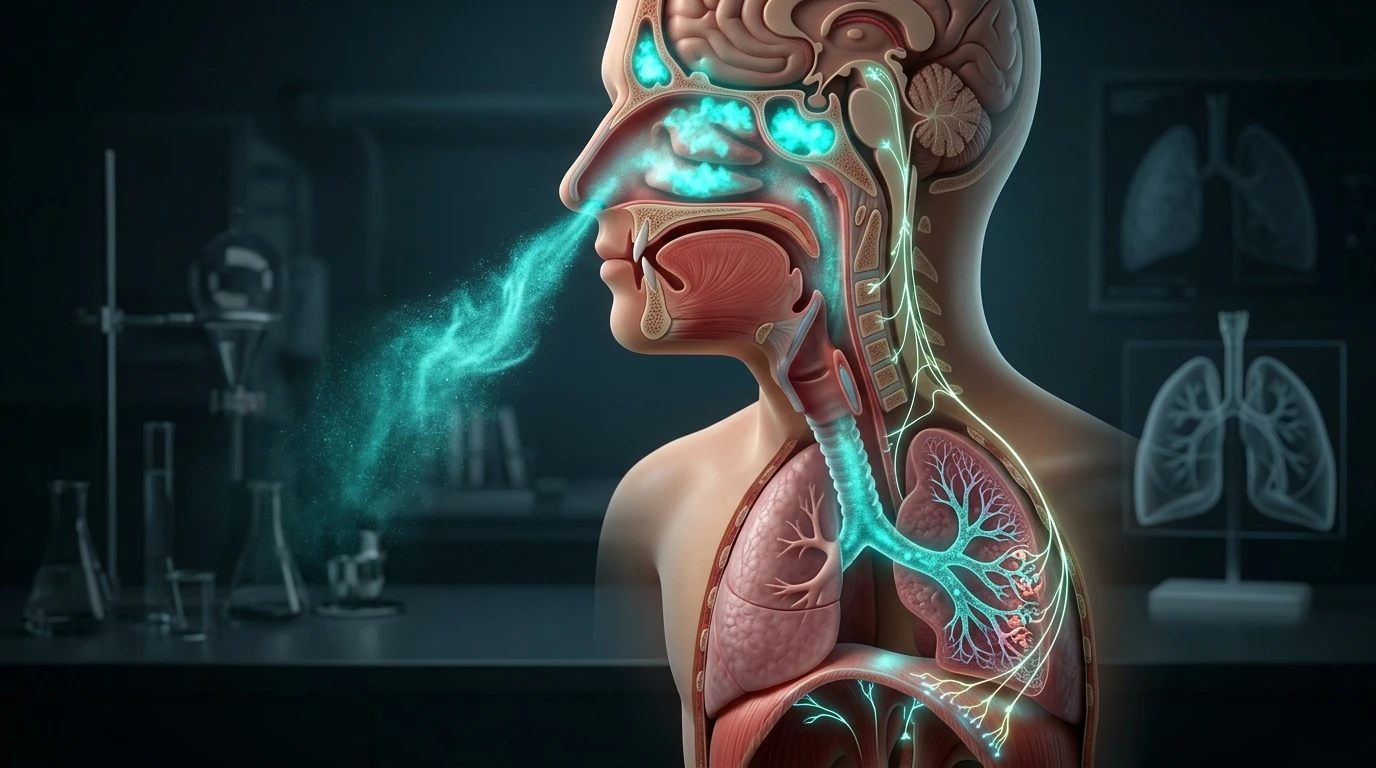
1. The Biophysics of the Nasal Passageway: Air Conditioning & Resistance
The human nasal cavity is an extraordinary thermodynamic engineering system lined with vascularized turbinates (conchae) that create turbulent airflow. This architecture serves three vital biophysical functions:
- Circadian Endocrine Diagnostics: Explore our research on cortisol levels chart by time of day.
- Foundational Neurobiology: Review our clinical analysis on the physiological sigh and autonomic anxiety reset.
- Thermal and Hygroscopic Conditioning: Regardless of outside ambient temperature, the nasal turbinates warm incoming air to precisely 34°C–37°C (body temperature) and humidify it to 95%–100% relative humidity before it strikes the delicate alveolar membranes, preventing bronchospasm.
- Aerodynamic Resistance: The nasal airway creates approximately 50% more airflow resistance than mouth breathing. This physiological resistance forces the diaphragm to engage fully, creating deeper negative intrathoracic pressures that enhance venous return to the heart and stimulate parasympathetic pulmonary stretch receptors.
- Microbial Filtration: Nasal hairs (vibrissae) and mucosal ciliary escalators trap particles, bacteria, and allergens larger than 5 micrometers, expelling them before they can reach sterile bronchial passages.
2. Paranasal Nitric Oxide: The Airborne Endothelial Regulator
The maxillary and ethmoidal paranasal sinuses constitutively produce high concentrations of gaseous Nitric Oxide (NO) via inducible and endothelial Nitric Oxide Synthase (iNOS/eNOS). In fact, nasal cavity air contains NO concentrations exceeding 1,000 to 3,000 parts per billion (ppb), whereas exhaled oral air has almost none.
When an individual inhales through the nose, this high concentration of paranasal nitric oxide is carried directly down into the lower lung alveoli:
- Ventilation-Perfusion Matching: Nitric oxide diffuses across alveolar walls into surrounding pulmonary capillary smooth muscle, activating soluble guanylyl cyclase (sGC) to form cyclic GMP (cGMP). This dilates alveolar capillaries, dramatically optimizing ventilation-perfusion (˙V/˙Q) matching.
- Arterial Oxygenation: By shunting blood to well-ventilated lung zones, nasal breathing elevates arterial oxygen saturation (PaO2) by 10% to 18% compared to mouth breathing.
- Antiviral & Antimicrobial Defense: Nitric oxide is a potent endogenous broad-spectrum disinfectant that inactivates viral envelope proteins and halts bacterial replication in the upper airway.
3. Nasorespiratory Entrainment: Coordinating Amygdala & Hippocampal Waves
Pioneering neuroscience from Northwestern University (Zelano et al.) revealed that nasal breathing directly synchronizes electrical oscillations across the human limbic system. Olfactory sensory neurons in the nasal roof fire rhythmic action potentials with each nasal inhalation.
These impulses travel through the olfactory bulb and entrain local field potentials in the piriform cortex, amygdala, and hippocampus, generating synchronized theta and gamma rhythms. Crucially, this neural entrainment occurs exclusively during nasal inhalation; when subjects switch to mouth breathing, this limbic synchronization collapses completely, impairing spatial memory and emotional regulation.
4. Comparative Physiology: Nasal Breathing vs. Chronic Mouth Breathing
| Physiological Parameter | Obligate Nasal Breathing | Chronic Mouth Breathing |
|---|---|---|
| Paranasal Nitric Oxide Delivery | Continuous high delivery (1,000–3,000 ppb) | Near-zero; sinuses remain stagnant |
| Pulmonary Gas Exchange (˙V/˙Q) | Optimized; 10–18% higher arterial PaO2 | Mismatched; shallow alveolar perfusion |
| Airway Resistance & Mechanics | 50% higher; engages diaphragmatic excursions | Low resistance; promotes shallow apical chest breathing |
| Autonomic Nervous System Tone | Parasympathetic Dominant (vagal tone elevated) | Sympathetic Overdrive (compensatory adrenaline) |
| Limbic Brainwave Entrainment | Maintains hippocampal and amygdala theta synchronization | Completely absent; desynchronized cortical processing |
| Nocturnal Sleep Quality | Prevents pharyngeal collapse; deep SWS sleep | Severe snoring, upper airway collapse, sleep apnea |
5. Pathophysiology of Mouth Breathing: Sympathetic Overdrive & Apnea
Chronic mouth breathing bypasses natural resistance, leading to rapid, shallow chest breathing. This hyperventilation blows off excess Carbon Dioxide (CO2), inducing respiratory alkalosis.
According to the Bohr Effect, low arterial CO2 shifts the hemoglobin-oxygen dissociation curve to the left, tightly binding oxygen to hemoglobin and preventing its unloading into peripheral tissues and brain parenchyma. This paradoxically causes cellular tissue hypoxia despite 99% blood oxygen saturation, triggering continuous compensatory sympathetic adrenaline spikes, resting tachycardia, dry mouth, dental caries, and fragmented nocturnal sleep.
6. The Clinical Nasal Rehabilitation Protocol: Restoring Optimal Mechanics
To rehabilitate dysfunctional mouth breathing and restore autonomic equilibrium, clinicians prescribe progressive biophysical protocols:
- Mouth Taping for Sleep: Applying medical-grade porous micropore tape vertically across the lips forces obligate nasal breathing throughout the night. This elevates nocturnal oxygen saturation, eliminates dry mouth, expands slow-wave sleep, and increases nocturnal rMSSD.
- Nasal Unblocking Maneuvers (The Buteyko Hold): Take a gentle nasal breath in and out, pinch the nose closed, and gently nod the head until a moderate air hunger is reached (typically 15–25 seconds). Release and resume gentle nasal breathing. The temporary accumulation of CO2 acts as a powerful local smooth muscle relaxer, dilating the nasal vasculature and clearing nasal congestion.
- Resonance Frequency Humming Protocol: 5 minutes of slow diaphragmatic breathing (5.5 breaths per minute) with audible humming on each exhalation increases paranasal nitric oxide by 15-fold while driving powerful vagal bradycardia via respiratory sinus arrhythmia.
Frequently Asked Questions (Clinical FAQ)
Why is mouth breathing so harmful for the autonomic nervous system?
Mouth breathing bypasses nasal resistance and paranasal nitric oxide, leading to rapid, shallow chest breathing and excessive CO2 loss. This triggers the Bohr Effect (cellular oxygen starvation) and keeps the body trapped in chronic sympathetic fight-or-flight.
Is mouth taping at night safe?
Yes, provided you use medical-grade, gentle tape (like 3M Micropore) and can breathe comfortably through your nose while awake. A small piece placed vertically over the center of the lips is sufficient to prevent mouth drop while still allowing coughing or breathing if needed.
How does humming increase nitric oxide so dramatically?
The paranasal sinuses are small air pockets connected to the nasal cavity by tiny openings (ostia). The acoustic vibration of humming creates air turbulence that pulls trapped nitric oxide out of the sinuses into the nasal airway, increasing concentrations by 1,500%.
Can nasal breathing help improve memory and focus?
Yes. Research shows that nasal inhalation synchronizes electrical brainwaves across the hippocampus and amygdala. Switching to mouth breathing abolishes this synchronization, impairing memory consolidation and emotional control.
What should I do if my nose is chronically congested?
The nose operates on a "use it or lose it" principle: mouth breathing actually worsens nasal congestion by engorging turbinates. Practicing gentle breath-holds (accumulating CO2) naturally dilates nasal airways. Additionally, treating underlying dust/mold allergies or chronic sinusitis restores patency.
Does nasal breathing improve athletic performance?
Yes. While nasal breathing feels harder initially due to airway resistance, it increases arterial oxygen delivery, optimizes CO2 tolerance, and prevents exercise-induced bronchospasm, significantly improving stamina and aerobic threshold.
Scientific References & Clinical Citations
- Nitric oxide and the paranasal sinuses — The Anatomical Record (2002). [PubMed / Study Link]
- Nasal Respiration Entrains Human Limbic Oscillations and Modulates Cognitive Function — Journal of Neuroscience (2016). [PubMed / Study Link]
- Inhalation of nitric oxide in humans: a new method of pulmonary vasodilation — New England Journal of Medicine (1991). [PubMed / Study Link]
- Humming greatly increases nasal nitric oxide — American Journal of Respiratory and Critical Care Medicine (2002). [PubMed / Study Link]