
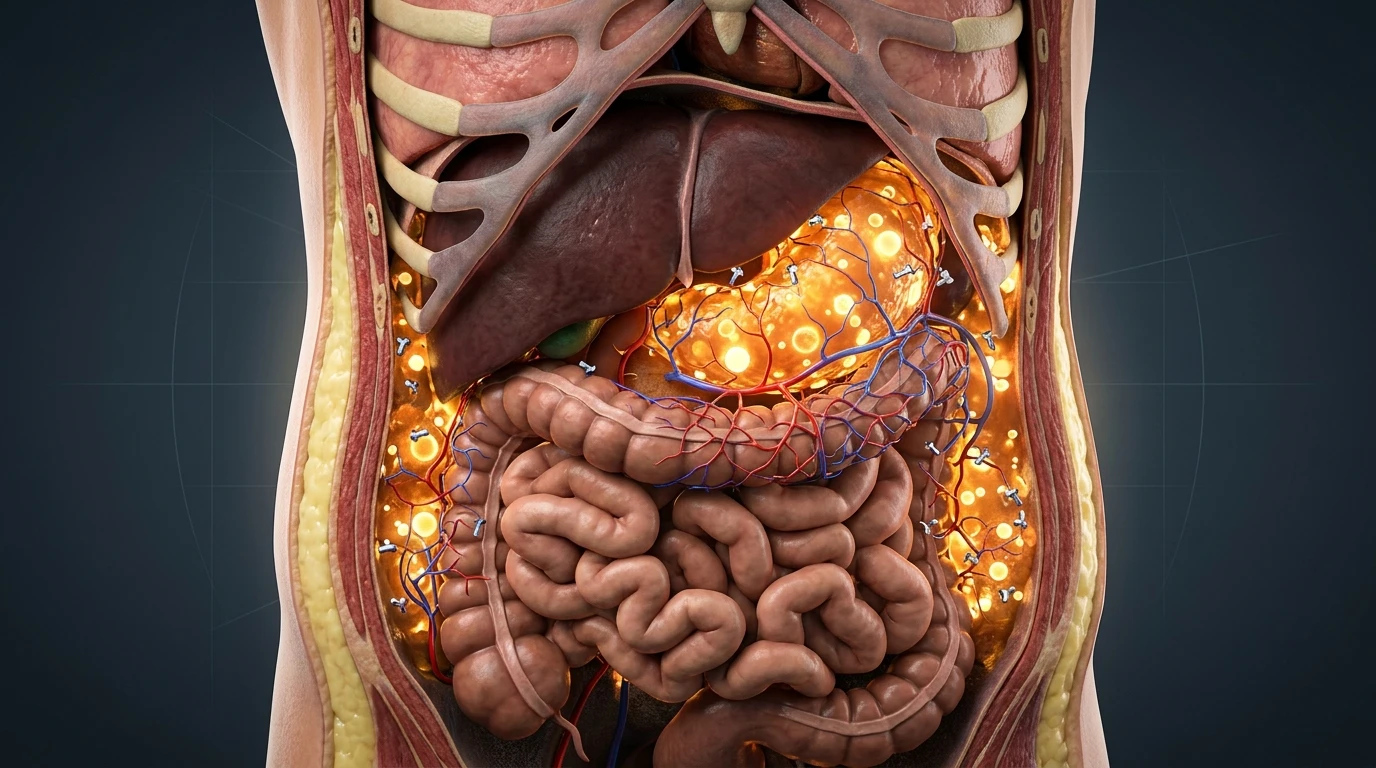
1. Visceral vs. Subcutaneous Fat: Two Completely Different Organs
To understand why chronic psychological stress selectively deposits fat around the midsection, one must first recognize that the human body harbors two fundamentally distinct classes of adipose tissue: subcutaneous fat (the pinchable fat layer resting directly beneath the skin) and deep visceral fat (the intra-abdominal adipose tissue packing around the liver, pancreas, intestines, and kidneys).
While subcutaneous fat functions primarily as passive thermal insulation and long-term energy storage, visceral adipose tissue operates as an intensely active, vascularized endocrine organ. Crucially, research published in Endocrinology demonstrates that visceral adipocytes express a four- to five-fold higher concentration of glucocorticoid receptors (GR) than subcutaneous adipocytes.
Whenever systemic cortisol elevates due to sleep deprivation, emotional distress, or physiological inflammation, cortisol molecules preferentially bind to these hyper-dense intra-abdominal receptors, initiating transcriptional programs that direct metabolic fuel straight into deep visceral lipid droplets.
2. The 11β-HSD1 Enzyme: Local Cortisol Amplification
One of the most remarkable discoveries in metabolic endocrinology is that systemic circulating cortisol measured in a standard morning blood test does not tell the full story. Within abdominal fat cells resides an enzyme called 11β-hydroxysteroid dehydrogenase type 1 (11β-HSD1).
Under normal circumstances, the liver and kidneys convert active cortisol into its inert, inactive metabolite: cortisone. However, visceral fat cells utilize high levels of 11β-HSD1 to perform the exact reverse reaction—taking harmless, inactive cortisone from the bloodstream and reactivating it back into potent, active cortisol directly inside the fat cell.
In individuals with chronic stress and metabolic inflammation, visceral 11β-HSD1 activity is upregulated by up to 300%. This creates a localized microenvironment where intracellular cortisol levels inside abdominal fat are up to three times higher than systemic blood concentrations. This explains why millions of people struggle with stubborn "cortisol belly" even when their serum lab work appears within conventional reference ranges.
3. The Toxic Synergy: Cortisol + Insulin = Maximum Lipogenesis
In acute survival contexts, cortisol acts as a catabolic, fat-mobilizing hormone: it breaks down glycogen and peripheral tissues to flood the bloodstream with glucose and free fatty acids so a prehistoric human could sprint away from a predator. So why does chronic cortisol cause abdominal obesity?
The answer lies in the deadly hormonal interaction between cortisol and insulin:
- Cortisol elevates blood glucose via hepatic gluconeogenesis and blunts peripheral GLUT4 glucose transporters in skeletal muscle, causing acute insulin resistance.
- In response to elevated blood glucose, the pancreas secretes high surges of insulin.
- While cortisol alone mobilizes energy, cortisol in the presence of elevated insulin activates lipoprotein lipase (LPL)—the primary gatekeeper enzyme that pulls triglycerides out of the bloodstream and deposits them into fat cells.
- Because visceral fat has the highest concentration of both glucocorticoid and insulin receptors, midsection fat cells experience hyper-active LPL expression while lipolysis (fat breakdown) is completely halted by insulin.
4. Comparative Breakdown: Cortisol Belly vs. Subcutaneous Fat
| Characteristic | Cortisol / Visceral Belly Fat | Standard Subcutaneous Adipose Tissue |
|---|---|---|
| Anatomical Location | Deep intra-abdominal (omentum, mesentery, perirenal) | Superficial hypodermis across limbs, hips, and chest |
| Glucocorticoid Receptor Density | Extremely High (4x to 5x higher than subcutaneous) | Low to Moderate |
| 11β-HSD1 Enzyme Activity | Hyper-active (regenerates active cortisol internally) | Low baseline activity |
| Physical Feel & Texture | Firm, distended, pushes outward beneath abdominal wall | Soft, pinchable, loose tissue beneath the skin |
| Inflammatory Secretions | High TNF-α, IL-6, Resistin, and CRP | Low inflammatory profile; secretes protective Adiponectin |
| Direct Drainage | Portal vein directly into liver (drives NAFLD/MASLD) | Systemic venous circulation |
5. The Portal Hypotheses: Fatty Liver & Systemic Cytokines
Visceral fat is particularly dangerous because its venous drainage does not enter general circulation. Instead, all blood from visceral fat drains directly into the hepatic portal vein straight into the liver.
When visceral adipocytes become engorged and stressed, they flood the liver with an unceasing barrage of free fatty acids (FFAs) and pro-inflammatory cytokines (IL-6 and TNF-α). This hepatic portal lipid overload accelerates:
- Vagal Tone Measurement: Explore our research on HRV normative benchmarks by age and gender.
- Foundational Neurobiology: Review our clinical analysis on the physiological sigh and autonomic anxiety reset.
- Metabolic dysfunction-associated steatotic liver disease (MASLD / fatty liver).
- Overproduction of very low-density lipoproteins (VLDL) and small, dense LDL particles.
- Impaired hepatic insulin clearance, locking the body in persistent hyperinsulinemia.
6. Endocrine Reset Protocol: Blunting Cortisol-Driven Visceral Storage
Reversing cortisol-induced visceral adiposity requires shifting the endocrine signaling that fuels 11β-HSD1 and insulin secretion:
1. Stop High-Intensity Exhaustion: Grinding through chronic, exhausting 60-minute HIIT sessions while already suffering from high allostatic load spikes diurnal cortisol higher. Replace chronic cardio with zone-2 walking (8,000-10,000 steps daily) and heavy resistance training, which enhances muscle GLUT4 sensitivity without triggering prolonged adrenal output.
2. Downregulate 11β-HSD1 Naturally: Scientific studies show that polymethoxyflavones found in citrus peels, green tea epigallocatechin gallate (EGCG), and curcumin exhibit natural inhibitory activity against the 11β-HSD1 enzyme.
3. Protect the Cortisol Awakening Response: Eliminating late-night blue light exposure and establishing deep slow-wave sleep drops nighttime cortisol nadir, restoring normal sensitivity to the HPA axis.
Frequently Asked Questions (Clinical FAQ)
Why does stress fat specifically settle in the stomach rather than the legs or arms?
Visceral abdominal fat cells have 4 to 5 times more glucocorticoid (cortisol) receptors than fat cells anywhere else in the body. Furthermore, abdominal fat cells express high amounts of the 11β-HSD1 enzyme, which multiplies active cortisol levels inside the midsection.
Can sit-ups or abdominal crunches burn cortisol belly fat?
No. Spot reduction is a biological impossibility. Visceral fat sits beneath the abdominal wall around internal organs. Burning it requires shifting systemic hormonal signaling (lowering chronic cortisol and insulin levels) through sleep, autonomic regulation, and metabolic nutrition.
How does cortisol belly feel compared to subcutaneous fat?
Subcutaneous fat is soft, flabby, and easily pinched between your fingers. Cortisol visceral fat is deep and firm, often making the abdomen protrude outwards with a taut, hard texture.
Does fasting help or worsen cortisol belly fat?
Prolonged intermittent fasting or severe caloric restriction can backfire in chronically stressed individuals. Severe fasting signals starvation stress to the adrenal glands, triggering massive cortisol spikes that can actually increase visceral fat deposition once food is consumed.
What supplements help reduce the cortisol belly response?
Clinical studies highlight Phosphatidylserine (which blunts ACTH and cortisol surges), Ashwagandha KSM-66 (shown to reduce serum cortisol by 27-30%), and EGCG from green tea (which naturally downregulates 11β-HSD1 activity).
How quickly can cortisol belly fat be reversed once stress is managed?
Because visceral fat is metabolically active and richly vascularized, it actually mobilizes faster than stubborn subcutaneous fat once insulin and cortisol are lowered. Patients often notice significant reductions in waist circumference within 4 to 8 weeks of proper endocrine and sleep restoration.
Scientific References & Clinical Citations
- Glucocorticoids and Visceral Obesity: The Role of 11β-HSD1 — The Journal of Clinical Endocrinology & Metabolism (2019). [PubMed / Study Link]
- Cortisol and Abdominal Fat Distribution in Healthy Women — Psychosomatic Medicine (2000). [PubMed / Study Link]
- Stress-Induced Cortisol and Visceral Adipose Tissue Accumulation — Obesity Reviews (2021). [PubMed / Study Link]
- Hepatic and Adipose 11β-Hydroxysteroid Dehydrogenase Type 1 in Metabolic Syndrome — Endocrine Reviews (2018). [PubMed / Study Link]