
1. The Diagnostic Blind Spot: Why Serum Cortisol Misses Receptor Burnout
In standard medical practice, endocrinological assessment of adrenal function relies on total serum cortisol or salivary four-point diurnal curves. While these assays accurately quantify the secretory output of the adrenal zona fasciculata, they provide zero insight into the downstream bioactivity of cortisol at peripheral target tissues.
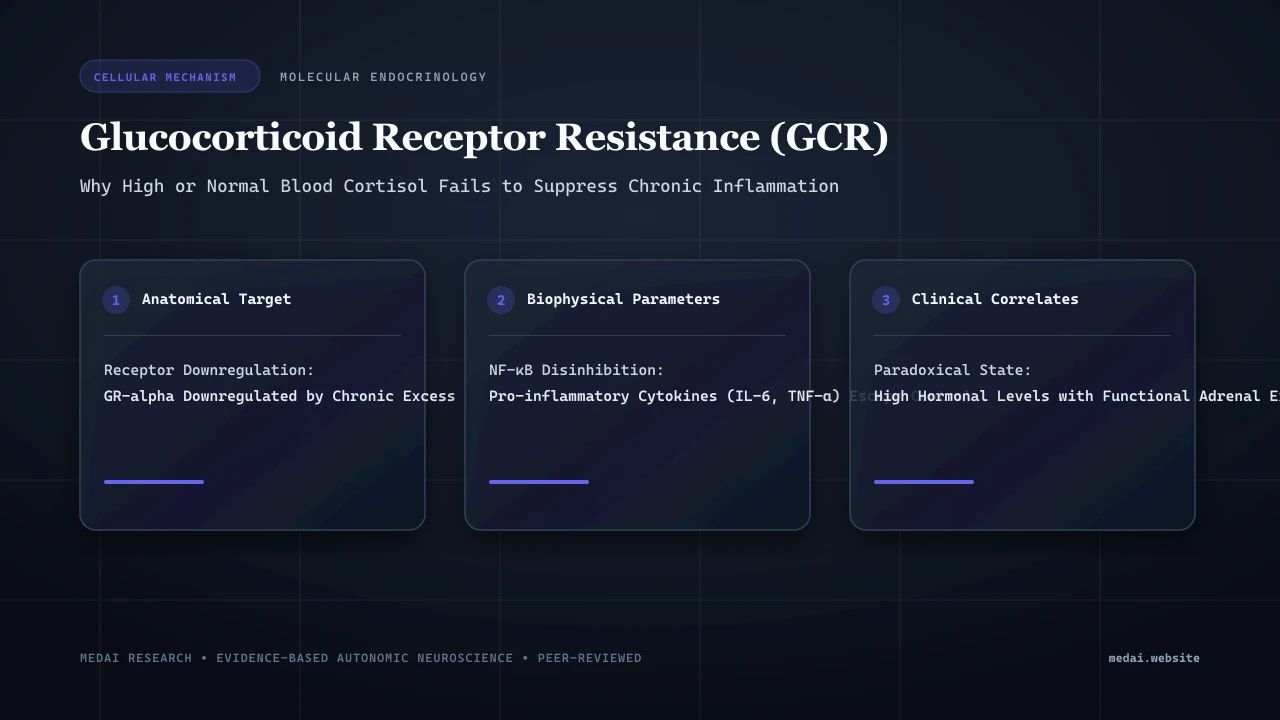
Cortisol is a lipophilic steroid that exerts its biological effects by diffusing across the plasma membrane into the cytoplasm. Inside, it must bind to the unliganded Glucocorticoid Receptor Alpha (GRα), maintained in a high-affinity state by heat-shock chaperones (HSP90, HSP70, FKBP51). When tissues experience relentless allostatic load—from chronic psychological stress, systemic endotoxemia, or persistent viral reactivation—intracellular signaling defenses down-regulate the receptor complex. The adrenal glands produce adequate hormone, but target tissues have unplugged the receivers. For patients exploring adrenal axis issues, our guide to cortisol dysregulation and systemic stress provides broader physiological context.
2. Molecular Pathophysiology: Phosphorylation, FKBP51 & Splice Variants
Bench-to-bedside research identifies four core molecular mechanisms driving glucocorticoid receptor burnout:
- Vagal Tone Measurement: Explore our research on HRV normative benchmarks by age and gender.
- Foundational Neurobiology: Review our clinical analysis on the physiological sigh and autonomic anxiety reset.
- Receptor Hyperphosphorylation: Pro-inflammatory cytokines (TNF-α, IL-1β) hyperactivate p38 MAPK and JNK kinases, phosphorylating the GR N-terminal domain at Serine 211 and Serine 226. Excessive Ser226 phosphorylation accelerates nuclear export and triggers premature proteasomal degradation.
- FKBP51 Chaperone Trapping: The immunophilin FKBP51 maintains low ligand affinity. Under prolonged cortisol exposure, the FKBP5 gene is up-regulated via an epigenetic loop, locking GR into a low-affinity, translocation-incompetent state.
- Alternative Splicing to GRβ: The NR3C1 gene can splice into GRβ, which lacks the ligand-binding domain. GRβ migrates to the nucleus, heterodimerizes with active GRα, and binds to DNA, acting as a potent dominant-negative inhibitor that blocks cortisol signaling.
- Epigenetic Hypermethylation: Chronic inflammation triggers DNA methyltransferase activity, hypermethylating the 1F promoter region of NR3C1, permanently reducing GR density across monocytes, lymphocytes, and hippocampal neurons.
3. The Inflammatory Storm: NF-κB Disinhibition and Cytokine Transcription
The primary evolutionary role of cortisol is to dampen inflammation. In a healthy cell, liganded GRα translocates to the nucleus and binds directly to the p65 subunit of Nuclear Factor kappa B (NF-κB)—a process called transrepression.
By tethering to NF-κB and recruiting Histone Deacetylase 2 (HDAC2), GR compacts chromatin, silencing the transcription of inflammatory genes (IL6, TNF, COX2, iNOS). In glucocorticoid resistance, this transrepression fails completely. Despite normal serum cortisol, NF-κB remains continuously active in immune cells, causing sterile low-grade inflammation, microglial activation, and mitochondrial bioenergetic exhaustion.
4. Comparative Biomarkers: Sensitive vs. Resistant State
| Biomarker / Parameter | Glucocorticoid Sensitive State | Cellular Glucocorticoid Resistance (GCR) |
|---|---|---|
| Circulating Serum/Salivary Cortisol | Normal circadian curve (High AM, low PM) | Statistically normal, mildly elevated, or flattened curve |
| Intracellular GRα Density | High (5,000 - 15,000 receptors/leukocyte) | Severely reduced due to proteasomal degradation |
| GRβ Splice Isoform Ratio | Very low (<1% of total GR pool) | Markedly elevated (acts as dominant-negative decoy) |
| FKBP51 Chaperone Expression | Low baseline; transient inducible spike | Chronically overexpressed; locks low-affinity state |
| Nuclear NF-κB / p65 Binding | Rapidly transrepressed by GRα | Constitutively active; unabated cytokine transcription |
| Ex-Vivo Dexamethasone Suppression | >80% inhibition of LPS-induced IL-6 | Blunted suppression (<30% IL-6 reduction) |
5. Advanced Functional Diagnostics: Ex-Vivo Assays & DUTCH Testing
Because standard labs miss receptor resistance, advanced functional medicine employs specialized testing:
- Ex-Vivo Leukocyte Dexamethasone Inhibition Assay: PBMCs are challenged with LPS in the presence of dexamethasone. Persistent cytokine secretion confirms severe cellular receptor unresponsiveness.
- Metabolized Cortisol vs. Free Cortisol (DUTCH): Measures urinary free cortisol alongside tetrahydro metabolites (THF, allo-THF, THE). Elevated metabolized cortisol with low-normal free cortisol highlights hyper-clearance by 11β-HSD and compensatory receptor down-regulation.
- Corticosteroid-Binding Globulin (CBG) Quantification: High estrogen sharply elevates CBG, reducing free bioactive cortisol without altering total hormone counts.
- hs-CRP and IL-6 Discordance: Finding high hs-CRP (>3.0 mg/L) or elevated IL-6 alongside normal salivary cortisol is a classic sign of impaired glucocorticoid transrepression.
6. Clinical Resensitization Protocol: Restoring Receptor Sensitivity
Treating receptor resistance with exogenous steroids often worsens down-regulation. Instead, interventions focus on cooling inflammatory kinases and remodeling chromatin:
- Phytosomal Curcumin (400–800 mg/day): Down-regulates p38 MAPK phosphorylation, reducing receptor tagging and proteasomal degradation.
- Resveratrol & Pterostilbene: Activate Sirtuin 1 (SIRT1), restoring HDAC2 recruitment to the GR complex to reinstate NF-κB silencing.
- Endotoxin Clearance: Gram-negative LPS from an inflamed gut drives TLR4 activation and receptor resistance. Spore probiotics, zinc carnosine (75 mg BID), and serum bovine immunoglobulins (SBI, 2.5 g/day) neutralize circulating endotoxins.
- Vagal Autonomic Retraining: Chronic sympathetic hyperarousal bombards adrenergic receptors, destabilizing GR complexes. Daily transcutaneous vagus nerve stimulation (tVNS) down-regulates sympathetic drive, removing the neural signals perpetuating desensitization.
Frequently Asked Questions (Clinical FAQ)
Why did my lab tests show normal cortisol when I feel completely exhausted?
Standard lab tests measure circulating hormone quantity in the blood, not cellular sensitivity. If your intracellular glucocorticoid receptors are desensitized or down-regulated by chronic inflammation, your cells experience functional deficiency despite normal blood levels.
How does glucocorticoid resistance differ from so-called Adrenal Fatigue?
Adrenal fatigue is a disproven concept claiming the adrenal glands become physically exhausted and fail to produce hormone. In reality, the adrenal glands are usually producing adequate cortisol, but the intracellular receptors across your tissues have become resistant to its biological signals.
Can taking supplemental hydrocortisone fix cortisol resistance?
No. Administering exogenous steroids to a patient with cortisol resistance often accelerates receptor down-regulation and increases the expression of the dominant-negative GRβ isoform, worsening cellular unresponsiveness.
What is the gold standard test to confirm glucocorticoid resistance?
The gold standard in research is the ex-vivo PBMC dexamethasone inhibition assay, measuring cytokine suppression after steroid incubation. Clinically, doctors identify it by combining high inflammatory markers (hs-CRP, IL-6) with normal salivary cortisol and systemic symptoms.
How long does it take to resensitize down-regulated glucocorticoid receptors?
Receptor turnover and epigenetic chromatin remodeling typically require 12 to 24 weeks of consistent intervention focused on reducing endotoxemia, cooling MAPK kinase pathways, and restoring autonomic balance.
Does chronic psychological stress directly damage glucocorticoid receptors?
Yes. Sustained psychological threat leads to prolonged sympathetic activation and recurrent surges of pro-inflammatory cytokines, which phosphorylate glucocorticoid receptors, tag them for destruction, and up-regulate the inhibitory chaperone FKBP51.
Scientific References & Clinical Citations
- Glucocorticoid resistance in inflammatory diseases — The Lancet (2013). [PubMed / Study Link]
- Chronic stress, glucocorticoid receptor resistance, inflammation, and disease risk — PNAS (2012). [PubMed / Study Link]
- Primary generalized familial and acquired glucocorticoid resistance — European Journal of Clinical Investigation (2013). [PubMed / Study Link]
- Why are depressed patients inflamed? A reflection on glucocorticoid resistance — European Neuropsychopharmacology (2017). [PubMed / Study Link]