
1. Transcranial Doppler (TCD) Imaging: The Objective Ultrasound Proof
For decades, patients presenting with Postural Orthostatic Tachycardia Syndrome described a crippling cognitive clouding termed "brain fog"—characterized by sluggish processing speed, inability to sustain concentration, memory lapses, and severe word-finding difficulty upon standing. Because conventional brain MRI and CT scans in POTS are structurally normal, these cognitive deficits were historically dismissed as anxiety or depression.
The advent of Transcranial Doppler (TCD) ultrasonography during tilt table testing has revolutionized our understanding. By placing high-frequency (2 MHz) ultrasound probes over the transtemporal acoustic bone window, researchers continuously measure Middle Cerebral Artery (MCA) mean blood flow velocity (CBFv).
In healthy individuals, cerebral autoregulation maintains cerebral blood flow velocity within ±3% of baseline when standing. In patients with POTS, TCD reveals an immediate and sustained 15% to 20% drop in cerebral blood flow velocity upon standing, directly starving cerebral cortical neurons of oxygen and glucose. Learn how deep breathing can influence autonomic calming in the neurobiology of the physiological sigh.
2. The Carbon Dioxide Mechanism: Hypocapnic Cerebral Vasoconstriction
Why does cerebral blood flow drop if systemic blood pressure remains stable? In 2014, groundbreaking investigations by Stewart, Medow, and colleagues at New York Medical College uncovered the primary physiological culprit: orthostatic hyperventilation and hypocapnia.
When a POTS patient stands, gravitational blood pooling reduces stroke volume. Arterial baroreceptors and carotid body chemoreceptors sense this hypoperfusion and trigger involuntary rapid, shallow breathing (hyperventilation). This blows off carbon dioxide, causing end-tidal (CO_2) ((P_{ET}CO_2)) to drop below 30 mmHg (severe hypocapnia).
Carbon dioxide is the body's most powerful natural cerebral vasodilator. When intracranial (CO_2) plunges, cerebral vascular smooth muscle constricts aggressively. Even though the heart is pumping blood vigorously in the chest, the brain's own arteries clamp down, causing profound intracranial ischemia.
3. Prefrontal Cortex Dysfunction: Executive Memory, Processing & Word Finding
Because the prefrontal cortex and anterior cingulate gyrus have the highest metabolic rate and oxygen consumption in the human brain, they are the first to falter under cerebral hypoperfusion:
| Cognitive Domain Tested | Supine (Lying Flat) Performance | 70-Degree Upright Tilt Performance | Underlying Neurological Mechanism |
|---|---|---|---|
| Working Memory (2-Back / 3-Back) | Normal (95% accuracy) | Severe impairment (<65% accuracy) | Dorsolateral prefrontal cortex hypoperfusion |
| Information Processing Speed | Normal reaction times (350 ms) | Marked slowing (520+ ms) | Delayed subcortical axonal conduction velocity |
| Verbal Fluency & Word Retrieval | Fluid speech and rapid recall | Hesitant speech, tip-of-the-tongue lapses | Left inferior frontal gyrus (Broca's area) hypoperfusion |
| Sustained Visual Attention | Intact visual tracking | Micro-sleeps, saccadic tracking errors | Parieto-occipital hypoperfusion and visual snow |
Crucially, cognitive deficits in POTS are posture-dependent: the moment the patient is tilted back down into a supine position, cerebral blood flow velocity returns to baseline and cognitive performance immediately normalizes.
4. Impaired Neurovascular Coupling and Blood-Brain Barrier Leakage
Under normal conditions, when a specific brain region becomes active (such as the visual cortex when reading), astrocytes and pericytes dilate local arterioles to deliver an instant surge of oxygenated blood—a process known as neurovascular coupling (functional hyperemia).
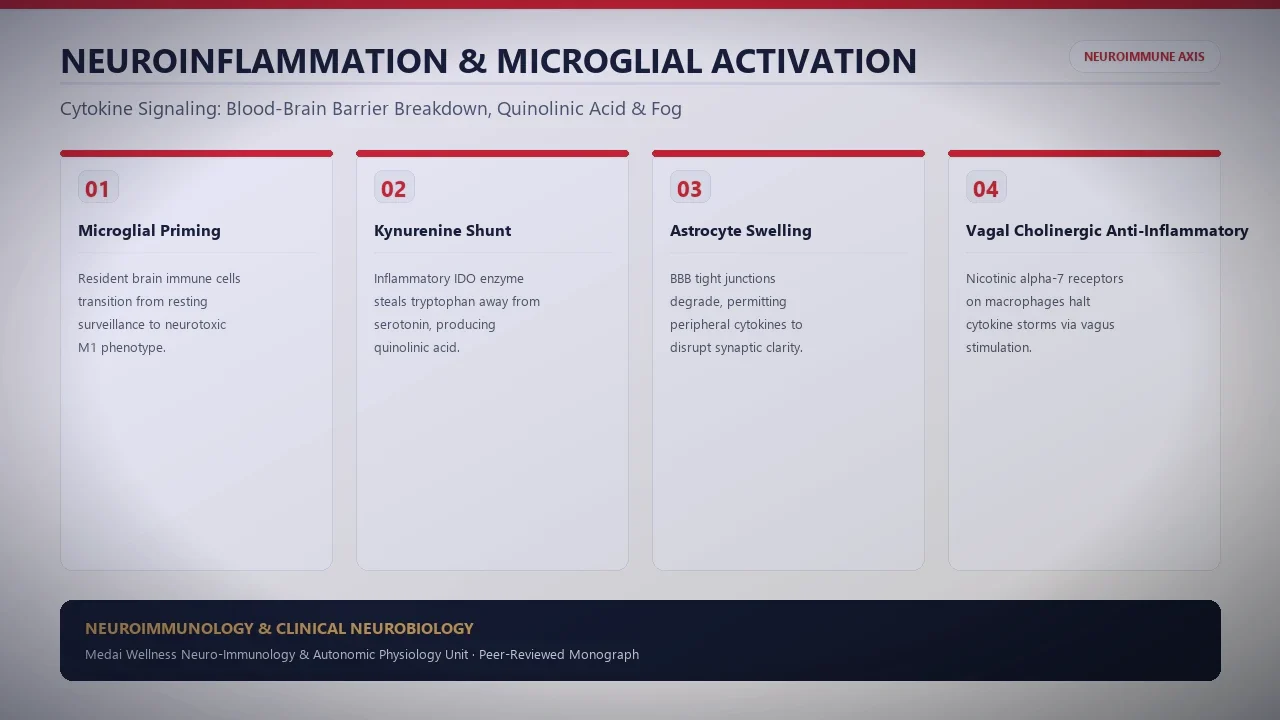
In POTS patients, functional functional near-infrared spectroscopy (fNIRS) demonstrates blunted neurovascular coupling. Furthermore, chronic intracranial hypoperfusion and adrenergic storm induce mild endothelial dysfunction at the blood-brain barrier (BBB), allowing peripheral inflammatory cytokines to cross into the central nervous system, perpetuating chronic fatigue and neuro-inflammation.
5. Evidence-Based Interventions to Restore Cerebral Perfusion
Overcoming POTS brain fog requires interventions that directly target cerebral hemodynamics and carbon dioxide retention:
- Controlled Nasal Respiration (Capnometry Retraining): Slow, deliberate nasal breathing (5 to 6 breaths per minute) prevents hypocapnic hyperventilation, maintaining end-tidal (CO_2) above 35 mmHg and keeping cerebral arteries dilated.
- Acute Oral Hydration (Water Bolus): Drinking 500 mL of cold water 15 minutes before cognitive tasks activates the gastrovascular pressor reflex, raising stroke volume and cerebral blood flow velocity by 10% to 15%.
- Abdominal Compression Binders: Compressing the mesenteric splanchnic circulation with a 20–30 mmHg binder prevents blood pooling in the abdomen, directing cardiac output upward to the carotid arteries.
- Cerebrovascular Modulators (Midodrine & Pyridostigmine): Midodrine stabilizes standing systemic vascular resistance, while pyridostigmine enhances parasympathetic ganglionic transmission, lowering heart rate and improving cerebral oxygenation.