
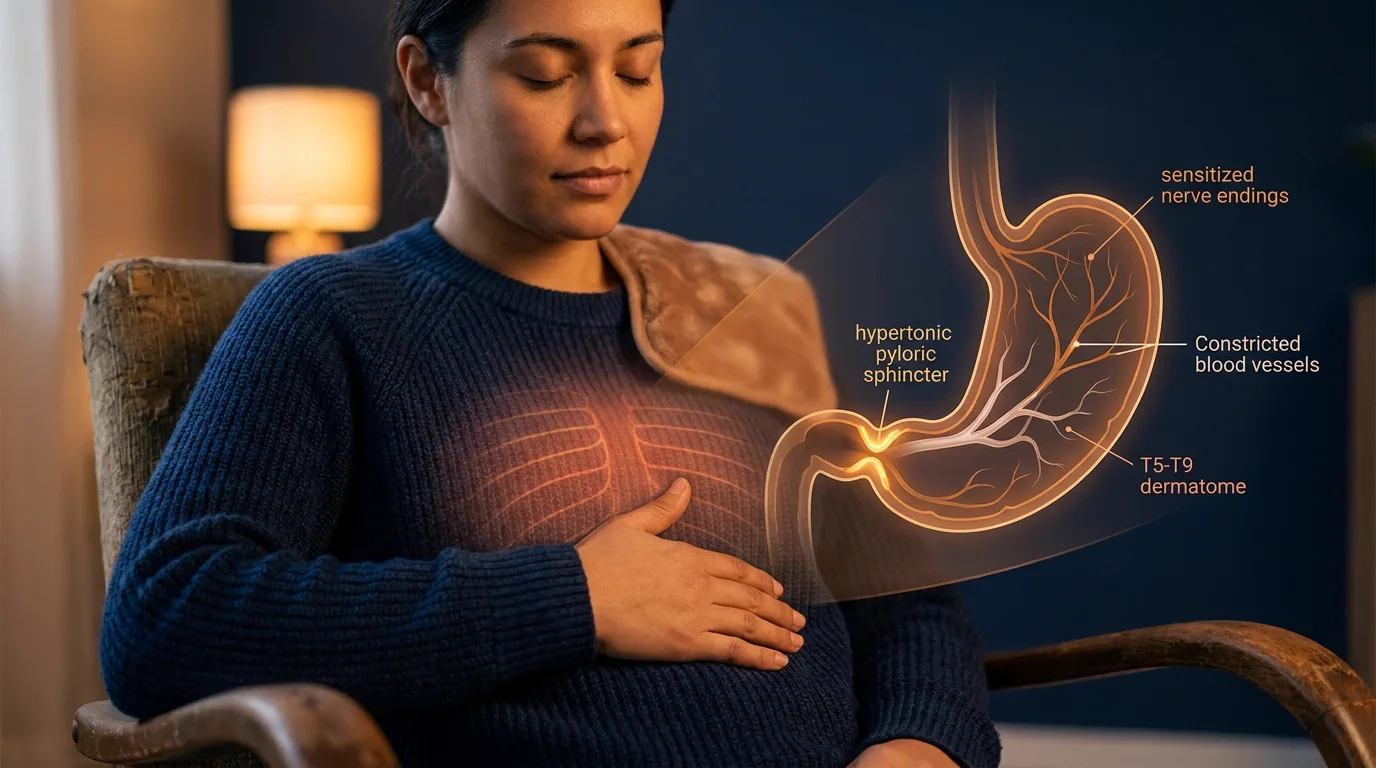
Up to 60% of individuals with anxiety disorders report chronic gastrointestinal symptoms. Understanding the precise neural pathways allows you to target relief at the source: the gut-brain axis. This article provides the complete mechanism map and immediate somatic protocols.
Why Anxiety Causes Stomach Pain: The Neural Pathways
When your brain detects a threat (a deadline, a social conflict, a catastrophic thought), the amygdala activates the sympathetic nervous system within milliseconds. This "fight-or-flight" cascade produces three direct gut effects:
| Sympathetic Effect | Gut Consequence | Subjective Sensation | Time Course |
|---|---|---|---|
| Splanchnic vasoconstriction | 40–60% reduction in gut blood flow | Cramping, ischemic discomfort, "hollow" feeling | Seconds |
| Inhibition of enteric motor neurons | Gastric stasis + colonic hypermotility | Nausea, bloating, urgency, incomplete evacuation | Minutes |
| Visceral hypersensitivity (spinal sensitization) | Lowered pain threshold for normal distension | Burning, sharp, or "knife-like" pain | Hours–days (plasticity) |
Meanwhile, the vagus nerve—your primary parasympathetic regulator—is actively suppressed. Without vagal "braking," the enteric nervous system (your "second brain") fires erratically, producing the chaotic motility patterns characteristic of functional GI disorders.
The Enteric Nervous System: Your Gut's Independent Brain
The enteric nervous system (ENS) contains 200–600 million neurons—more than the spinal cord—and can operate independently of the CNS. It contains complete reflex circuits for peristalsis, secretion, and blood flow regulation. However, it receives heavy modulatory input from:
- Vagal efferents (parasympathetic): "Rest and digest" mode
- Sympathetic efferents (splanchnic nerves): "Fight or flight" mode
- Spinal afferents: Pain and distension signaling to CNS
- Vagal afferents: Nutrient, mechanical, and chemical signaling to brainstem
Anxiety flips the switch from vagal to sympathetic dominance, and the ENS faithfully executes the "emergency program"—shutting down digestion, diverting blood, and emptying the bowel for flight.
The 5 Most Common Anxiety Stomach Pain Patterns
| Pattern | Location | Mechanism | Associated Symptoms | Rome IV Overlap |
|---|---|---|---|---|
| 1. Epigastric Burning | Below sternum, midline | Acid sensitization + delayed gastric emptying | Early satiety, belching, nausea | Functional Dyspepsia (PDS/EPS) |
| 2. Periumbilical Cramping | Around navel | Chaotic colonic contractions | Bloating, urgency, mucus | IBS-M/D |
| 3. Epigastric "Knot/Tightness" | Upper abdomen, band-like | Pyloric/fundic hypertonicity | Appetite loss, shallow breathing | Functional Dyspepsia (EPS) |
| 4. Nausea Without Vomiting | Upper GI, throat | Gastric arrhythmia (ICC dysregulation) | Salivation, cold sweat, pallor | Functional Nausea/Vomiting |
| 5. Lower Quadrant Urgency | Lower abdomen, rectal | Mass peristaltic movements | Diarrhea, tenesmus, anxiety | IBS-D |
1. Upper Abdominal Burning (Functional Dyspepsia Pattern)
Stress-induced acid sensitization plus delayed gastric emptying creates a burning sensation below the sternum, often mistaken for heartburn. Unlike GERD, this burning often occurs on an empty stomach or is unrelated to meals. The mechanism: sympathetic inhibition of gastric accommodation (fundus fails to relax) + vagal withdrawal reducing bicarbonate/mucus secretion = unbuffered acid contact with sensitized mucosa.
2. Periumbilical Cramping (IBS-Mixed Type)
Alternating sympathetic inhibition and rebound parasympathetic surge causes chaotic colonic contractions felt as waves of cramping around the navel. This is the classic "nervous diarrhea/constipation alternation" pattern. The migrating motor complex (MMC) is disrupted, leading to uncoordinated segmental contractions instead of organized peristalsis.
3. Epigastric "Knot" or Tightness
Chronic low-grade sympathetic tone keeps the pyloric sphincter and gastric fundus contracted, creating a persistent sensation of a tight band below the ribs. Patients describe "a fist clenching my stomach." This is often accompanied by shallow, chest-dominant breathing (which maintains sympathetic tone) and early satiety (fundus cannot accommodate food).
4. Nausea Without Vomiting
Vagal withdrawal disrupts the gastric pacemaker (interstitial cells of Cajal), generating gastric arrhythmia (tachygastria or bradygastria) perceived as queasiness. The area postrema (chemoreceptor trigger zone) receives amplified vagal afferent signaling from the dysrhythmic stomach, creating nausea without the motor pattern for emesis.
5. Lower Quadrant Urgency (Diarrhea-Predominant)
Sudden parasympathetic rebound after acute stress triggers mass peristaltic movements (high-amplitude propagating contractions), producing urgent loose stools. This is the "get the hell out" biological program—emptying the bowel for flight. Often preceded by cramping, flushing, and a sense of impending doom.
Immediate Somatic Relief: 5 Techniques to Calm the Nervous Stomach
These techniques target the autonomic nervous system directly, bypassing cognitive effort:
1. 4-6 Diaphragmatic Breathing (2 minutes)
Inhale 4 seconds, exhale 6 seconds. The mechanical diaphragmatic descent massages the stomach and proximal duodenum while stimulating subdiaphragmatic vagal fibers. Key: Hand on belly rises; hand on chest stays still. This is the single most effective acute intervention.
2. Warm Abdominal Compress (10 minutes)
Apply a hot water bottle or microwaveable heat pack to the upper abdomen. Thermal stimulation increases local blood flow (counteracting splanchnic vasoconstriction), activates spinal gating mechanisms (Gate Control Theory), and relaxes smooth muscle via heat-sensitive TRPV channels.
3. Clockwise Abdominal Self-Massage (3 minutes)
Using gentle pressure, trace a clockwise circle around your navel following the anatomical path of the colon (ascending → transverse → descending). This mechanically encourages antegrade motility, reduces gas trapping, and provides proprioceptive input to the ENS.
4. Vocal Humming on Exhale (2 minutes)
Low-frequency humming creates pharyngeal vibration that travels down the recurrent laryngeal branches of the vagus nerve to the esophageal and gastric plexuses. Combine with 4-6 breathing: hum on the 6-second exhale.
5. Left Lateral Recumbent Position (5–10 minutes)
Lying on your left side uses gravity to promote gastric emptying (pylorus is lowest point) and reduces acid exposure to the esophageal sphincter. This is the anatomical recovery position for upper GI distress.
Daily Protocol to Prevent Anxiety Gut Flares
| Time | Practice | Duration | Target Mechanism |
|---|---|---|---|
| Morning (fasted) | 4-6 breathing + Rosenberg Basic Exercise | 5 min | Set vagal baseline; prime MMC |
| Pre-Breakfast | 3 humming exhales | 30 sec | Prime gastric secretion |
| Pre-Lunch | 4-6 breathing | 2 min | Counter morning stress accumulation |
| Post-Lunch | Left lateral rest (if possible) or seated 4-6 | 5–10 min | Support gastric emptying |
| Pre-Dinner | 3 humming exhales | 30 sec | Prime gastric secretion |
| Evening (pre-bed) | guided sleep audio | 10 min | Downregulate for sleep; gut repair |
Nutritional Support for the Anxious Gut
During active flares, reduce mechanical and chemical load while the nervous system resets:
- Bone Broth: Glycine, glutamine, collagen—fuel for enterocytes and GABA precursor.
- Cooked Vegetables: Steamed carrots, zucchini, spinach—low fiber, high nutrients.
- White Rice / Sourdough: Low residue, easy digestion, glucose for brain.
- Bananas: Potassium, prebiotic (inulin), natural antacid.
- Ginger Tea: Prokinetic, antiemetic, anti-inflammatory (gingerols).
- Peppermint Oil (enteric-coated): Antispasmodic for cramping (avoid if reflux).
Avoid during flares: Caffeine (gastric stimulant + anxiogenic), alcohol (barrier disruptor), raw cruciferous (gas-producing), high-FODMAP foods, spicy foods, large meals.
When to Seek Medical Evaluation
Red flags requiring immediate evaluation:
- Unintentional weight loss >5%
- Blood in stool (bright red or melena)
- Nocturnal diarrhea (waking from sleep)
- Progressive dysphagia or odynophagia
- Family history of GI cancer, IBD, celiac
- New onset >age 50
- Iron deficiency anemia
For a comprehensive approach, explore our Gut-Brain Axis Hub and the article on Stress & IBS: The Vagus-Gut Axis Connection.
Medical Disclaimer: Seek immediate medical attention for severe abdominal pain, blood in stool, unexplained weight loss, or pain that wakes you from sleep. This article does not replace professional medical evaluation.