
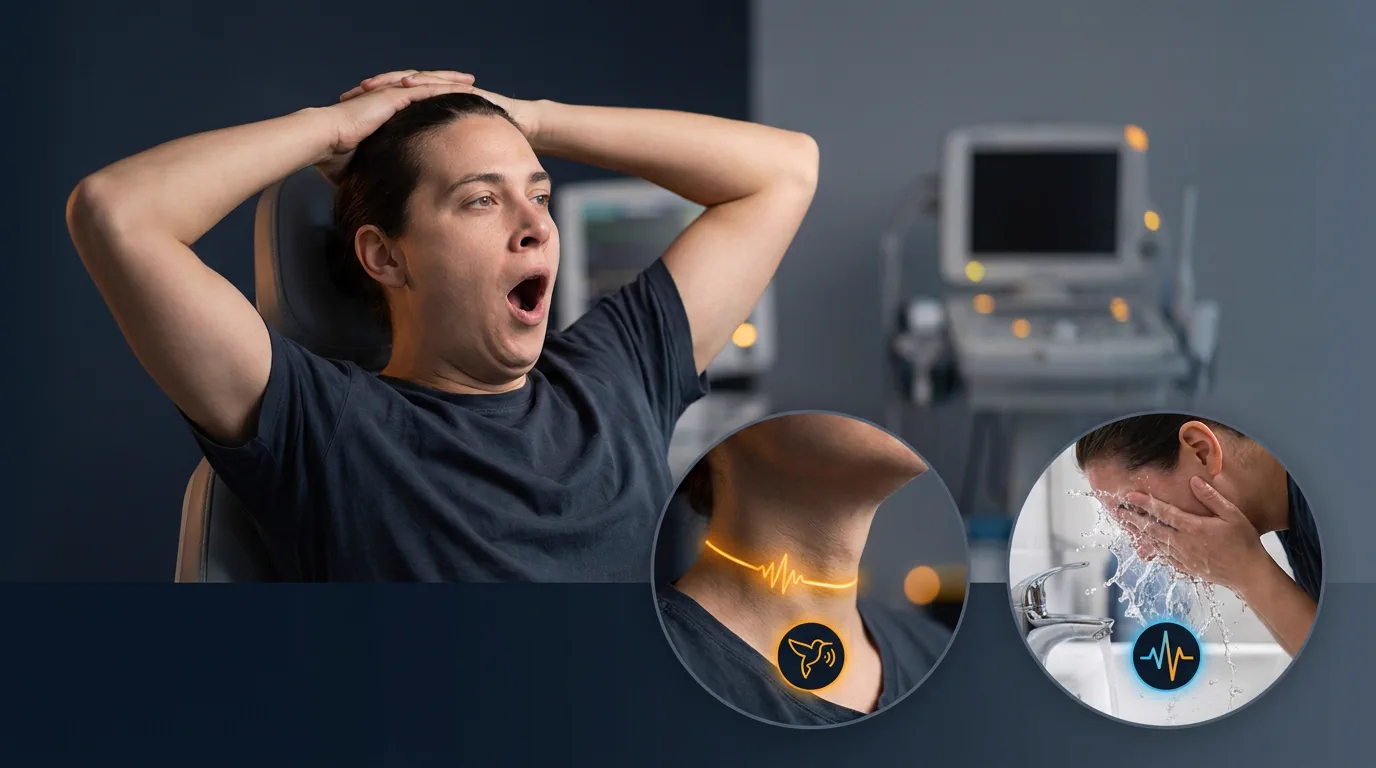
By engaging sensory nerve endings in the neck, eyes, ears, pharynx, and diaphragm, these somatic exercises mechanically stimulate vagal pathways, elevating heart rate variability (HRV) and restoring ventral vagal safety in minutes. This guide provides 15 evidence-based exercises organized by anatomical target, with progression protocols for long-term vagal toning.
The Neurobiology of Vagal Stimulation
The vagus nerve (CN X) contains mechanoreceptors, baroreceptors, chemoreceptors, and stretch receptors that respond to physical pressure, stretch, temperature shifts, and chemical signals. When you execute specific ocular movements, diaphragmatic breathing ratios, or vocalizations, these receptors send afferent sensory impulses directly to the Nucleus Tractus Solitarius (NTS) in the brainstem.
Research published in Frontiers in Neuroscience confirms that mechanical vagal stimulation increases parasympathetic outflow, dampening sympathetic nervous system dominance within 60 to 120 seconds. The key is frequency over intensity: brief, repeated stimulation throughout the day produces greater autonomic remodeling than single long sessions.
| Exercise Category | Anatomical Target | Primary Mechanism | Execution Time | Vagal Branch |
|---|---|---|---|---|
| Ocular Resets | Suboccipital muscles & CN III/IV/VI | Oculocardiac reflex & suboccipital release | 30–60 seconds | Ventral vagal (via PAG) |
| Auricular Stimulation | Auricular vagal branch (Arnold's nerve) | Cutaneous vagal receptor activation | 1–2 minutes | Auricular → NTS direct |
| Pharyngeal Vocalizations | Recurrent laryngeal nerve | Mechanical pharyngeal vibration | 1–3 minutes | Pharyngeal → NTS direct |
| Diaphragmatic Resets | Subdiaphragmatic vagal plexus | Abdominal pressure & baroreflex activation | 2–5 minutes | Subdiaphragmatic → NTS |
| Cervical Mobility | Vagus nerve in carotid sheath | Neural glide & decompression at jugular foramen | 1–2 minutes | All branches (mechanical) |
Top 5 Ocular & Neck Somatic Exercises
These exercises leverage the oculocardiac reflex (cranial nerve III → vagus nerve connection) and mechanical decompression of the vagus nerve at the jugular foramen and cervical spine.
1. Stanley Rosenberg's Basic Exercise (The Gold Standard)
Protocol: Interlace your fingers behind your head, cradling the occiput. Keeping your head face-forward, move your eyes as far right as possible without turning your neck. Hold for 30–60 seconds until you involuntarily yawn, swallow, or sigh. Repeat to the left.
Mechanism: Lateral eye movement engages the oculomotor nerve (CN III) which has direct projections to the periaqueductal gray (PAG) and nucleus of the tractus solitarius (NTS), triggering a parasympathetic surge. The interlaced fingers provide gentle suboccipital traction, decompressing the vagus nerve at the jugular foramen.
Clinical note: The yawn/swallow/sigh is the "tell"—it indicates successful ventral vagal engagement. If no reflex occurs in 60 seconds, reduce range or try the Salamander variation.
2. Suboccipital Release Stretch
Protocol: Gently tilt your right ear toward your right shoulder while gazing upward toward the left ceiling corner. Hold for 45 seconds, breathing slowly. Switch sides.
Mechanism: This combination of lateral flexion and contralateral gaze stretches the rectus capitis posterior minor/major and obliquus capitis superior/inferior muscles, which directly overlie the vertebral artery and vagus nerve pathway at the atlanto-occipital junction.
3. The Salamander Eye Reset (Rosenberg Variation)
Protocol: Turn your eyes to the right while gently bending your head and neck to the right (ear toward shoulder). Hold for 30 seconds. Repeat to the left.
Mechanism: Combined cervical rotation and ipsilateral gaze creates a "neural slack" that allows the vagus nerve to glide freely within the carotid sheath, reducing mechanical irritation from forward-head posture.
4. Carotid Sinus Massage (Baroreflex Activation)
Protocol: Locate the carotid pulse just lateral to the thyroid cartilage. Using 2–3 fingertips, apply gentle circular pressure for 5–10 seconds. CAUTION: Only perform seated. Contraindicated in carotid disease, stroke history, or on anticoagulants.
Mechanism: Mechanical deformation of the carotid sinus baroreceptors signals the NTS that blood pressure is high, triggering a reflex vagal surge to lower heart rate and dilate vessels.
5. Lateral Neck Vagal Slide (Neural Glide)
Protocol: Place two fingertips on the collarbone (clavicle) and gently tilt your head away, creating a gentle stretch along the cervical vagus pathway. Slowly glide fingertips up toward the jaw angle while maintaining the tilt. Repeat 5–8 times per side.
Mechanism: Neural gliding (neurodynamics) improves vagus nerve mobility within the carotid sheath, reducing adhesions from inflammation, surgery, or chronic tension. This is especially valuable for post-whiplash or post-thyroidectomy patients.
Top 5 Vocal & Auricular Vagus Nerve Exercises
Pharyngeal and ear stimulation directly access superficial vagal nerve endings with high receptor density.
6. Tragus Ear Massage (Arnold's Nerve Stimulation)
Protocol: Using thumb and forefinger, gently massage the ear tragus (the small cartilage flap in front of the ear canal) and inner concha in small circular motions for 60–90 seconds per ear. Pressure should be firm but comfortable.
Mechanism: The auricular branch of the vagus nerve (Arnold's nerve) innervates the tragus, concha, and posterior ear canal. Cutaneous stimulation here projects directly to the NTS without passing through the jugular foramen—making it the most accessible vagal entry point.
Enhancement: Add a low humming tone while massaging for combined auricular + pharyngeal stimulation.
7. Vocal Humming (Voiced Resonance)
Protocol: Take a deep belly breath and emit a long, low-pitched "Hmmmm" sound, maximizing chest and throat vibration during the exhalation. Aim for 130–150 Hz (low male speaking voice range). Repeat 5–7 cycles.
Mechanism: Humming creates mechanical vibration in the pharyngeal wall, stimulating the pharyngeal branch of the vagus nerve. Low frequencies penetrate tissue more effectively. The extended exhale simultaneously activates the cardiac vagal brake.
Research: A 2018 study in Frontiers in Psychology found 5 minutes of humming increased HF-HRV by 24% and reduced systolic BP by 8 mmHg.
8. Deep Vowel Chanting ("VU" or "OM")
Protocol: Sing the sound "VU" (like "voo" but with lips lightly touching) on a long exhale, letting the sound resonate deep in your pelvis and chest cavity. Focus on feeling vibration in the sternum, throat, and pelvic floor. Repeat for 3–5 minutes.
Mechanism: The "V" consonant creates lip vibration (facial nerve → pons → NTS connections), while the "U" vowel maximizes pharyngeal resonance. This combines facial, pharyngeal, and laryngeal vagal branches.
9. Gargling with Water (Pharyngeal Motor Activation)
Protocol: Take a sip of room-temperature water. Gargle vigorously for 30 seconds, creating strong turbulence in the posterior pharynx. Spit out. Repeat 2–3 times.
Mechanism: The motor action of gargling requires coordinated contraction of the superior, middle, and inferior pharyngeal constrictors (innervated by the pharyngeal plexus → vagus nerve). This "exercises" the vagal motor nucleus directly.
10. Pharyngeal Tongue Press (Palatoglossal Arch Stimulation)
Protocol: Press the flat of your tongue firmly against the roof of your mouth (hard palate) for 10 seconds while exhaling slowly through your nose. Release. Repeat 5 times.
Mechanism: This engages the palatoglossal arch (innervated by the vagus nerve via the pharyngeal plexus) and stimulates the palatine tonsil region—a dense vagal afferent zone.
Top 5 Diaphragmatic & Cold Exposure Practices
11. 4-6 Extended Exhale Breathing (Cardiac Vagal Brake)
Protocol: Inhale through your nose for 4 seconds, then exhale slowly through pursed lips for 6 seconds. The extended exhale activates the cardiac vagal brake. Practice 5 minutes, 3× daily. Read our guide on 4-6 vagus nerve breathing.
Mechanism: Slow exhalation maintains elevated intrathoracic pressure, stimulating pulmonary stretch receptors (Hering-Breuer reflex) and cardiac baroreceptors, both projecting via vagus to NTS. The 4:6 ratio optimizes respiratory sinus arrhythmia (RSA).
12. Cold Water Facial Immersion (Mammalian Dive Reflex)
Protocol: Fill a bowl with ice water (0–4°C / 32–39°F). Take a breath, hold, and submerge your face (forehead, cheeks, nose) for 15–30 seconds. Repeat 2–3 times with 1-minute breaks.
Mechanism: Cold stimulates the trigeminal nerve (CN V) ophthalmic and maxillary branches, which project to the dorsal motor nucleus of the vagus and nucleus ambiguus, triggering immediate bradycardia and peripheral vasoconstriction. This is the most powerful acute vagal activator known.
Safety: Not for those with cardiovascular disease, Raynaud's, or cold urticaria. Start with cold washcloth on face if immersion is too intense.
13. Diaphragmatic Belly Expansion (Subdiaphragmatic Vagal Stretch)
Protocol: Place one hand on your chest and one on your abdomen. Inhale so only your abdominal hand rises, stretching subdiaphragmatic vagal fibers. Exhale passively. Practice 5 minutes.
Mechanism: The diaphragm's descent mechanically stretches the subdiaphragmatic vagal plexus innervating the stomach, liver, and proximal gut. This stimulates gastric motility and afferent signaling to the NTS.
14. Thoracic Spine Rotation (Sympathetic Chain Modulation)
Protocol: Sit upright and gently twist your upper torso side to side while taking slow deep breaths. Hold each rotation for 3 breaths. Focus on mobility at T1–T4 (sympathetic outflow to heart/lungs).
Mechanism: The sympathetic chain ganglia run alongside the thoracic spine. Thoracic rotation mechanically modulates sympathetic outflow, indirectly enhancing parasympathetic-vagal dominance via autonomic balance.
15. Somatic Shake Out (Tremoring Discharge)
Protocol: Stand up and shake your arms, legs, and shoulders vigorously for 60–90 seconds. Let your jaw go loose, bounce slightly at the knees. Follow with 3 slow 4-6 breaths.
Mechanism: Tremoring is the natural mammalian discharge mechanism for completing the fight/flight mobilization cycle (observed in animals after predator escape). It discharges trapped sympathetic energy and signals "threat passed" to the amygdala.
Daily Sequence: 3-Minute Vagal Reset Routine
For consistent improvement in baseline vagal tone, practice this simple morning sequence:
- 1 Minute: Stanley Rosenberg's Basic Exercise (Ocular reset).
- 1 Minute: Tragus Ear Massage & Neck Slide.
- 1 Minute: 4-6 Extended Exhale Breathing with Humming.
Progression Protocol: 8-Week Vagal Toning Program
| Week | Focus | Daily Practice | Target HRV Change |
|---|---|---|---|
| 1–2 | Foundation | Basic Exercise + 4-6 breathing (5 min AM/PM) | +5–10% RMSSD |
| 3–4 | Expansion | Add ear massage + humming (8 min AM/PM) | +15–20% RMSSD |
| 5–6 | Integration | Full 15-exercise rotation (15 min AM, 10 min PM) | +25–30% RMSSD |
| 7–8 | Maintenance | Personalized 10-min flow + acute as needed | Stable elevated baseline |
Discover more clinical insights on what the vagus nerve is and how to optimize your autonomic health.
Medical Disclaimer: This article is for educational purposes only. Individuals with carotid artery disease, fainting disorders, or severe neck injuries should consult a doctor before performing neck massage or vagus nerve exercises. Stop immediately if you experience dizziness, visual changes, or fainting.