
1. Why Traditional Cognitive Grounding Fails During Panic
The popular "5-4-3-2-1" grounding technique was designed for mild anxiety, cognitive rumination, or environmental distraction. However, when a full-blown panic attack ignites, the central nucleus of the amygdala stimulates the locus coeruleus and sympathetic preganglionic neurons. Blood flow is aggressively diverted away from the prefrontal cortex and channeled toward the brainstem and peripheral skeletal musculature.
Demanding that a patient in acute panic cognitively search for "four things they can touch and three things they can hear" requires high-order executive sorting, language retrieval, and selective attention. The patient fails, feels out of control, and experiences catastrophic secondary panic. Somatosensory grounding bypasses language entirely by delivering intense, immediate sensory inputs directly to the lower spinal cord and cerebellum.
2. The Dorsal Column-Medial Lemniscal Pathway
The human nervous system features two major ascending sensory highways in the spinal cord:
- The Anterolateral (Spinothalamic) System: Carries slow, unmyelinated or thinly myelinated pain, temperature, and threat-salient inputs. This system fires continuously during panic attacks, projecting alarms to the reticular formation, parabrachial nucleus, and thalamus.
- The Dorsal Column-Medial Lemniscal (DCML) Pathway: Carries fast, heavily myelinated (A-beta) proprioceptive and tactile information from joints, muscle spindles, and deep skin receptors directly to the nucleus gracilis and cuneatus in the medulla.
By unleashing a deliberate flood of high-intensity proprioceptive input through the DCML pathway, you activate gate control theory at the spinal and brainstem levels. Fast proprioceptive signals physically crowd out and inhibit the transmission of visceral threat alarms, acting as a neurobiological circuit breaker.
Neuro-Biomechanics Note: Golgi Tendon Organ (GTO) Reflexes
Golgi tendon organs located at musculotendinous junctions detect mechanical tension during heavy isometric contractions. When GTOs fire vigorously (such as during wall pushing), they stimulate Ib inhibitory interneurons in the spinal cord, triggering autogenic inhibition that rapidly reduces whole-body skeletal muscle hypertonicity.
3. Mechanoreceptors: The Biology of Deep Pressure Input
Deep somatosensory grounding targets specific cutaneous and articular mechanoreceptors:
- Pacinian Corpuscles: Rapidly adapting receptors located in the deep dermis and periosteum that respond to high-frequency vibration and heavy mechanical pressure.
- Ruffini Endings: Slowly adapting receptors in deep tissue that respond to sustained lateral skin stretch and joint angle displacement.
- Plantar Mechanoreceptors: Specialized tactile sensors across the heel and metatarsal pads that inform the vestibular nuclei and cerebellum of solid gravitational contact.
When these receptors are stimulated simultaneously with significant mechanical force, the brainstem receives undeniable sensory proof of gravitational stability, forcing the autonomic nervous system to disengage mortal fight-or-flight reflexes.
4. Somatic Tracking and Physical Grounding Methods
Integrating somatosensory input requires coupling physical mechanics with mindful interoception. Clinical somatic practitioners utilize somatic tracking and physical grounding methods to anchor patients back into their objective physical bodies when depersonalization threatens to overwhelm them.
Rather than attempting to stop panic through positive affirmations, the patient observes raw physical sensations (e.g., the intense cold of tile floor under the bare feet, the solid resistance of a brick wall against the palms) with objective, clinical curiosity. This recruits the insular cortex in an exploratory mode rather than a defensive fear posture.
5. The Four Clinical Proprioceptive Reset Maneuvers
These four physical interventions can be executed anywhere and require zero cognitive effort:
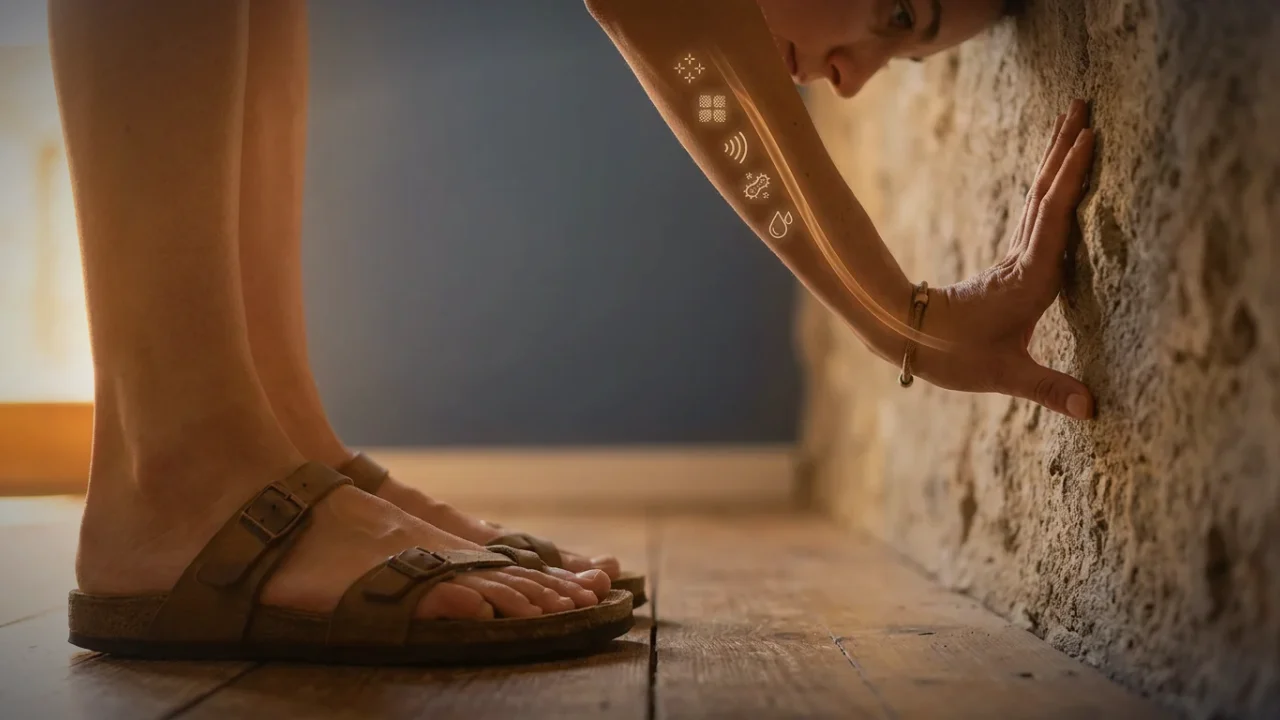
- 1. The Isometric Wall Press: Stand facing a solid wall. Place your palms flat against it at shoulder height, step one foot back into a lunge, and push the wall with 80% maximum muscular effort for 15 to 20 seconds. This fires millions of GTOs and Pacinian corpuscles across the shoulders, spine, and calves.
- 2. Calcaneal Stamping (Heel Drops): Stand barefoot on a hard surface. Rise onto your tiptoes and drop your body weight firmly onto your heels with a solid, audible thud. Repeat 10 times in steady cadence. The shockwave travels up the tibia and femur directly to the vestibular nuclei.
- 3. Bilateral Knee Compression: While seated, cross your hands over your knees, placing the right palm on the left knee and left palm on the right knee. Squeeze your knees outward while your arms forcefully resist inward, creating an intense isometric cross-body lock for 10 seconds.
- 4. Cervical Suboccipital Traction: Interlace your fingers behind your head, cup the occipital ridge at the base of your skull, and gently pull upward toward the ceiling while pressing your skull backward against your hands for 8 seconds.
6. Post-Panic Autonomic Stabilization
Once the acute proprioceptive reset arrests the escalating panic cycle, the autonomic system enters a recovery window. During this phase, cortisol and adrenaline are clearing the bloodstream, often leaving the patient feeling shaky or chilly. To finalize stabilization:
- Wrap the shoulders in a heavy blanket or jacket to provide sustained tactile pressure.
- Sip warm water slowly, engaging rhythmic swallowing to stimulate vagal motor efferents.
- Refrain from immediate cognitive analysis or trying to "figure out why" the panic happened until 24 hours of nervous system restoration have passed.